
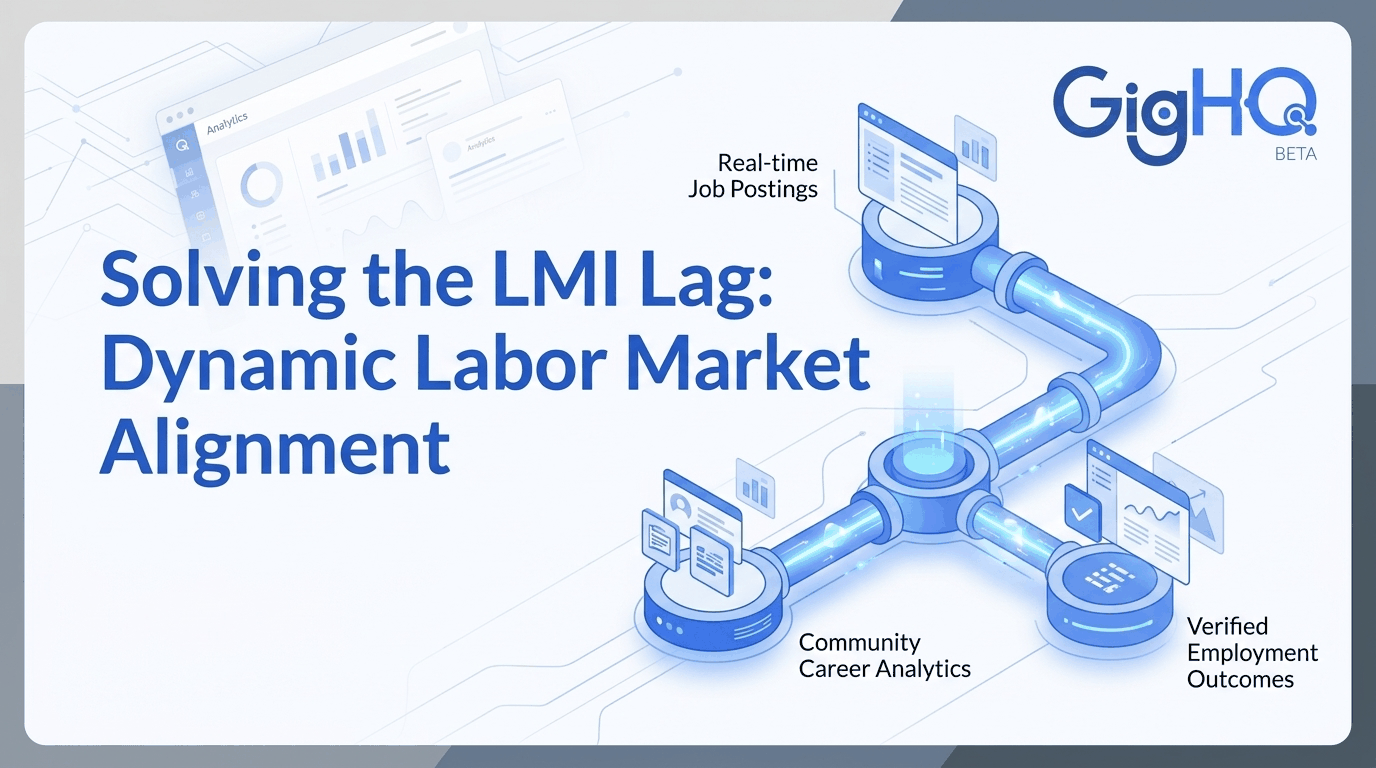
For higher education leaders, Workforce Development Organizations (WDOs), and community college presidents, aligning training programs with the labor market has always been the North Star. But in an economy transformed by artificial intelligence and rapid skill evolution, traditional planning tools are showing severe cracks.
Most institutions rely on a combination of two data sources: traditional Labor Market Information (LMI) (like state Unemployment Insurance wage records and Bureau of Labor Statistics projections) and real-time job posting analytics (like Lightcast or Chmura).
While these tools are valuable, relying on them exclusively creates a dangerous “Data Deficit.”
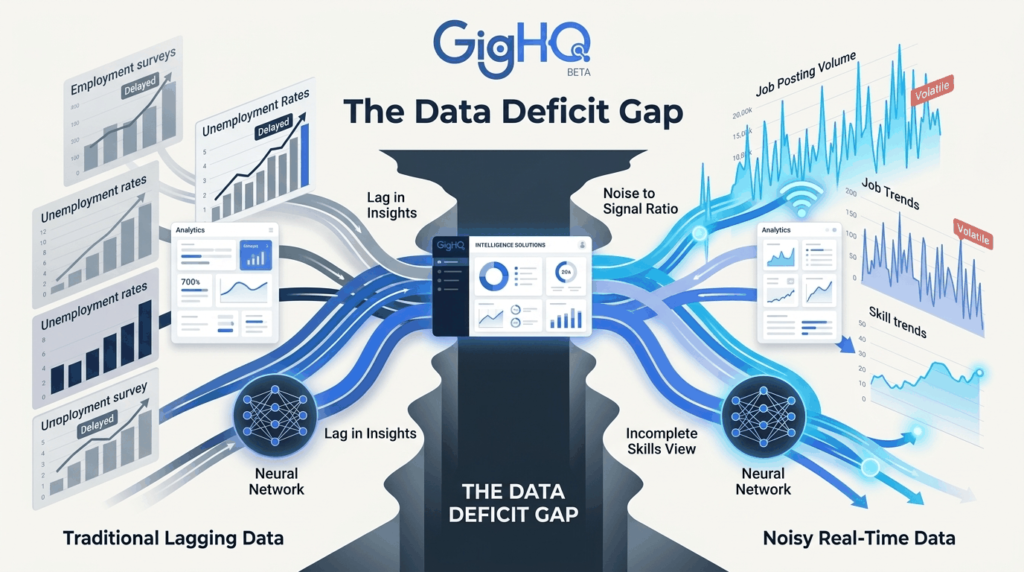
A landmark August 2026 report by the Harvard Project on Workforce and Education Design Lab, titled The Agile Community College: Dynamic Labor Market Alignment in an AI-Driven Economy, confirms what frontline career coaches have felt for years: traditional LMI lags behind reality by quarters or years, while real-time job posting data is riddled with blind spots and employer wishlists.
To achieve true workforce alignment, institutions must move past static, unverified data and capture continuous, closed-loop feedback from the actual job search.
The Blind Spots of Traditional vs. Real-Time LMI
When evaluating market demand, leaders often fall into one of two traps:
1. The Rearview Mirror Trap (Traditional LMI)
State Unemployment Insurance (UI) wage data provides official W-2 employment verification, but it comes with a severe time lag—often 2 to 6 quarters behind the current economy. In an AI-driven job market where skill demands shift in months, relying on 18-month-old wage data means building programs for a market that no longer exists. Furthermore, UI data suffers from geographic blindness; when a graduate moves out-of-state or enters non-traditional employment, they vanish from state datasets entirely.
2. The Wishlist Trap (Real-Time Job Postings)
To combat lagging data, many institutions turned to web-scraped job posting analytics. While job ad volume offers an immediate snapshot of employer activity, the Harvard report highlights two critical flaws:
- The 30–40% Middle-Skill Void: Approximately 30% to 40% of middle-skill job openings are never posted online. Sub-baccalaureate roles, apprenticeships, and local technical roles are significantly underrepresented in digital job board scraping, leaving community colleges and WDOs in the dark about actual local hiring.
- Wishlists vs. Conversions: Job postings represent employer aspirations, not employer hiring behavior. Postings routinely list inflated credential requirements, vague skill sets, or “ghost job” listings that sit online for months without an active intent to hire. A high volume of postings for a role does not prove that local employers are actually converting applicants into paid offers.
From Static Indicators to Dynamic Labor Market Alignment
The Harvard report argues that postsecondary and workforce institutions must transition from periodic workforce planning to Dynamic Labor Market Alignment—a continuous process of detecting, interpreting, and responding to skill shifts in real time.
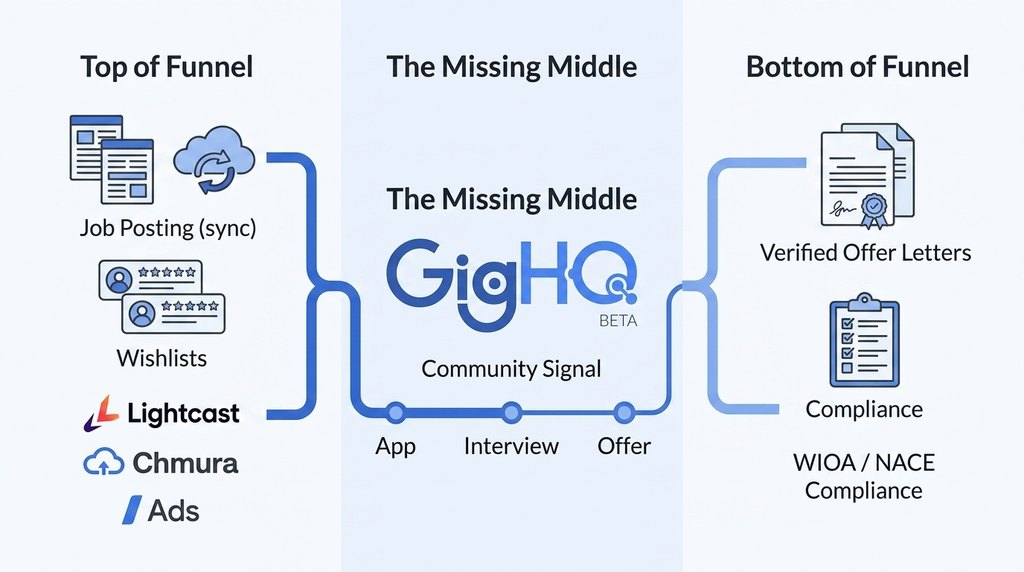
Achieving this level of institutional agility requires a shift in how institutions measure success. It is no longer enough to look at high-level job openings at the top of the funnel and broad employment rates at the bottom. Institutions need visibility into the middle of the funnel: the real-time application-to-offer journey.
Without visibility into application conversion rates, career centers cannot answer critical operational questions:
- Are our students failing to land interviews because of a true skills gap, or because they are applying to dead-end “ghost postings”?
- Which resume formats and specific skill credentials are actually yielding interview calls from local employers this month?
- Where are our graduates being ghosted, and where are they securing competitive starting salaries?
The GigHQ Solution: “Community Signal” as the Missing Middle
This is where GigHQ.ai bridges the intelligence gap.
While platforms like LinkedIn track where someone works, and traditional job boards show where companies post, GigHQ functions as a real-time outcomes sensor. Through our AI-powered job search copilot, students and job seekers automatically track their applications, interviews, rejections, and offer letters in a single, streamlined dashboard.
By aggregating this anonymized activity within student cohorts and institutions, GigHQ generates the Community Signal—the “missing middle” data layer for workforce development.
How the Community Signal Powers Institutional Agility:
- Live Conversion Analytics: Instead of relying on posting volume, WDO leaders and coaches see real-time application-to-interview and interview-to-offer conversion rates across specific majors, credentials, and local companies.
- “Ghost Job” & Market Inefficiency Filtering: GigHQ’s data layer identifies listings that receive high application volumes but zero interview conversions, protecting students from wasting hundreds of hours applying into the void.
- Hyper-Local Skill Matching: Institutions can see exactly which resume keywords, certifications (like AWS, CompTIA, or OSHA), and project experiences are generating interview callbacks right now at local employers—allowing faculty to adjust curriculum and micro-credentials dynamically.
- Passive Outcome Verification: When a student receives an offer letter through their tracked workflow, GigHQ automatically captures time-stamped verification (employer, title, salary, start date). This equips institutions with audit-ready proof for WIOA compliance, NACE First Destination Surveys, and Workforce Pell standards without relying on low-response alumni surveys.
Moving from Data Chasers to Strategic Advisors
When career centers and workforce teams operate in the dark, staff time is consumed by manual follow-up calls, spreadsheet maintenance, and guessing games.
By integrating GigHQ.ai, institutions replace the “train and pray” model with continuous market feedback:
- For Students: An AI-powered copilot (CoverGenius, ResumeRank, and SmartPrep) that removes application friction, optimizes resumes, and guides them toward responsive employers.
- For Coaches: Real-time intervention alerts that highlight which students have high application volumes but low interview conversion rates, allowing for targeted resume and interview coaching before the student drops out of the search.
- For Executive Leadership: A dynamic, audit-ready dashboard that proves program ROI to funders, legislative bodies, and accreditors.
Watch how GigHQ transforms cohort tracking without spreadsheets in our YouTube Walkthrough, or explore the Coach’s Portal Demo to see real-time cohort tracking in action.
Bridge the LMI Gap with GigHQ.ai
Real-time job postings show you what employers say they want. UI wage data shows you what happened two years ago. GigHQ’s Community Signal shows you what is working today.
Ready to bring true institutional agility and real-time outcome tracking to your organization?
👉 Request a Partnership Demo with GigHQ.ai and see how our data layer turns chaotic job searches into actionable workforce intelligence.
Our Platform Tools:

ResumeRank
Scan your resume, get a score, fix what matters.

CoverGenius
Generate personalized, AI-powered cover letters in seconds.

OutreachAgent
Craft perfect networking and AI-powered follow-up emails with ease.

CareerCompass
Instantly generate a personal marketing plan from your resume to define your brand and attract the right opportunities.

Smart Prep
Simulates a real interview based on your resume and the job description, giving you real-time feedback to build your confidence.

Profile Spark
Optimize your LinkedIn profile to attract recruiters and opportunities.