Higher education and workforce development are undergoing a seismic transformation. With the reauthorization of workforce legislation, shifting state funding models tied to economic return on investment (ROI), and heightened scrutiny around graduate career readiness, the pressure on institutions to deliver verifiable student outcomes has never been higher.
Yet, walk into almost any university career center or workforce program, and you will find institutions relying on software architectures designed a decade ago: Handshake and 12Twenty.
While both platforms have built massive footprints across North American campuses, a fundamental question must be asked: Are these platforms built to improve student education-to-employment outcomes, or are they built to monetize institutional access?
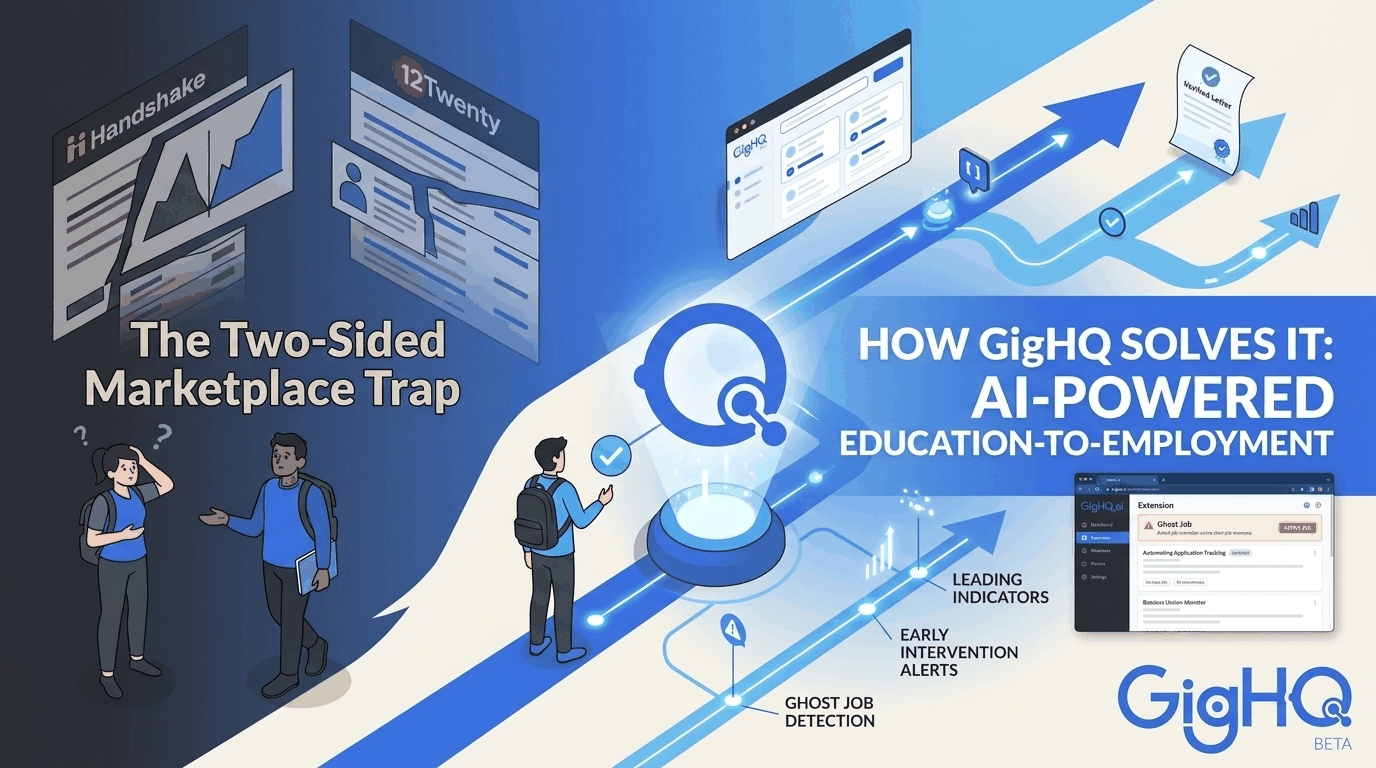
When you examine the underlying business models, network incentives, and architectural priorities of both platforms, a stark reality emerges: Handshake and 12Twenty operate as two-sided recruitment marketplaces and compliance databases, not outcome-acceleration engines.
Here is an objective breakdown of how Handshake and 12Twenty make money, why their structural models leave the student job search broken, and how GigHQ.ai is shifting the paradigm from transactional job posting to real-time outcome intelligence.
1. Deconstructing the Two-Sided Marketplace
To understand why traditional Career Services Management (CSM) platforms struggle with real-time student outcomes, you have to look at who pays the bills and what incentives drive platform product roadmaps.
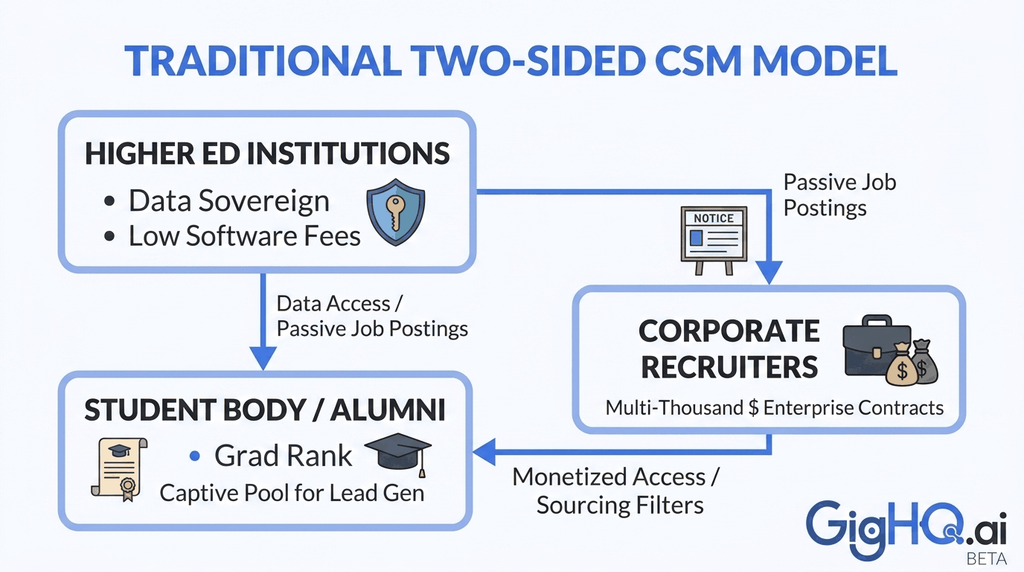
Handshake: The Centralized Liquidity Engine
Handshake operates a centralized national marketplace model connecting over 1,400+ colleges and universities with more than 750,000 employers, covering approximately 75% of U.S. undergraduates.
- The Monetization Asymmetry: Handshake built its empire on an asymmetrical pricing model. Universities are charged relatively low enterprise fees (often ~$8,000 annually), while corporate employers generate the lion’s share of revenue.
- The Employer Paywall: To proactively search across Handshake’s 18+ million students and alumni, employers are pushed from basic free tiers (capped at 10 candidate messages a month) to the Talent Engagement Suite (TES)—a multi-seat enterprise subscription ranging from $10,000 to over $250,000 per year (with a median contract value near ~$30,000).
- The Core Incentive: Handshake is incentivized to maximize top-of-funnel recruiter outreach, network scale, and listing volume. The platform succeeds when corporate enterprise recruiters pay premium contract rates to broadcast job postings and message candidate cohorts in bulk.
12Twenty: The Curated System of Record
12Twenty takes an institution-centric, data-sovereign approach, heavily concentrated in specialized graduate programs, MBA environments, and law schools across 4,000+ university programs.
- The Outcome-Reporting Focus: 12Twenty positions its “Career Cloud” as an administrative CRM and audit engine designed to capture NACE First Destination Survey (FDS) data and MBA CSEA-compliant employment statistics.
- The Employer Monetization: While direct single-school job posting is often free, employers seeking multi-school distribution across the 12twenty Job Network purchase job posting credits or custom hiring packages (with published network metrics averaging ~$624 per hire).
- The Core Incentive: 12Twenty is built around administrative compliance and institutional research. It exists to give career center administrators customizable portals and retrospective outcome reporting.
2. The Core Problem: Why Neither Platform Solves the “Education-to-Employment” Gap
Despite their vast scale, neither Handshake nor 12Twenty is architected to actively guide or accelerate a student’s day-to-day journey from classroom learning to a verified job offer.
Here is why:
A. The “Black Box” of the Job Search
Both platforms treat the actual application process as an external black box:
- On Handshake, students click “Apply Externally” and disappear into corporate applicant tracking systems (Workday, Greenhouse, Taleo). The career center loses all real-time visibility into whether that application resulted in a screen, an interview, or immediate rejection.
- On 12Twenty, outcome data is collected retrospectively—often 6 to 12 months after graduation via self-reported alumni surveys.
By the time a university notices that 60% of a specific major cohort is struggling in the job market, that graduating class is already gone.
B. Marketplace Noise and “Ghost Jobs”
In a two-sided marketplace optimized for employer job volume, quantity frequently overshadows quality.
According to recent labor market analyses, up to 73% of job postings online show signs of being “ghost jobs”—stale listings, pipeline-fillers, or evergreen requisitions where no active hiring is occurring. Because platforms like Handshake prioritize employer listing scale, students spend dozens of hours submitting applications into algorithmic voids, with over 95% of blind applications receiving zero response.
C. Students as the Product, Not the User
When enterprise recruiters are paying $30,000+ annually for talent filters and messaging access, the student profile becomes a lead-generation asset.
Neither platform functions as a daily tactical copilot for the job seeker. They do not help students:
- Analyze live job descriptions against their specific resumes in real time.
- Overcome the blank-page problem with tailored, high-intent application materials.
- Practice tailored mock interview questions specific to the target company’s questions.
- Passively track application statuses without manual data entry.
3. The Comparison: Two-Sided Marketplace vs. AI Intelligence Layer
The following matrix highlights the architectural divergence between legacy campus marketplaces and a modern outcome intelligence platform:
| Strategic Dimension | Handshake | 12Twenty | GigHQ.ai |
|---|---|---|---|
| Primary Architectural Model | Centralized Two-Sided Marketplace | Institutional CRM & System of Record | AI Job Search Copilot & Real-Time Outcome Layer |
| Primary Revenue Driver | Enterprise Recruiter Subscriptions ($10k–$250k/yr) | Institutional Licenses & Multi-School Recruiter Postings | Enterprise WDO/Higher-Ed Subscriptions & Free Seeker Platform |
| Student Experience | Job board browsing & passive inbound recruiter messaging | Branded campus job portal & survey intake | Active AI Copilot (Auto-tracking, ResumeRank, CoverGenius, SmartPrep) |
| Outcome Tracking Method | Top-of-funnel clicks & optional self-reported surveys | Retrospective First Destination Surveys (FDS) | Passive, continuous ingestion via dedicated @gighq.ai email & browser telemetry |
| Market Inefficiency Protection | None (High volume of open requisitions) | Basic 6-day institutional review window | Ghost Job Detection & Community Signal telemetry |
| Actionable Intelligence for Advisors | Lagging profile data | Lagging 6-month survey reports | Leading indicators: Real-time application-to-interview velocity alerts |
4. How GigHQ.ai Redefines Education-to-Employment
GigHQ.ai was founded on a simple premise: You cannot fix employment outcomes by looking in the rearview mirror.
Instead of building another transactional job board where students are commoditized, GigHQ sits directly inside the student’s daily workflow, transforming chaotic job searches into structured, high-conversion career execution.
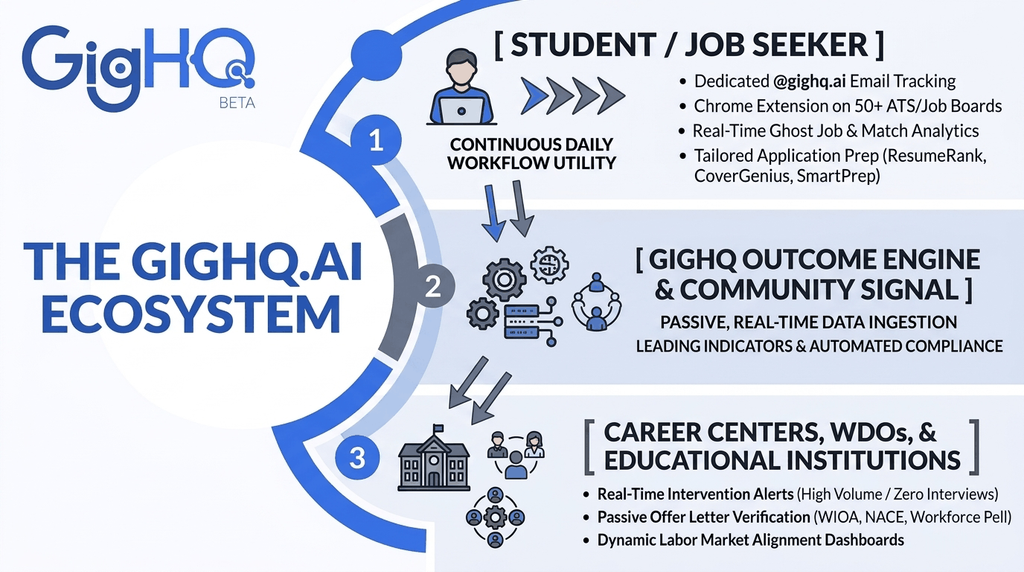
1. Built for the Job Seeker (The Daily Copilot)
To capture accurate outcome data, you must provide overwhelming daily value to the job seeker. GigHQ provides students with a complete Job Search Command Center:
- Automated Application Ingestion: Every student receives a dedicated @gighq.ai email address. Application confirmations, interview invitations, and status updates are automatically logged into a structured dashboard—eliminating spreadsheets and manual tracking entirely.
- The GigHQ Chrome Extension: Operating seamlessly across LinkedIn, Indeed, Handshake, and 50+ ATS platforms (Workday, Greenhouse, Lever, Ashby), the extension extracts role metadata and provides instant Ghost Job warnings and community response rates.
- Generative Pre-Application Intelligence: Tools like ResumeRank score candidate alignment against live job requirements, while CoverGenius crafts job-tailored outreach and SmartPrep generates simulated mock interviews grounded in target role competencies.
Watch how the GigHQ Chrome Extension and Copilot work in action:
- GigHQ Chrome Extension Walkthrough
- AI-Powered Application Tracking Demo
- SmartPrep Interview Practice Demo
2. Built for the Institution (Leading Indicators vs. Lagging Surveys)
Rather than chasing alumni with phone calls and emails six months after graduation to meet NACE or WIOA knowledge rate standards, institutions using GigHQ gain access to an automated, auditable data stream:
- Early Intervention Alerts: If 40% of students in a specific technical program are submitting 50+ applications with zero interview conversions, career advisors receive real-time alerts in March—allowing for resume tuning, interview coaching, and employer interventions before graduation.
- Audit-Proof Outcome Verification: GigHQ automatically identifies and timestamps official offer letters and onboarding correspondence, creating verifiable evidence required for emerging compliance standards (Workforce Pell, WIOA Q2/Q4 retention, and CPHE Standard 19 ROI mandates).
- The Community Signal: By aggregating closed-loop application and response data, GigHQ illuminates which employers are genuinely hiring entry-level talent and which are posting inactive requisitions.
5. Moving Beyond the Job Board Era
The historical model of higher-ed career services—licensing a closed job board, hosting an annual career fair, and blasting post-grad surveys—is no longer sufficient in an era demanding verified education-to-employment ROI.
Handshake solved the problem of recruiting distribution.
12Twenty solved the problem of institutional reporting.
GigHQ.ai solves the problem of student outcome realization.
By placing cutting-edge AI tools directly in the hands of job seekers and transforming their application journey into actionable institutional intelligence, GigHQ bridges the gap between education and meaningful employment.
Transform Your Career Services and Student Outcomes
- Explore our Job Market Radar to see real-time hiring insights.
- Read how we are shifting the AI narrative in career services.
- Learn about our MCP Server integration for Claude and ChatGPT.
- Request an institutional consultation to discover how GigHQ can automate outcome verification for your cohorts.
Our Platform Tools:

ResumeRank
Scan your resume, get a score, fix what matters.

CoverGenius
Generate personalized, AI-powered cover letters in seconds.

OutreachAgent
Craft perfect networking and AI-powered follow-up emails with ease.

CareerCompass
Instantly generate a personal marketing plan from your resume to define your brand and attract the right opportunities.

Smart Prep
Simulates a real interview based on your resume and the job description, giving you real-time feedback to build your confidence.

Profile Spark
Optimize your LinkedIn profile to attract recruiters and opportunities.