This article is part of a larger guide on navigating LinkedIn as a Job Seeker. To read the full guide, click here.
1. Introduction: The “Easy Apply” Conundrum
The modern job search is increasingly mediated by digital platforms, with LinkedIn standing out as a dominant force for professional networking and recruitment. Within this ecosystem, LinkedIn’s “Easy Apply” feature has emerged as a prominent tool, designed to streamline the job application process for candidates. It allows individuals to submit applications for numerous positions with minimal clicks, often using their existing LinkedIn profile as a primary source of information.
However, this convenience has generated considerable debate and suspicion among job seekers. Questions abound regarding its true efficacy: Does it genuinely enhance a candidate’s prospects, or does it lead to applications being lost in a digital void? Similarly, employers grapple with the implications of a feature that can significantly increase application volume but potentially dilute candidate quality.
This report aims to provide a comprehensive analysis of LinkedIn’s “Easy Apply” functionality. It will delve into the operational mechanics of the feature, meticulously examine its advantages and disadvantages for both job candidates and employers, and critically assess its impact on the likelihood of securing interviews and job offers. Ultimately, this analysis will equip job seekers with the understanding necessary to make informed, strategic decisions about when, and if, to utilize the “Easy Apply” button.
2. Understanding LinkedIn “Easy Apply”
To make an informed decision about using “Easy Apply,” it is crucial to first understand its definition, mechanics, and how it differs from traditional application methods.
2.1 What is “Easy Apply”?
LinkedIn’s “Easy Apply” feature enables job seekers to apply for positions directly within the LinkedIn platform, without being redirected to an external company careers site. The system leverages the information already present in a candidate’s LinkedIn profile, such as work history, education, and skills, to pre-fill parts of the application. This is distinct from the standard “Apply” button on LinkedIn, which typically redirects the user to the employer’s own application portal or Applicant Tracking System (ATS). The primary appeal of “Easy Apply” lies in its speed and simplicity, offering a “click and go” experience for applicants.
2.2 How “Easy Apply” Works for Job Candidates
When a job seeker encounters a listing with an “Easy Apply” option and chooses to proceed, LinkedIn guides them through a series of prompts. Much of their information is pre-filled from their profile. Candidates are usually required to provide contact information (email and phone number) and have the option to upload a resume and, if required or offered, a cover letter. Some applications may also include a few screening questions posed by the employer. Once submitted, the application, along with an overview of the candidate’s LinkedIn profile (including their photo, headline, education, and skills), becomes accessible to the recruiter.
2.3 How “Easy Apply” Works for Employers
For employers, “Easy Apply” allows them to host job applications directly on LinkedIn’s platform, including its mobile app. This can potentially capture more applicants, with LinkedIn suggesting it can double the number of applicants by creating a seamless, mobile-friendly experience. Recruiters receive these applications within LinkedIn, where they can manage and organize candidates. Depending on their settings, recruiters may receive email notifications about new applications. The system can also be integrated with an employer’s existing Applicant Tracking System (ATS), allowing application data to be sent automatically, though the effectiveness of this integration can vary. Employers can also incorporate a limited number of screening questions to help filter the incoming applications.
3. Pros and Cons for the Job Candidate
The “Easy Apply” feature presents a mixed bag of advantages and disadvantages for job seekers. While the allure of convenience is strong, potential drawbacks can significantly impact application success.
3.1 Advantages for the Candidate
- Convenience and Speed: The most significant advantage is the sheer convenience and speed it offers. Job seekers can apply for multiple jobs in a short amount of time without navigating complex external application systems or repeatedly entering the same information. This efficiency is particularly appealing to those with limited time for their job search.
- Increased Application Volume (Efficiency): By streamlining the process, candidates can increase the number of applications they submit, theoretically broadening their reach and potentially increasing their chances of landing interviews.
- Accessibility and Broader Reach: “Easy Apply” can make job applications more accessible, especially on mobile devices. It may also encourage applications for roles that candidates might otherwise skip if faced with a more cumbersome process, potentially leading to unexpected opportunities.
- Enhanced Profile Visibility: Applying through “Easy Apply” makes the candidate’s LinkedIn profile directly visible to the recruiter or hiring manager. A well-crafted profile can then serve as a comprehensive digital resume, potentially leading to further engagement or even unsolicited job offers if the profile impresses.
3.2 Disadvantages for the Candidate
- Intense Competition and Risk of Getting Lost: The very ease of “Easy Apply” leads to a high volume of applications for popular roles. Employers can receive an overwhelming number of submissions, making it significantly harder for any single application to stand out. This can result in qualified candidates being overlooked in a sea of applicants. The sheer volume means many applications might “get lost in the crowd”.
- Lack of Customization and Personalization: “Easy Apply” typically uses a standardized format based on the LinkedIn profile. This offers limited opportunity to tailor the application—resume or cover letter—specifically to the nuances of each job description or company culture. Generic applications are less compelling and can be easily spotted by recruiters. Candidates are often unable to mention referrals or explain in detail why they are the top candidate for that specific role. This lack of personalization can be a critical flaw, as a tailored approach is often what distinguishes a candidate.
- Limited Information Conveyed Initially: When recruiters first view “Easy Apply” submissions, they often see only a snapshot of the candidate’s LinkedIn profile: photo, headline, past and present job titles, education, and skills. If the profile is not meticulously optimized or up-to-date, it can appear “bare-bones” and fail to convey the candidate’s full story or qualifications. The initial impression is based on minimal data, and a headline truncated to 30 characters might not be enough to capture attention.
- No Opportunity for a Traditional Cover Letter (Often): While some “Easy Apply” applications allow for a cover letter attachment, many do not prioritize it, or the feature might be overlooked by candidates rushing through the process. This is a significant drawback, as a well-crafted cover letter provides context, demonstrates genuine interest, and allows candidates to articulate their fit beyond the structured data of a resume or profile. Some hiring managers explicitly value cover letters and may disregard applications without them.
- Potential for Lower Perceived Effort/Interest: The ease of the application might inadvertently signal to employers that the candidate has put minimal effort into applying, potentially leading to the perception of lower interest in that specific role or company. Applications that appear to be part of a “mass apply” strategy are often less appealing. This “convenience trap” means that the time saved by the candidate might come at the cost of making a weaker impression.
- ATS Compatibility and Parsing Issues: While resumes can be uploaded, there are concerns about how well LinkedIn-generated PDFs or profiles are parsed by various Applicant Tracking Systems (ATS) used by employers. If the ATS cannot accurately read the resume, a qualified candidate might be filtered out before a human ever sees their application. LinkedIn has reportedly made efforts that could make their PDF profiles less readable by parsing software, which could be a disservice to users.
- The “Application Black Hole” Phenomenon: Many users report sending out numerous “Easy Apply” applications with very few or no responses, leading to the feeling that their applications are disappearing into a “black hole.” This can be demoralizing and an inefficient use of a job seeker’s hope, if not their time.
The convenience offered by “Easy Apply” is undeniable, but it introduces a risk: by making it easy for everyone to apply, it makes it harder for anyone to be noticed. Candidates who rely heavily on this method without understanding these drawbacks may find their job search efforts are less effective than they could be.
4. Pros and Cons for the Employer
Employers also experience a dual impact from the “Easy Apply” feature, balancing the benefit of a larger candidate pool against challenges in managing application quality and volume.
4.1 Advantages for the Employer
- Increased Applicant Pool: The primary benefit for employers is the potential to attract a larger volume of applicants. The simplified, mobile-friendly application process reduces candidate drop-off, meaning more individuals are likely to complete an application, especially those who might be deterred by cumbersome, employer-specific interfaces. LinkedIn suggests employers can capture up to two times as many applicants using this feature.
- Faster Sourcing for Certain Roles: For urgent hires or high-volume, entry-level positions where a large candidate pool is desirable quickly, “Easy Apply” can be an efficient sourcing tool. It allows recruiters to cast a wider net and get more eyes on their job postings rapidly.
- Convenience and Modern Employer Brand: Offering an “Easy Apply” option can make the company appear user-friendly and modern, potentially improving the employer brand by signaling an understanding of candidates’ desire for efficiency.
- Quick Access to LinkedIn Profile Snapshot: Recruiters gain immediate access to the candidate’s LinkedIn profile, which can provide a quick overview of their work history, skills, and recommendations, allowing for a rapid initial assessment if the profile is well-maintained.
- ATS Integration Potential: LinkedIn offers integrations that can send application data directly to an employer’s Applicant Tracking System (ATS), streamlining the data management process if the integration works effectively.
4.2 Disadvantages for the Employer
- Overwhelming Volume of Applications: The ease of application often leads to a deluge of submissions, many of which may be from unqualified or irrelevant candidates. Recruiters can become inundated, spending excessive time sifting through hundreds, sometimes thousands, of applications.
- Lower Average Candidate Quality and Relevance: A significant challenge is the trade-off between quantity and quality. Because “Easy Apply” lowers the barrier to entry, many candidates may apply without thoroughly reading the job description or assessing their fit. Reports suggest that a large percentage, potentially 70-90%, of “Easy Apply” applicants may not be a good fit, including those mass-applying or even AI bots. This means identifying qualified candidates becomes like finding a “needle in a haystack”.
- Reduced Candidate Engagement and Intent: The minimal effort required to submit an “Easy Apply” application can correlate with lower candidate engagement and interest in the specific role or company. These “passive applications” may result from candidates who haven’t fully considered their application, leading to higher rates of ghosting or unresponsiveness later in the hiring process.
- Bypassing of Critical Screening Information: “Easy Apply” often bypasses traditional screening methods like tailored cover letters or detailed, job-specific application questions. This information can be vital for assessing a candidate’s motivation, communication skills, and cultural alignment beyond just keywords on a resume. Relying solely on resumes and LinkedIn profiles might cause recruiters to overlook candidates with strong transferable skills but lacking perfect keyword matches.
- Strain on Recruiters and Applicant Tracking Systems (ATS): The sheer volume of applications can place a significant burden on recruiters’ time and on the company’s ATS. Overloaded systems may experience slowdowns or crashes, and the manual review workload for recruiters increases substantially. This has led to a situation where, as one Head of Talent noted, LinkedIn provided “Easy Apply” for free, flooded ATS systems, and then began selling AI-powered tools to solve the problem they helped create. This “ATS arms race” implies that employers might need to invest in further technology to manage the output of “Easy Apply,” adding complexity back into a system designed for simplicity.
- Difficulty in Discerning Serious Candidates: The lack of personalization makes it harder for recruiters to distinguish genuinely interested and qualified candidates from those who are simply clicking “apply” on numerous postings. Employers often prioritize applications submitted through their own websites because these are generally more detailed and demonstrate a higher level of effort and interest.
The “paradox of convenience” for employers is that while “Easy Apply” can fill the top of the hiring funnel quickly, it often does so with a high proportion of unsuitable applications. This shifts the burden from attracting applicants to efficiently and accurately filtering them, a task that can be just as, if not more, resource-intensive. Employers must therefore be strategic, perhaps reserving “Easy Apply” for specific types of roles and supplementing it with robust screening mechanisms.
5. Impact on Interview and Hiring Likelihood
A critical question for job seekers is whether using “Easy Apply” ultimately helps or hinders their chances of landing an interview and getting hired. The available evidence and user experiences suggest a complex and often discouraging picture.
5.1 General User Experiences and Reported Success Rates
Anecdotal evidence and user-reported success rates with “Easy Apply” are predominantly negative, although not universally so. Many job seekers recount submitting hundreds of applications via “Easy Apply” with minimal to no response. For instance, one user reported sending out numerous applications with about 10% using “Easy Apply” and receiving no responses from the “Easy Apply” submissions, whereas other methods yielded contacts and interviews. Another user who received two interviews from “Easy Apply” noted their “hit rate was much higher applying through the company website”. The general sentiment is that “Easy Apply” yields a significantly lower success rate compared to direct applications.
Some users do report getting interviews and even jobs through “Easy Apply”. However, these instances appear to be less common and are often shared without the context of the overall number of “Easy Apply” applications submitted. This can create a skewed perception if one focuses only on the occasional success stories without considering the more common experience of non-response. The sheer volume of “no responses” often goes unstated or becomes normalized in the job search grind.
Recruiters themselves acknowledge the volume issue, with one stating they received 450 applicants for a position and didn’t have time to sort through additional incoming messages from candidates attempting to stand out after an “Easy Apply”. Furthermore, recruiters typically spend mere seconds scanning a resume—around 7 seconds on average—and this time is often even shorter for “Easy Apply” applications due to the high quantity. This naturally reduces the opportunity for a candidate to be shortlisted for an interview. For many, “Easy Apply” can feel like purchasing a lottery ticket: a low-effort action with an extremely low probability of a significant return, but the remote possibility keeps some users clicking. While this might be acceptable for opportunistic, low-stakes applications, it’s an unreliable primary strategy.
5.2 Factors Influencing Success with “Easy Apply”
Several factors can influence whether an “Easy Apply” application leads to a positive outcome:
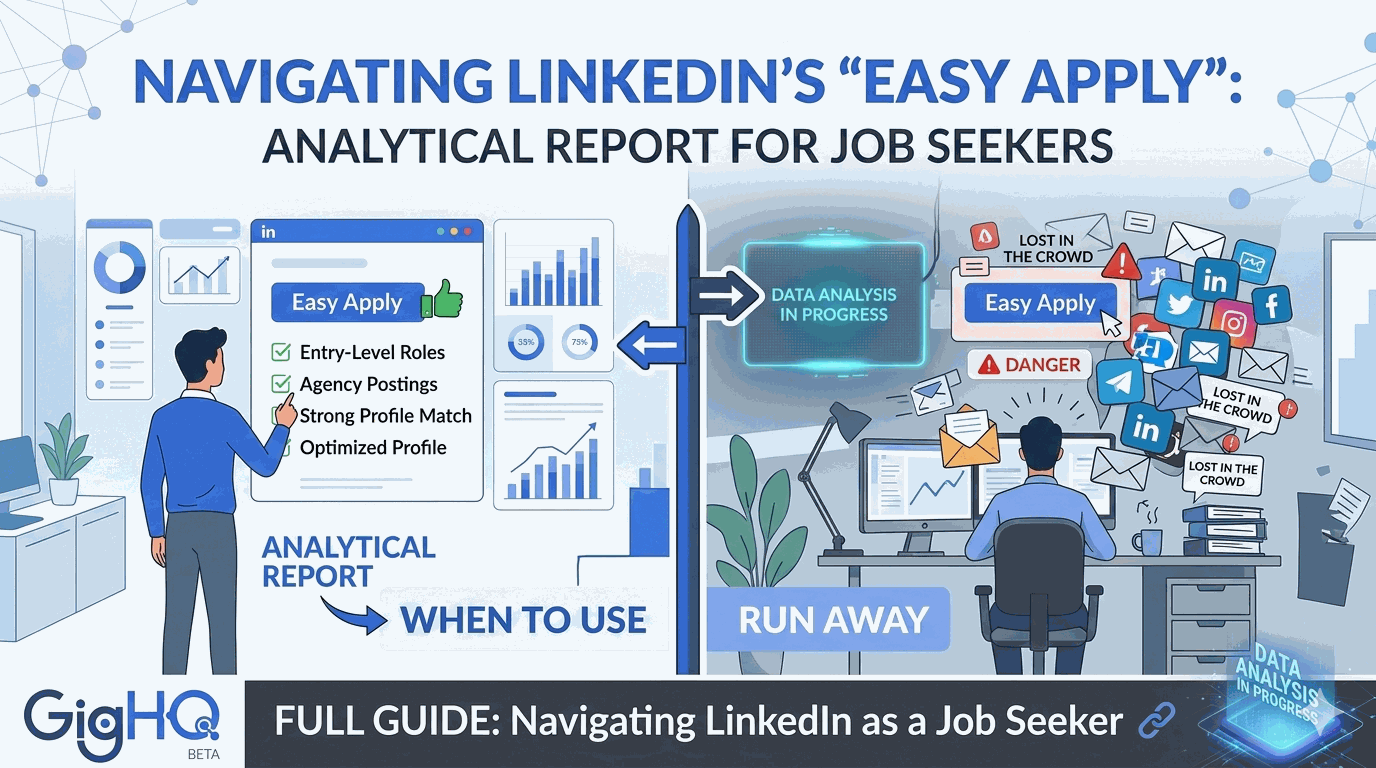
- Role Type and Industry: “Easy Apply” may be more effective for entry-level or high-volume roles where employers are primarily focused on quickly building a large candidate pool. For senior, specialized, or niche positions that require highly tailored applications and specific expertise, “Easy Apply” is generally less suitable. Some industries, like tech and creative fields, might be more receptive to LinkedIn applications due to the emphasis on networking, while traditional sectors like finance or government may prefer applications through their own websites.
- Quality of LinkedIn Profile: A comprehensive, well-optimized, and compelling LinkedIn profile is paramount if using “Easy Apply”. Since the profile snapshot is often the first—and sometimes only—thing a recruiter sees, it must effectively convey the candidate’s qualifications and value. A user in a discussion forum noted, “Unless your LinkedIn is really good – has a lot of information like your resume, easy apply is often useless”.
- Competition Level: For highly desirable roles or companies, the sheer number of applicants using “Easy Apply” can drastically diminish an individual’s chances of standing out.
- Employer’s Screening Process and Preferences: Companies vary in how they process “Easy Apply” applications. Some may have sophisticated ATS systems that might not parse LinkedIn-generated applications well, while others might have recruiters who deprioritize these submissions in favor of direct applications or those with more personalization. If an employer has a specific system for applications, deviating from it (e.g., by messaging a recruiter who prefers to manage all applications through the designated “Easy Apply” channel for that post) could lead to the application being ignored.
- Source of the Job Posting (Direct Employer vs. Agency): An interesting observation from user experiences is that “Easy Apply” might yield more responses when the job is posted by a recruitment agency rather than a direct employer. Recruitment agencies often aim to expand their candidate databases quickly. An “Easy Apply” submission provides them with a profile and resume with minimal effort from either party. This might result in a “view,” “download,” or even generic initial contact from an agency, which a candidate might perceive as a positive response. However, this type of “success” may be for general database inclusion rather than for the specific job applied to, representing a different dynamic than securing an interview for a targeted role with a direct employer.
- Luck and Timing: Occasionally, an “Easy Apply” application might simply arrive at the right moment when a recruiter is actively reviewing and the applicant pool for that specific role is still manageable.
While “Easy Apply” is not entirely devoid of success stories, the balance of evidence suggests it is generally less likely to lead to an interview compared to more direct and tailored application methods, particularly for competitive roles.
6. Strategic Application: “Easy Apply” vs. Direct Company Applications
Job seekers often face a choice: the convenience of “Easy Apply” or the potentially more impactful route of applying directly through a company’s website. Understanding the nuances of each approach is key to a strategic job search.
6.1 Advantages of Applying Directly on Company Websites
Opting to apply via an employer’s dedicated career portal offers several distinct advantages:
- Demonstrates Genuine Interest and Initiative: Navigating to a company’s website and completing their application process typically requires more effort than a one-click “Easy Apply.” This additional effort can signal to recruiters a higher level of commitment and genuine interest in that specific organization and role. As one source notes, this can cue the recruitment team that a candidate might be a better cultural fit, as they’ve likely browsed other pages to learn about the company. This “signaling effect”—where a more “costly” action in terms of time and effort indicates stronger intent—can be a subtle differentiator in a competitive market.
- Allows for More Tailored and Comprehensive Applications: Company portals often provide more detailed job descriptions and allow for more extensive information submission, including customized cover letters, answers to specific questions, and portfolios or work samples. This enables candidates to tailor their application precisely to the role and showcase their qualifications more effectively than a generic LinkedIn profile snapshot might allow.
- Direct Submission into the Company’s Primary System (ATS): Applying directly ensures the application enters the employer’s main recruitment database or ATS without passing through a third-party intermediary like LinkedIn. This can reduce the risk of data transfer errors or formatting issues and ensures the application is in the system the talent acquisition team primarily uses.
- Access to the Most Up-to-Date and Detailed Job Information: Company career pages are generally the definitive source for job openings and often contain more comprehensive information about the role, responsibilities, and company culture than might be available on third-party sites.
- Potentially Less Competition from “Mass Applicants”: While still competitive, the additional steps involved in a direct application may deter less serious or “mass” applicants who favor the speed of “Easy Apply”. Some recruiters may prioritize reviewing resumes received directly through their website, assuming a higher level of applicant seriousness.
- Prioritization by Some Employers: Many organizations explicitly state or implicitly prefer candidates who apply through their own portals, viewing these applications as more serious or better aligned with their internal processes.
6.2 When to Consider “Easy Apply”
Despite the advantages of direct applications, there are scenarios where “Easy Apply” might be considered:
- As a Supplementary, Not Primary, Strategy: If time is severely limited, “Easy Apply” can be used to apply to a larger number of roles quickly, but it should ideally not be the method used for top-priority jobs. One should not rely solely on “Easy Apply” or LinkedIn for their entire job search.
- For Roles Posted by Recruitment Agencies: As previously noted, “Easy Apply” might be more effective for agency postings, as agencies often use it for rapid candidate pool expansion.
- When It’s the Only Option Presented for a Specific LinkedIn Job ID: Sometimes, a job posting on LinkedIn may only offer “Easy Apply,” with no clear link to apply for that same specific requisition on the company’s career page. In such cases, the employer has designated “Easy Apply” as the application method on that platform. Attempting to circumvent this by finding a general careers page could be counterproductive if the recruiter is managing applicants for that specific post through the LinkedIn system.
- For Low-Stakes Exploration or Opportunistic Applications: For roles that are of mild interest or for exploring peripheral opportunities where the time investment of a full, tailored application isn’t justified.
- As a Networking Follow-Up Formality: If a candidate has already networked with someone at the company who then directs them to submit a formal application via an “Easy Apply” link, the primary “application” has effectively occurred through the personal connection.
6.3 When to Prioritize Direct Company Applications
Direct applications should generally be prioritized in the following situations:
- For Roles You Are Genuinely Interested In and Well-Qualified For: If a job is a strong fit and a high priority, the extra effort of a direct application is usually warranted to maximize chances.
- When Customization is Key to Making Your Case: If the role requires specific skills or experiences that need to be highlighted through a tailored resume and cover letter.
- For Companies You Highly Value: Applying directly demonstrates a greater level of respect and focused interest in that particular organization.
- To Ensure Optimal ATS Processing: To ensure the application is received and processed correctly by the company’s internal systems, in their preferred format.
6.4 The Dual Approach Strategy: Combining Strengths
A highly effective strategy can be to combine both methods:
- Apply formally through the company’s website first to ensure a detailed, tailored application is in their primary system.
- Then, use LinkedIn to connect with the hiring manager or relevant team members. Send a polite message expressing strong interest, mentioning the direct application, and briefly highlighting key qualifications.
This “dual approach” leverages the formality and thoroughness of a direct application with the networking power and visibility of LinkedIn. It acts as a hedge, ensuring the application is in the official queue while also attempting to make a personal connection that might prompt a closer look at the submission.
Table 1: Application Methods Compared: “Easy Apply” vs. Direct Company Website Application
| Feature/Aspect | LinkedIn “Easy Apply” | Direct Company Website Application |
| Speed & Convenience | High; “click and go” | Moderate to Low; requires navigating external site, more data entry |
| Customization Potential | Low; relies on LinkedIn profile, limited cover letter options | High; allows for tailored resumes, cover letters, answers to specific questions |
| Perceived Candidate Effort/Interest | Potentially Low; ease might signal less targeted interest | Potentially High; extra effort signals stronger interest and initiative |
| Likelihood of Detailed Review | Lower; due to high volume and quick scanning by recruiters | Higher; often prioritized, more detailed information encourages deeper review |
| ATS Integration/Reliability | Variable; potential parsing issues, dependent on LinkedIn & employer ATS | Generally High; directly into employer’s native system |
| Opportunity for Cover Letter/Docs | Limited/Optional; often not prioritized or available | High; usually dedicated sections for cover letters and supporting documents |
| Access to Fullest Job Details | Moderate; may be summarized | High; typically the most comprehensive and up-to-date source |
| Typical Application Volume | Very High; due to ease of use | Moderate to High; but often a more filtered pool of applicants |
| Reported Interview Success Rate | Generally Lower; many “no response” experiences | Generally Higher; particularly for targeted applications |
This comparative table underscores that the choice of application method is a strategic one, with clear trade-offs. The “Easy Apply” path offers speed at the potential cost of impact, while direct applications demand more effort for a potentially greater chance of meaningful consideration.
7. Making “Easy Apply” Work for You (If You Choose to Use It)
While direct applications are often preferable, there will be instances where a job seeker opts for “Easy Apply.” In such cases, certain steps can be taken to maximize its potential effectiveness, recognizing that the foundation of any “Easy Apply” submission is a robust LinkedIn profile.
7.1 Optimizing Your LinkedIn Profile – Your “Easy Apply” Foundation
Since the LinkedIn profile serves as the primary application document for “Easy Apply,” its optimization is non-negotiable. Recruiters will see a snapshot of this profile first, and if it’s not compelling, they may not proceed to view an attached resume.
- Compelling Headline: This is critical as it’s one of the first pieces of information a recruiter sees and is often truncated to around 30 characters in list views. The headline should clearly state the target job title or key areas of expertise within this limit to immediately signal relevance. A generic headline like “Currently seeking opportunities” is unlikely to capture attention.
- Comprehensive and Keyword-Rich Profile: The entire profile, especially the “About” (summary) and “Experience” sections, should be detailed, mirror the depth of a traditional resume, and be infused with keywords relevant to the desired roles and industry. This helps with both human recruiter screening and potential algorithmic filtering.
- Professional Photo: A clear, professional headshot is an essential component of the initial profile snapshot presented to recruiters.
- Strong Summary/About Section: This section should be leveraged as a de facto cover letter, directly addressing potential employers by highlighting key strengths, quantifiable achievements, years of experience, and the unique value the candidate can bring.
- Detailed Experience Section: Each role should include clear descriptions of responsibilities and, crucially, quantifiable achievements that demonstrate impact.
- Skills Section: Keep this updated with relevant skills, and encourage endorsements from connections to add weight.
- Recommendations: Actively seek and provide recommendations. Testimonials from former colleagues, managers, or clients can significantly enhance credibility.
The goal is to create a “minimum viable application” through the profile snapshot that is potent enough to pass the initial quick scan by a recruiter and encourage them to explore further. Every visible element must contribute to a positive first impression.
7.2 Strategic Use of “Easy Apply”
Beyond profile optimization, strategic actions during the “Easy Apply” process itself can make a difference:
- Always Attach a Tailored Resume: Even with a comprehensive profile, always upload a resume. Ideally, this resume should be tailored as much as possible to the general type of job being applied for. It provides an opportunity for more detail, context, or a narrative structure that the LinkedIn profile might not fully accommodate. While there are concerns about ATS parsing of LinkedIn-generated PDFs, a standard PDF format is generally recommended for uploaded resumes.
- Include a Cover Letter if an Option is Provided: If the “Easy Apply” interface offers an option to include a cover letter, even if marked as optional, take advantage of it. A concise, tailored cover letter can significantly enhance the application by expressing specific interest and fit.
- Answer Screening Questions Thoughtfully: If the application includes screening questions (e.g., years of experience, certifications, willingness to relocate), answer them accurately and carefully. These are often initial knockout factors.
- Be Selective, Not Indiscriminate: Avoid using “Easy Apply” to “mass apply” to hundreds of jobs without regard for fit. Focus on roles where the profile is a very strong match, or where “Easy Apply” is the only application method offered for that specific posting. Deliberate application is more effective than sheer volume.
- Consider a Polite Follow-Up (with Caution): If the recruiter or hiring manager can be identified, some candidates consider sending a brief, polite follow-up message on LinkedIn after submitting an “Easy Apply” application, reiterating interest and highlighting fit. However, this is a delicate area. Some recruiters, overwhelmed by “Easy Apply” volume, may view such messages as an unwelcome addition to their workload or an attempt to circumvent their process. Others might appreciate the initiative. This requires careful judgment based on the company, role, and the candidate’s ability to craft a truly value-added message.
- Track Your Applications: Maintain a record of all applications, including those submitted via “Easy Apply,” noting the date, role, and company. This helps manage the job search process and any potential follow-ups.
Using “Easy Apply” effectively means treating it not as a mindless click, but as a condensed application that still requires strategic preparation and execution, with the LinkedIn profile as its cornerstone.
8. Conclusion: To Click or Not to Click? Making an Informed Decision
The LinkedIn “Easy Apply” button presents a modern dilemma for job seekers: embrace the convenience or approach with caution. This analysis has shown that “Easy Apply” is a double-edged sword, offering undeniable speed for candidates and a wider applicant net for employers, but often at the cost of intense competition, reduced personalization, and a deluge of low-quality applications that can overwhelm recruiters.
8.1 Summarized Findings – The Double-Edged Sword
For candidates, the allure of applying to many jobs quickly is countered by the high probability of their application being lost in a vast sea of similar, often generic, submissions. The lack of customization and the initial limited information presented to recruiters mean that making a strong, unique impression is challenging. Consequently, the reported effectiveness of “Easy Apply” in securing interviews is generally lower than more traditional, tailored application methods, though not entirely negligible.
For employers, “Easy Apply” can rapidly expand the candidate pool, but this often leads to a significant administrative burden in sifting through a high percentage of unqualified applicants. This can strain resources and potentially obscure truly promising candidates.
8.2 Key Considerations Before Clicking “Easy Apply”
Before utilizing the “Easy Apply” feature, a job seeker should consider:
- The nature of the job: Is it an entry-level, high-volume role where speed might be valued by the employer, or a specialized/senior position demanding a nuanced application?
- Personal job search bandwidth: Is time so constrained that “Easy Apply” is a necessary tactic for maintaining application momentum, or is there capacity for more focused, tailored efforts?
- The strength and completeness of the LinkedIn profile: Is the profile fully optimized to serve as a compelling standalone application document?
- Availability of a direct application route: Does the company offer a way to apply for the same specific role through its own career portal?
- Personal tolerance for low response rates: Is the candidate prepared for the likelihood of fewer responses compared to other application methods?
8.3 Recommendations for the Discerning Job Seeker
Based on the analysis, the following recommendations are offered:
- Prioritize Direct Applications for Key Roles: For positions that are a strong fit and of high interest, applying directly through the company’s career portal should be the default strategy. This allows for maximum customization, demonstrates genuine interest, and ensures the application is in the employer’s primary system. This is a form of “strategic effort” that often yields better returns.
- Use “Easy Apply” Selectively and Strategically:
- As a supplementary tool, not the cornerstone of the job search.
- When it is the only application method explicitly offered by the employer for a specific job ID on LinkedIn.
- For opportunistic applications to less critical roles or to broaden reach, provided the LinkedIn profile is exceptionally well-matched and optimized.
- Potentially for roles posted by recruitment agencies, understanding that their objective might be broader database building.
- Never Rely Solely on “Easy Apply”: A diversified job search strategy incorporating networking, direct applications to company websites, and targeted outreach to hiring managers or recruiters is far more likely to yield positive results.
- Optimize Your LinkedIn Profile Irrespective of “Easy Apply”: A strong, comprehensive, and keyword-rich LinkedIn profile is a valuable asset for all facets of a modern job search conducted on the platform, not just for “Easy Apply” submissions.
- Consider the “Dual Approach”: If applying directly to a company website, consider a polite follow-up networking attempt on LinkedIn with a relevant contact. If using “Easy Apply” for an important role (and it’s the only option), try to find a way to make a more personal connection if feasible and appropriate, while being mindful of recruiter preferences.
- Manage Expectations and Maintain Perspective: Understand that response rates from “Easy Apply” are often low. This should not be a source of discouragement for the overall job search but rather an indicator to focus energy on higher-impact activities. The way a company utilizes “Easy Apply” might even offer subtle clues about its recruitment process or volume-driven approach, which can be a data point for the candidate.
- Trust Your Judgment: If a job posting or the “Easy Apply” process feels impersonal, or if there are concerns about the application being overlooked, erring on the side of a more direct and personalized approach (if available) is generally advisable.
8.4 Final Thought: Empowering Your Job Search
LinkedIn’s “Easy Apply” is a tool, and like any tool, its utility is determined by the context and manner of its use. It reflects an ongoing evolution in recruitment technology, and both job seekers and employers are still adapting. By understanding its mechanics, the distinct advantages and disadvantages it presents, and the perspectives of all parties involved, job seekers are better equipped to make strategic decisions. The ultimate aim is not merely to apply, but to apply effectively, navigating the job market with informed choices that align with individual career goals and maximize the chances of success. The landscape of job searching tools will continue to change, necessitating ongoing critical evaluation and adaptability from those seeking new opportunities.
Our Platform Tools:

ResumeRank
Scan your resume, get a score, fix what matters.

CoverGenius
Generate personalized, AI-powered cover letters in seconds.

OutreachAgent
Craft perfect networking and AI-powered follow-up emails with ease.

CareerCompass
Instantly generate a personal marketing plan from your resume to define your brand and attract the right opportunities.

Smart Prep
Simulates a real interview based on your resume and the job description, giving you real-time feedback to build your confidence.

Profile Spark
Optimize your LinkedIn profile to attract recruiters and opportunities.