Remote work has gone from optional perk to baseline expectation, especially for early-career professionals. Handshake reports that 75 percent of Gen-Z candidates prioritize flexible work, but nearly two-thirds worry they’ll lack visibility or support once they’re offsite. Your resume needs to prove you’re more than willing to work remotely, you’re built for it. Here’s how to signal “remote-ready” at a glance.
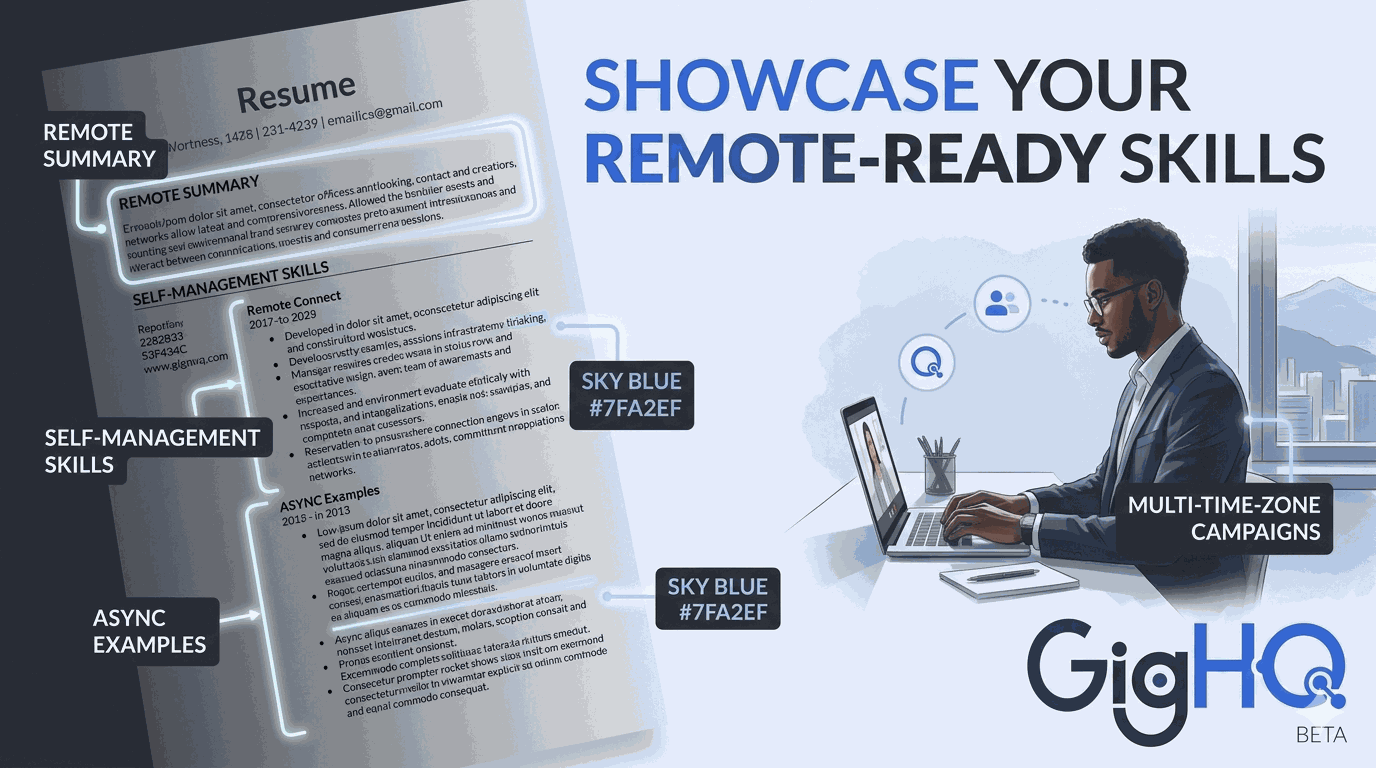
1. Lead with a Strong Summary
Why it matters: Recruiters spend as little as six seconds on a resume scan. Your summary is prime real estate to declare your remote strengths.
Do this:
- Open with your title and location-independent status, for example:
“Digital Marketing Associate | Remote-First Professional” - Highlight one or two remote competencies:
“Self-starter with 2+ years coordinating multi-time-zone campaigns.” - Tie it to measurable impact if possible.
Example (weak):
“Recent graduate skilled in digital marketing tools and eager to learn remote work processes.”
Example (strong):
“Remote-First Marketing Associate who managed social campaigns across three time zones, boosting engagement by 40 percent.”
2. Emphasize Core Remote Competencies
ATS and recruiters look for proof you can thrive without in-person oversight. Organize a brief “Remote Skills” section using clear, hard-skill language.
Key competencies to showcase:
- Asynchronous Communication: “Wrote and managed weekly project updates via Slack and Confluence.”
- Self-Management: “Developed and maintained a personal task-tracking system in Trello to meet 100 percent of deadlines.”
- Tech Fluency: “Proficient with Zoom, Microsoft Teams, GitHub, and Google Workspace.”
- Collaboration Tools: “Co-led cross-functional retrospectives over Miro.”
Place this section immediately after your summary or core competencies, before diving into work history.
3. Integrate Remote Examples into Your Experience
Rather than tacking a “remote” bullet onto a list of duties, weave remote context into each role’s achievements. That turns a generic responsibility into concrete proof of your adaptability.
Do this:
- For each job or project, add 1–2 bullets that reference remote work explicitly.
- Focus on outcomes, what you delivered and how you did it at a distance.
Example (generic):
- “Coordinated product launch with marketing and sales teams.”
Example (remote-ready):
- “Led async product launch coordination across marketing, sales, and engineering in three time zones, delivered launch materials two days ahead of schedule.”
4. Format for Clarity and Parsing
Complex layouts can trip up both machines and humans. Keep your resume structure simple so remote signals stand out.
Best practices:
- Single-column layout with clear headings: Summary, Skills, Experience, Education.
- Use bullet points (4–6 per role) to break up dense text.
- Bold remote-related keywords to draw the eye. Ex., “Remote-First,” “Async Updates,” “Cross-Time-Zone”.
5. Before & After: Transforming a Bullet
Let’s compare a weak bullet to a remote-ready bullet.
- Before:
“Collaborated with global team on customer support documentation.” - After:
“Organized and facilitated async documentation sprints with 5-member global support team, reducing update cycle from 10 days to 4 days.”
Notice how the second version:
- Mentions async methodology
- Quantifies the team size
- Highlights the efficiency gain
6. Five Actionable Tips
- Mirror Job Language
Scan the posting for phrases like “self-starter,” “virtual collaboration,” or “distributed team.” Use those exact terms where they accurately describe you. - Show Time-Zone Awareness
If you’ve coordinated across zones, include specifics (“Stand-ups at 8 AM GMT for U.K., U.S., and APAC teams”). - Link to Artifacts
Add links to a public portfolio or project repository that demonstrates remote collaboration. Like, GitHub, Notion docs, or a shared blog. - Highlight Tools in Context
Instead of listing “Zoom” in a skills section alone, describe how you used it (“Hosted biweekly Zoom workshops for 20+ participants”). - Keep It Concise
Remote signals should be unmistakable but not repetitive. One bullet per role is enough. Don’t overload every line with the word “remote.”
Conclusion & Next Steps
A resume that sells your remote aptitude gets you into the interview room; a resume that proves it gets you the offer. By leading with a focused summary, spotlighting remote competencies, and embedding real-world async examples, you’ll stand out to hiring managers hunting for talent who can hit the ground running. No office required.
Continue Your Hybrid/Remote Journey
Dive into our other deep-dive guides:
- Pros & Cons of Remote Work
- Networking Remotely
- Managing Distributed Learning & Growth
- Maintaining Healthy Boundaries in Hybrid Roles
Or return to the Hybrid/Remote Career Strategy Hub for the full roadmap.
Our Platform Tools:

ResumeRank
Scan your resume, get a score, fix what matters.

CoverGenius
Generate personalized, AI-powered cover letters in seconds.

OutreachAgent
Craft perfect networking and AI-powered follow-up emails with ease.

CareerCompass
Instantly generate a personal marketing plan from your resume to define your brand and attract the right opportunities.

Smart Prep
Simulates a real interview based on your resume and the job description, giving you real-time feedback to build your confidence.

Profile Spark
Optimize your LinkedIn profile to attract recruiters and opportunities.