Doing More With Less: Scaling a Two-Year College Career Center
Career services leaders at two-year colleges keep asking the same question: how do we do more with less?

Career services leaders at two-year colleges keep asking the same question: how do we do more with less? It came up again at a recent NACE Community and Two-Year Affinity Group meeting, where more than 30 professionals from community colleges, universities, employers and nonprofits compared notes on serving students with small teams and big expectations. Their answers were practical, specific and sometimes surprising. Here is what we heard, and what it suggests for any career center trying to widen its reach without widening its headcount.
The squeeze: small centers, wide mandates
Two-year college career centers are asked to do a lot. They help first-year students find their footing, reach non-traditional and working learners, connect graduates to employers, and prove their value to administrators, often with a handful of staff. The group’s own survey made the pressure visible. When members were asked what they most want to learn this year, the top answers were student engagement and outreach, career readiness, employer partnerships, ethical use of AI, and education-to-employment pathways. One co-lead put the shared dilemma plainly: we have small centers, so how do we increase our impact and scale our services? The group also skews early-career. The largest share of members has one to five years of experience, which means many teams are building their playbooks in real time.
What scaling looks like in practice
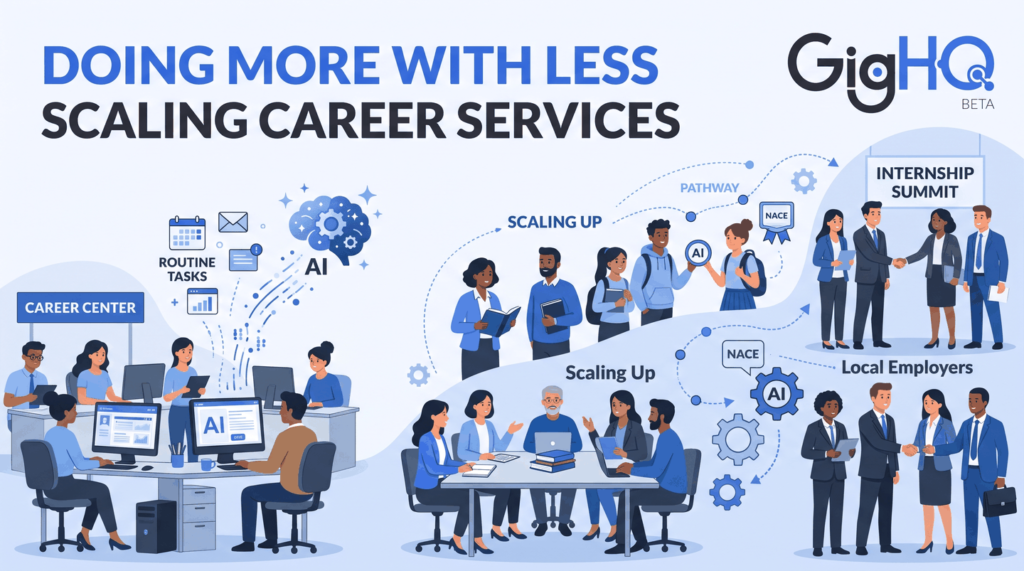
The most useful moments on the call were examples from members who are already stretching a small team further. A few patterns stood out. Multiply your reach through faculty. One college runs a monthly faculty lunch-and-learn on weaving NACE career competencies into syllabi, supported by a workbook that maps lessons to competencies and shows how to explain those skills to students. Another is developing a similar workbook. Faculty become the career center’s distribution channel, and free food helps. Find campus champions. Members returned again and again to the idea of identifying the people on campus who believe in this work and getting them to tell others. Buy-in was named the perennial hard problem, and champions are how it gets solved. Pool resources across institutions. In one region, five colleges and universities jointly host an internship summit where employers share their best practices on hiring, onboarding and recruiting. Instead of five centers each chasing the same employers, they share the effort.
Reach students before they arrive
One community college used Perkins grant funding to build five workshops based on the NACE competencies and delivers them to local high schools, where students earn a digital badge for career readiness. Build pathways, not just placements. One member described an earn-and-learn model that pairs two-year degrees with paid, employer-connected work experiences and works backward from what local industries need. Their lesson was that a pathway is only as strong as the support around it. Transportation, coaching, professional communication, workplace expectations and money skills all determine whether a student gets into a job and stays in it. Make engagement fun. One career center is planning a game demo day to draw students in, and wants to build competency-based activities in its learning management system. Fund the experience. Members also raised paid internships and internship scholarships. Finding paid opportunities for two-year students is hard, and the group noted that NACE research links paid internships to stronger earnings over a career, with a disparate impact on students who can’t afford to work for free.
Where AI fits, and where it doesn’t
AI came up as both an opportunity and a source of uncertainty. Members asked how other campuses use AI to scale employment services, such as resume support, and said it is hard to tell where peers actually stand. “Everybody’s doing it” is not much help without context: how, at which school, and with which students? The co-leads framed the goal as using AI to expand capacity while preparing students for a changing workplace, and doing it ethically. Many institutions already have AI task forces or working groups, and career centers belong at that table. A useful way to think about it is to put AI where it removes repetitive work, not where it replaces judgment. Routine tasks like tracking applications, organizing outreach, and surfacing the next step for each student are good candidates. Advising conversations, employer relationships and decisions about a student’s path are not. When AI handles the first group, advisors get more time for the second.
A starter playbook for doing more with less
Recruit three faculty champions. Start with instructors who already care about career outcomes, and give them a simple tool, such as a workbook that links course content to career competencies. Host a recurring lunch-and-learn. A monthly, low-pressure session builds faculty buy-in without a formal mandate. Share the load with nearby institutions. A joint employer event or internship summit costs each school less and draws more employers. Work backward from local employers. Identify the industries hiring in your region, then align programs, workshops and work-based learning with their needs. Wrap pathways in support. Plan for transportation, coaching, professional communication and money skills, not only the job placement. Automate the repetitive work. Use tools that track applications and next steps so advisors can spend their time on conversations that need a human. Measure what happens after graduation. Completion, relevant experience and employment at a family-sustaining wage tell you more than enrollment alone.
Scaling without losing the human touch
The takeaway from the call was encouraging. Small centers are not waiting for bigger budgets. They are borrowing ideas from each other, recruiting faculty as partners, sharing employer relationships across campuses, and looking for smart ways to automate the routine. That last piece is where we focus at GigHQ.ai. By building agent-native career management tools and integrating capabilities like our Chrome extension and MCP server, we handle the tracking, organizing, and follow-up that consume a career center’s day. Whether deployed in ChatGPT or in Claude, our platform empowers students and gives advisors real-time insights through our job market radar to shift the narrative around AI in career services.
You can see our tools in action through our video demos, including our platform overview, our Chrome extension walkthrough, our workflow deep-dive, our analytics demonstration, and our integration highlights. To learn more about our team and mission, visit about us or explore our blogs.
If you lead a career center and want to talk about how to extend your team’s reach, we’d love to hear from you.