
The Three-Tool Rule for Your Job Search
If your job search feels like a second job spent learning software, you're not imagining it. The people who coach students for a living described the same thing. They called it AI fatigue: the mental and emotional exhaustion of being expected to constantly learn, evaluate, and manage new AI tools on top of everything else.

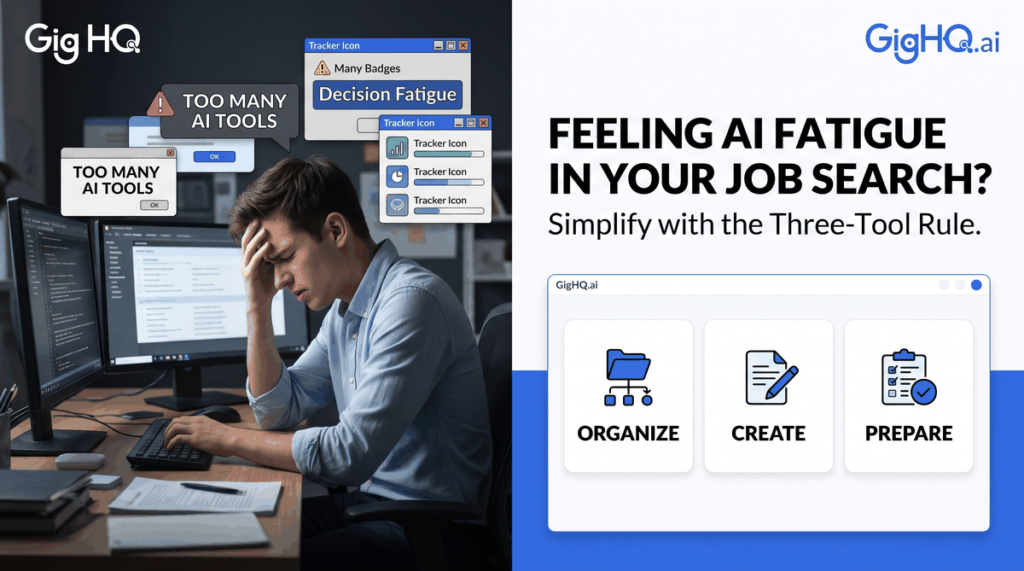
If your job search feels like a second job spent learning software, you’re not imagining it.
There’s a résumé optimizer, an interview simulator, a cover letter generator, a job matcher, an outreach assistant, and a new “must-try” tool every week. Each one promises to save you time. Together, they can eat the time you were trying to save.
This isn’t only a job seeker problem. At a recent NACE session for online career services professionals, the people who coach students for a living described the same thing. They called it AI fatigue: the mental and emotional exhaustion of being expected to constantly learn, evaluate, and manage new AI tools on top of everything else. In a live poll of about 50 attendees, the top drivers were the constant stream of new tools and the question of when and how to use AI at all.
If the experts feel it, job seekers certainly do. Here’s a simple rule that helps.
Why more tools make your search worse
It feels productive to sign up for another tool. Often it isn’t, for three reasons.
- Decision fatigue. Every tool adds a choice. Which one drafts this email? Which one checks my résumé? Which one do I trust? Energy spent choosing is energy not spent applying.
- Overload. One presenter at the NACE session pointed to neuroscientists and organizational psychologists who suggest that once you juggle four or more AI tools, people tend to become cognitively overwhelmed. Her analogy: it’s like resolving to get healthy by running eight miles a day, starting CrossFit, and overhauling your diet all at once, starting tomorrow.
- Shallow skill. Another presenter admitted that trying to learn everything meant she never became confident with any of it. The same happens in a job search. Ten tools used superficially beat none, but they lose to two or three you actually know how to use well.
The three-tool rule
The rule is simple: use three tools or fewer across your whole job search. Pick one for each core job, and stop there.
Here’s a minimum viable stack. The categories matter more than the brands (though finding one platform that unifies them is even better).
| Role | What it does | Test for the right pick |
| Organize | Tracks every application, contact, deadline, and follow-up in one place. (e.g., The GigHQ Chrome Extension & automated @gighq.ai email) | Can I see my whole pipeline at a glance? |
| Create | Helps draft and sharpen résumés, cover letters, and outreach in your own voice. (e.g., GigHQ’s ResumeRank & CoverGenius) | Does the output still sound like me? |
| Prepare | Helps you practice interviews and research companies. (e.g., GigHQ’s SmartPrep & Job Market Radar) | Do I walk into conversations more confident? |
Three is a guideline, not a law. If two tools cover your needs, stop at two. The point is a ceiling that forces you to ask whether a new tool earns its place.
How to decide what earns a slot
A career services leader at the session offered a test for teams adopting new tools. It works just as well for your own search: does this tool reduce my workload or improve my results? If it does neither, it isn’t helping, however impressive the demo.
Before adding anything, ask:
- What problem is this solving? If you can’t name it in one sentence, skip it.
- What would it replace? A new tool should push an old one out, not join the pile.
- Will I still use it in two weeks? Novelty fades quickly.
- Can I explain what it did for me? If not, you can’t judge whether to trust it.
The session also made a point about expertise: you don’t need to master every AI platform. You need to understand your own process and how a tool supports it. In a job search, that means knowing your goals, your story, and your pipeline. The tools serve that, not the other way around.
Use AI as an aid, not a crutch
Fewer tools is half the answer. The other half is how you use them. A few habits from the session are worth borrowing.
- Try it yourself first. One attendee shared a colleague’s rule: spend five to ten minutes working something out on your own before turning to a teammate or an AI prompt. It keeps your critical thinking sharp and keeps AI in the role of supplement.
- Automate what you hate. One presenter’s approach is to list the tasks she’s dreading that week and ask AI what it can take off her plate. Reformatting a résumé or drafting a routine follow-up is a good fit. Deciding what you want your career to be is not.
- Let it be your editor, not your author. AI can tighten a draft and catch errors, but your ideas and voice should stay yours. (This is exactly why we built the GigHQ MCP Server, allowing you to connect your real career journal data directly to ChatGPT or Claude to act as your personal editor).
- Be able to explain everything you submit. If an interviewer asks about a line in your résumé or cover letter, you should be able to speak to it without help.
- Keep the human parts human. Students at the session still came to advisors for mock interviews and to talk through how an interviewer reacted, even after getting instant AI feedback. AI can give you ideas for career paths in 30 seconds, but how those paths fit your values and life priorities takes a real conversation, with a mentor, advisor, or friend.
Decide what “enough” looks like
The most useful question from the session may be the simplest: what is enough? Enough tools, enough AI help, enough applications this week. Without an answer, there’s always one more thing to try, and that’s where the fatigue comes from.
This week, try this:
- List every AI or job search tool you’ve signed up for.
- Assign each to one role: organize, create, or prepare.
- Keep the best one per role and pause the rest.
- Pick one workflow, such as tailoring applications, and get good at it before adding anything.
- Write down what “enough” means for your search this month.
AI isn’t going away, and you don’t have to resist it or chase every new release. A small, deliberate toolkit lets you spend your energy on the part of the job search that matters most: showing employers who you are.
That’s the philosophy behind GigHQ.ai: one place to track your applications, contacts, and career story, so you spend less time juggling tools and more time moving forward. Want to see what “enough” looks like? Watch how GigHQ simplifies the process and reclaim your job search today.