The Great Stay: What a Frozen Job Market Means for Job Seekers and Career Advisors
Guild workforce economist Guy Berger describes today's labor market as "the Great Stay": steady, but largely frozen. That's fine if you already have a job you like and hard if you're looking.

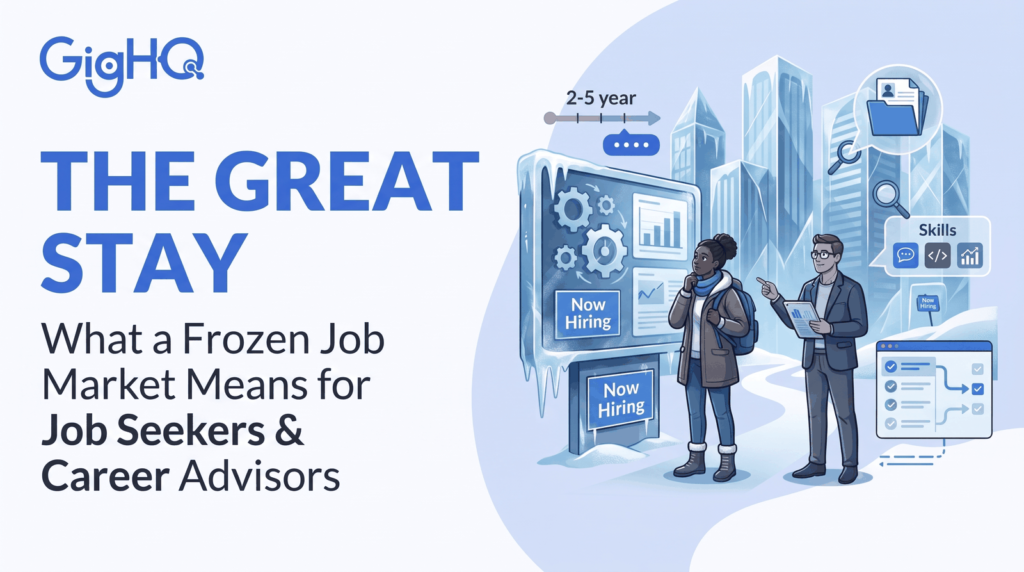
Guild workforce economist Guy Berger describes today’s labor market as “the Great Stay”: steady, but largely frozen. That’s fine if you already have a job you like and hard if you’re looking. If you’re searching right now, treat each skill or credential as a short-term bet (he suggests two to five years), keep an honest record of what’s actually working, and plan to adjust. Advisors can help by being candid about uncertainty and focusing on what each job seeker can control.
What is “the Great Stay”?
In a recent episode of The Cusp podcast, covered in Work Shift’s October 29 newsletter, Guy Berger, workforce economist in residence at Guild, described a labor market that is steady but largely frozen. People who already have a job they like are mostly staying put. If you’re trying to get in or move, it’s much harder.
Berger calls it “the Great Stay,” and Work Shift notes that it reflects a lot of uncertainty. He also says quality data on AI’s impact is lacking. He sees a plausible future where AI kills some jobs, creates others, and reshapes many more, but on a 20-year horizon or longer. For now, adoption is slow, and there aren’t many clear signs of how AI will change specific industries.
If your search feels slower than it “should,” you’re not imagining it. A quiet market means fewer openings come up, and more people compete for each one.
The mixed signals job seekers are getting
The confusion is real. In a Work Shift essay, Emily M. Dickens (SHRM) and Elissa Salas (SkillUp Coalition) point out that at major tech companies, new graduate and entry-level hiring is “down roughly 65%” compared to 2019 levels. They also note that AI has been cited in “more than 120K announced job cuts” so far in 2026. Meanwhile, some major employers have announced hiring plans, and fast-growing occupations span healthcare, skilled trades, and tech.
They tell the story of Molly, who finished a six-month coding bootcamp just as the market shifted under her. As they put it: “Molly didn’t make a bad decision. She made the decision our conventional wisdom led her to make.”
The lesson isn’t to stop investing in yourself. It’s that no single credential guarantees an outcome, and the advice you get should be honest about that.
Treat upskilling as a two-to-five-year bet
Berger’s most practical advice is about how to think about training right now:
“These bets that you’re making on human capital, you should view them as, ‘I’m going to use this human capital for two to five years, and am I going to get the right kind of return for it,’ … Rather than ‘I’m investing in the rest of my career.'”
For job seekers, that suggests a few questions to ask before you sign up for a course, certificate, or bootcamp:
- Will this help me land a role in the next two to five years? Look at the job postings you’re actually applying to, not general trend headlines.
- Can I recover the cost and time in that window? Shorter, cheaper, and more targeted options are often easier to justify.
- Does it build skills that carry over? Dickens and Salas emphasize durable skills like communication, critical thinking, problem-solving, and collaboration, along with the self-knowledge to make confident decisions when your path changes.
What job seekers can do in a frozen market
When openings are scarce, it pays to be deliberate with your effort.
- Track every application and its outcome. Write down where you applied, which resume version you used, how you found the role, and what happened. After a few weeks, patterns show up: which roles get responses, which channels lead to interviews, and where things stall.
- Change one thing at a time. If applications go nowhere, adjust your resume, your target roles, or your outreach, then watch whether results change.
- Lean on people, not just job boards. In a market where fewer people are leaving their jobs, referrals and warm conversations can help you hear about openings sooner.
- Be kind to yourself about the timeline. A slow search in the Great Stay says more about the market than about your worth.
What career advisors can do
Advisors and career centers are often the ones sitting across from a job seeker who feels stuck. A few ideas drawn from both pieces:
- Level with people. Dickens and Salas argue we owe learners honesty about which credentials and skills have staying power and which we can’t fully predict. Saying “we don’t know yet” builds trust.
- Frame training as a shorter-term bet. Berger’s two-to-five-year lens helps job seekers weigh cost and time against a realistic payoff.
- Use real data from your own job seekers. Patterns from your caseload, like which roles and employers respond, are often more useful than national headlines.
- Check in early on who’s stalled. In a slow market, people can go quiet for weeks. Catching that early lets you step in before frustration sets in.
Keep moving, with better information
The Great Stay won’t last forever, but nobody can say for sure when or how it ends. What you can control is how you spend your effort: make shorter, smarter bets on skills, track what’s working, and adjust as you go.
If it helps, GigHQ is a free job-search tracker for job seekers. Tracking your applications and outcomes in one place makes it easier to see what’s working. For career centers and advisors, GigHQ’s Coach Portal shows where every job seeker stands, so you know who needs support next.
Sources: Work Shift, “A Moving Target” (Oct. 29, 2026); Emily M. Dickens and Elissa Salas, “Are We Sending Young People False Signals About Their Futures?” (Work Shift, Oct. 27, 2026).