From Accreditation to Actual Placement: Bridging the Intelligence Gap in WIOA, Workforce Pell, and the Modern Job Hunt
With the tightening of Workforce Innovation and Opportunity Act (WIOA) performance measures, the rollout of Workforce Pell, the implementation of strict Gainful Employment debt-to-earnings formulas, and the emergence of outcomes-focused accrediting standards, educational and workforce development organizations (WDOs) face an urgent mandate: every publicly funded training pathway must lead to verifiable, high-quality employment.

Across higher education and regional workforce ecosystems, a quiet revolution is taking place. For decades, workforce development relied on an outdated “train and pray” model: enroll students, teach a static syllabus, hand over a certificate, and hope state unemployment records or sparse alumni surveys show positive employment six months later.
That era has officially come to an end.
With the tightening of Workforce Innovation and Opportunity Act (WIOA) performance measures, the rollout of Workforce Pell, the implementation of strict Gainful Employment debt-to-earnings formulas, and the emergence of outcomes-focused accrediting standards, educational and workforce development organizations (WDOs) face an urgent mandate: every publicly funded training pathway must lead to verifiable, high-quality employment.
A recent presentation on WIOA Compliance, AI, and Workforce Skills Strategy laid bare the astonishing administrative friction facing modern programs:
Consider a single credential—such as a certified medical assistant certificate at a regional university extended learning division. That single program must simultaneously satisfy institutional accreditors, programmatic review boards, state Eligible Training Provider Lists (ETPL), High-Skill High-Wage and In-Demand (HHI) lists, and federal Gainful Employment checks. What once took 47 staff hours of manual spreadsheet tracking per program must now happen in minutes through unified AI infrastructure.
Yet, solving the administrative and accreditation bottleneck upstream solves only half of the equation. Once an institution aligns its CIP and SOC codes, verifies debt-to-earnings thresholds, and modularizes courses into stackable credentials, an even more perilous hurdle emerges: the “last-mile” job search.
What happens when students complete these accredited pathways and step into the actual labor market?
They encounter a broken marketplace rife with ghost postings, automated ATS filters, and information silos.
Here is how institutions, workforce boards, and job seekers can bridge the intelligence gap between program governance and verified career outcomes.
1. The Quadruple Pressure: Governance, Accreditation, and Accountability
Workforce providers today operate in a high-stakes regulatory landscape defined by three massive shifts:
- The 50% Direct Upskilling Mandate & Retention Metrics: Legislative updates to WIOA (including the bipartisan framework under A Stronger Workforce for America Act) direct more funding into hard upskilling while evaluating programs on sustained retention (Q2 and Q4 employment rates) and the new Effectiveness in Serving Employers (ESE) indicator.
- Gainful Employment & Debt-to-Earnings Ratios: Institutions must prove their programs do not load students with debt disproportionate to actual early-career median wages.
- Skills-Based Articulation: Regional accrediting commissions (such as WSCUC, MSCHE, and NWCCU) are increasingly examining whether micro-credentials, certificates, and noncredit offerings genuinely translate into economic mobility and stackable academic credit.
- Moving from Self-Attestation to Audit-Ready Verification: Under DOL Training and Employment Guidance Letters (such as TEGL 26-16), self-reported alumni surveys no longer satisfy stringent data validation audits. Regulators require verified third-party evidence—such as timestamped offer letters and wage documentation.
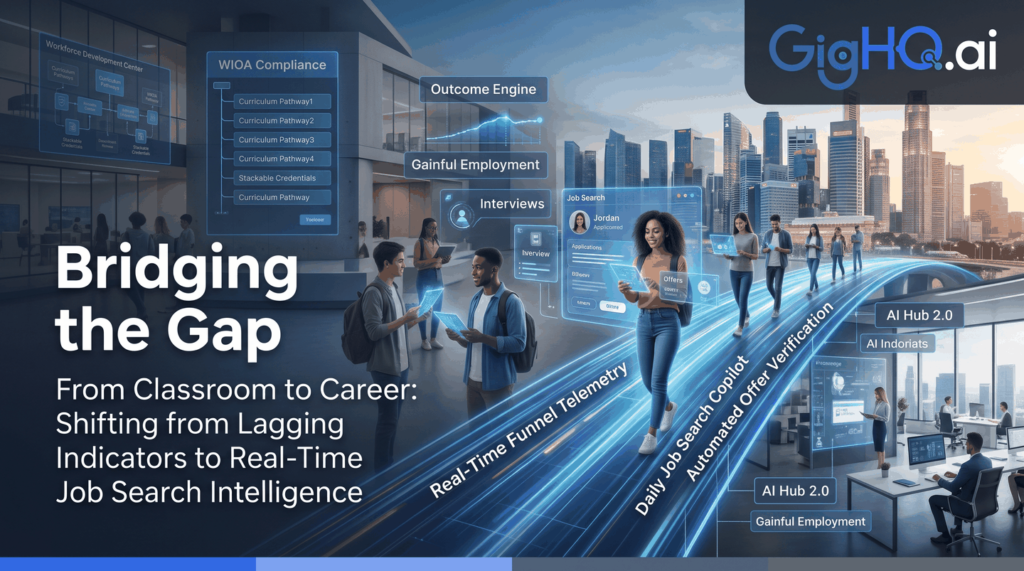
Modern platforms like the Accreditation Information Hub (AI Hub 2.0) are demonstrating how institutions can automate curriculum mapping and crosswalk their offerings against state registries in real time. But compliance is not just about passing an initial audit; it is about ensuring that graduates successfully convert their training into offers.
2. The Downstream Dilemma: The Post-Graduation “Black Box”
While institutions invest heavily in program design, their visibility often evaporates the moment a learner completes the course.
Traditional career services and workforce programs rely on retrospective tools:
- First Destination Surveys (FDS): Often yielding response rates below 25%, skewed heavily toward students who already landed jobs.
- State UI Wage Data: Arrives 6 to 12 months after the fact, missing students who relocate across state lines, enter remote roles, or engage in 1099/contract work.
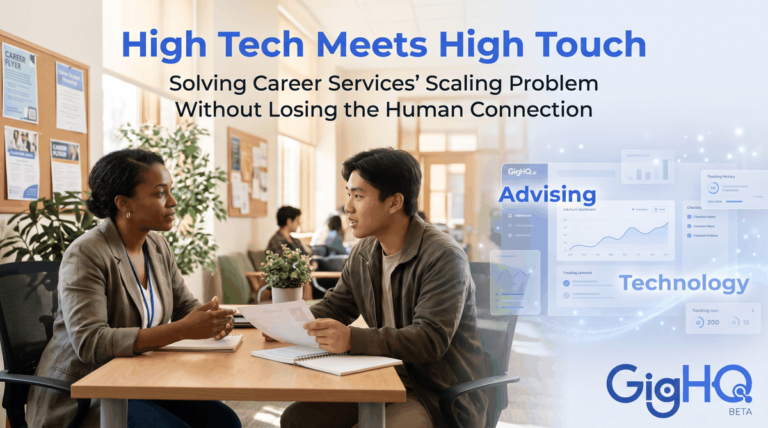
- Manual Case Management: Counselors spend up to 70% of their time chasing students via email or phone asking, “Have you heard back from anyone yet?” instead of providing strategic interview coaching.
This reliance on lagging indicators means that by the time an institution realizes a cohort’s resume is underperforming or that a particular regional employer has frozen hiring, months have passed—putting WIOA funding thresholds and ETPL eligibility at severe risk.
3. Shifting from Lagging Indicators to Real-Time “Community Signals”
To thrive under outcome-based funding, workforce boards and universities must shift from driving by the rearview mirror to using leading indicators.
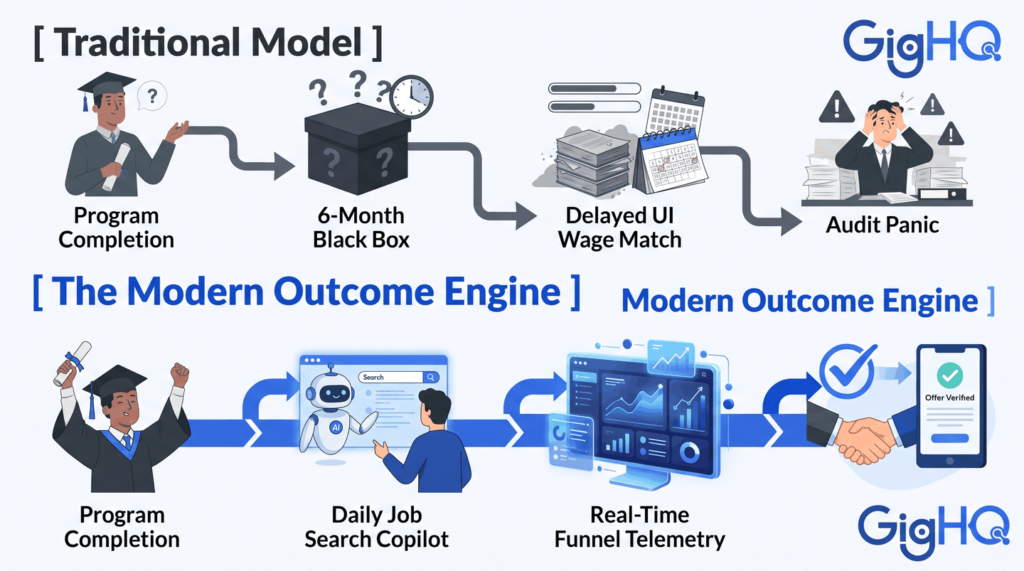
What if career counselors and program directors had real-time visibility into the job search funnel while students were actively looking?
This is where GigHQ.ai changes the dynamic:
- Intent & Activity Tracking: By giving job seekers a dedicated
@gighq.aiemail address and personal job search dashboard, every application, confirmation, rejection, and interview request is automatically logged without manual spreadsheet upkeep. - Leading Indicator Alerts: If 60% of an IT cohort has submitted over 40 applications with a 0% interview conversion rate, counselors receive an automated alert within weeks—allowing them to intervene and refine application materials before the cohort becomes a negative WIOA Q2 placement statistic.
- Detection of “Ghost Jobs”: With over 70% of online listings remaining inactive or purely informational, GigHQ’s Job Market Radar surfaces crowd-sourced Community Signals, steering students away from dead-end postings toward responsive employers.
4. Empowering the Student Persona: From Learner to Placed Candidate
In the video demonstration of the Accreditation Information Hub, the most critical persona is Jordan—the student who wants to know: “What kind of work will I be doing in two years, and what will it pay?”
Institutions map Jordan’s prior learning into stackable credentials. But when Jordan sits down to actually apply for work, she faces a competitive, noisy market dominated by mass AI auto-apply bots.
Jordan doesn’t need generic job boards; she needs an intelligent job search copilot that works alongside her daily workflow:
- Instant Fit & Gap Analysis: Using ResumeRank, Jordan can measure how her newly earned credentials stack up against specific employer job descriptions, identifying key missing keywords before submitting.
- Context-Driven Application Materials: With CoverGenius, she generates tailored, job-specific cover letters grounded in her documented projects and certifications.
- Simulated Interview Mastery: Tools like SmartPrep conduct interactive mock interviews tailored to the specific role and company, analyzing her responses using STAR and CAR storytelling frameworks.
- Seamless Workflow Integration: Whether browsing openings on LinkedIn, Indeed, or Handshake, the GigHQ Chrome Extension surfaces company hiring activity, identifies key contacts for networking, and logs the application with one click.
- AI-Native Assistants: For modern learners who work inside next-generation interfaces, the GigHQ MCP Server allows conversational management of the job hunt directly inside ChatGPT and Claude.
Watch how modern job seekers use real-time tools to navigate today’s hiring landscape:
- GigHQ Platform Overview & Demo
- Streamlining the Application Funnel
- Real-Time Matching vs. Traditional Boards
- AI-Powered Career Navigation in Action
- Demystifying Job Market Data for Job Seekers
5. The Dual Win: Student Empowerment Meets Institutional Compliance
When job seekers use tools that genuinely simplify their daily routine, compliance data is generated naturally as a byproduct of active engagement.
| Institutional Mandate | The Old Approach | The Modern GigHQ Solution |
| WIOA Q2 & Q4 Outcomes | Chasing alumni via cold phone calls and emails months after graduation. | Automated capture of application progression and timestamped digital offer letters. |
| Pell & Gainful Employment ROI | Waiting for delayed IRS/SSA wage link records. | Real-time visibility into wage offers, starting roles, and company hiring trends. |
| Curriculum & Market Alignment | Periodic faculty committees reviewing multi-year BLS forecasts. | Live labor market intelligence tracking which specific skills convert to interviews. |
| Counselor Productivity | Spending hours manually populating CRM tracking spreadsheets. | High-touch advisory supported by automated alerts for at-risk job seekers. |
By categorizing AI career copilots as programmatic career services (rather than overhead), institutions can directly utilize WIOA Title I and institutional support funding to equip students with enterprise-grade job search tools.
Conclusion: Building an End-to-End Workforce Engine
As national partnerships like The Workforce Trust unite accreditors around shared infrastructure, the front end of workforce development is becoming agile, modular, and data-driven.
To complete the journey, our placement and outcome systems must match that same standard of agility.
Bridging the gap between training and employment requires connecting upstream curriculum design to downstream job search execution. When institutions equip their learners with actionable intelligence, they do not just satisfy compliance audits—they fulfill their foundational promise to students: a clear, verifiable pathway to economic mobility.
Ready to Modernize Your Career Services and Placement Tracking?
- For Workforce Boards & Higher Ed: Discover how GigHQ.ai for Workforce Development Organizations turns chaotic job hunting into an auditable, real-time outcomes engine. Read our deep dive on shifting the AI narrative in career services.
- For Job Seekers: Take the stress out of your search. Install the free GigHQ Chrome Extension and experience the GigHQ Platform today.
- Explore More Insights: Visit our GigHQ Blog Hub and learn more about our mission.