High Tech, High Touch: Scaling Career Services Without Losing the Human
At a recent NACE session for online career services professionals, one observation stood out. When the facilitators asked the room what they were seeing, the response was that students are longing for one-on-one connection. They want someone who individualizes and customizes attention for them. And they may be tired of being directed to tools as a way to scale services.

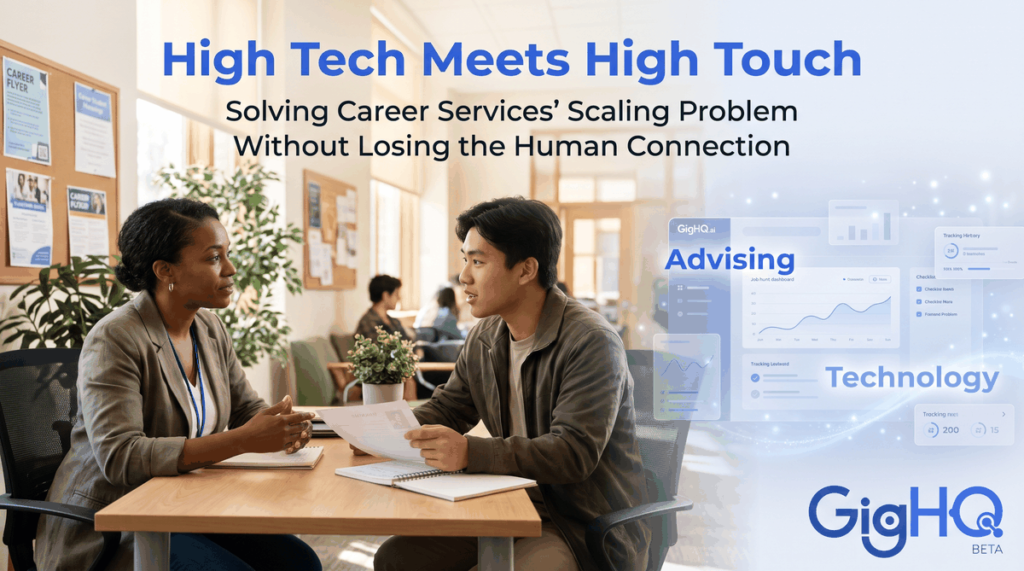
Career services has a scaling problem. Student populations are large, advising teams are small, and technology promises to close the gap. So we point students to tools: résumé checkers, interview simulators, AI career explorers.
But at a recent NACE session for online career services professionals, one observation stood out. When the facilitators asked the room what they were seeing, the response was that students are longing for one-on-one connection. They want someone who individualizes and customizes attention for them. And they may be tired of being directed to tools as a way to scale services.
That doesn’t mean technology has no place. As we’ve discussed when talking about shifting the AI narrative in career services, it means the goal isn’t choosing between high tech and high touch. It’s combining them deliberately, so each does what it’s best at.
The Pull Between Technology and Advising
Career services professionals are being asked to do several things at once. The session described the pressure to use AI tools, teach them to students, and respond to employer and institutional expectations that graduates be AI-fluent, all while keeping up with existing advising and programming.
The facilitators named this as a balancing act between technology initiatives and the one-on-one, small-group, and classroom work that advisors do. When the balance tips toward the tools, two things can happen.
- Advisors burn out. Learning and teaching new platforms becomes a second job. The session called this AI fatigue. Furthermore, advisors are often operating in a “black box,” lacking the real-time granular data—like application volume or interview conversion rates—needed to actually help students course-correct.
- Students feel processed. Being redirected to a tool, again, can feel like being handed off rather than helped.
The question for any team is how to use technology to support advising without letting it stand in for advising.
What a 30-Second Answer Leaves Out
One presenter described students who ask an AI tool to list every career a master’s degree could lead to, with networking and positioning advice for each. The answer arrives in 30 seconds. It may not be accurate, and it doesn’t account for the student’s feelings, values, or life priorities.
Career advising depends on context, judgment, and relationships with both students and employers. Three examples from the session show where that matters:
- Reading the room. A student ran their recorded interview through AI for feedback, then came to their advisor to talk through the moments when the interviewers glanced at each other. Interpreting that took empathy and a conversation.
- Practice with a person. Students who had an AI review their résumé still came in for a mock interview.
- Community. One advisor runs a weekly virtual meetup for students and alumni, including people who’ve already landed jobs and keep coming for the community. Their shared history lets conversations go deeper, because the advisor knows each person’s pain points.
AI can support all of this. It can’t replace the relationship underneath.
A Practical Division of Labor
A workable approach is to hand tools the work that’s repetitive or logistical, and keep people on the work that depends on trust and judgment. Here is one way to draw the line using GigHQ.ai. Adjust it for your team.
| Good Candidates for GigHQ.ai Tools | Best Kept Human (Advisors) |
| Tracking applications and follow-ups: Our automated email layer handles the messy logistics. | Exploring a student’s values and priorities: Discussing why a student wants a specific role. |
| Surfacing options to consider: Using our Job Market Radar and Chrome Extension to identify real hiring trends and avoid “ghost jobs.” | Weighing options against life circumstances: Helping students choose paths that fit their reality. |
| First drafts and grammar cleanup: Leveraging AI tools right where students work via our MCP Server for ChatGPT and Claude. | Deciding what story a résumé should tell: Crafting the overarching personal narrative. |
| Organizing information in one place: The GigHQ dashboard acts as a central command center for the job hunt. | Encouragement, accountability, and community: Providing the emotional support required during a grueling search. |
The left column is where a tool earns its keep by giving advisors time back. The right column is where an advisor’s time is best spent. If a tool pushes work from the left column into the right one, or the reverse, it’s worth asking why.
Habits That Keep the Work Human
The session’s discussion surfaced several practices teams can adopt right away:
- Anchor students in their values. One advisor runs a recurring virtual session for students and alumni on remaining human amid technology. Her foundation was a question: what are you anchored in? Students who know who they are and what matters to them can use AI intentionally, explain what they produced, and keep their own voice in it.
- Treat AI as an aid. An attendee suggested using it as a supplement where it helps, such as drafting routine messages, while staying deliberate about areas where you want to build your own skills.
- Protect critical thinking. Participants noted that over-reliance can erode problem-solving we could do ourselves if we stretched a bit.
- Be honest with students about the tradeoffs. Chat participants raised privacy, surveillance, and environmental concerns. Helping students use AI thoughtfully includes acknowledging those concerns and not only the benefits.
The Test for Every Tool
Since AI isn’t going away, the useful question is not whether to use technology but how. Here’s a single test to apply to any tool your team adopts: does it free up time for the conversations only people can have?
If advisors spend less time on logistics and more time coaching, the tool is helping. If they spend more time managing systems, or students feel redirected instead of supported, it isn’t, however capable it is.
That’s the standard we hold ourselves to at GigHQ. We build career management software that acts as a vital “Data Layer” for institutions and a copilot for students. Our job is to capture the “exhaust data” of the job search—applications sent, interview conversion rates, and friction points—so your team can move from a lagging stance of reporting failure to a leading stance of data-driven intervention.
We handle the tracking and organizing so you have more room for the human parts of a career search. If you’d like to compare notes on how that could work for your team, we’d be glad to talk.