AI Tools & Preparation
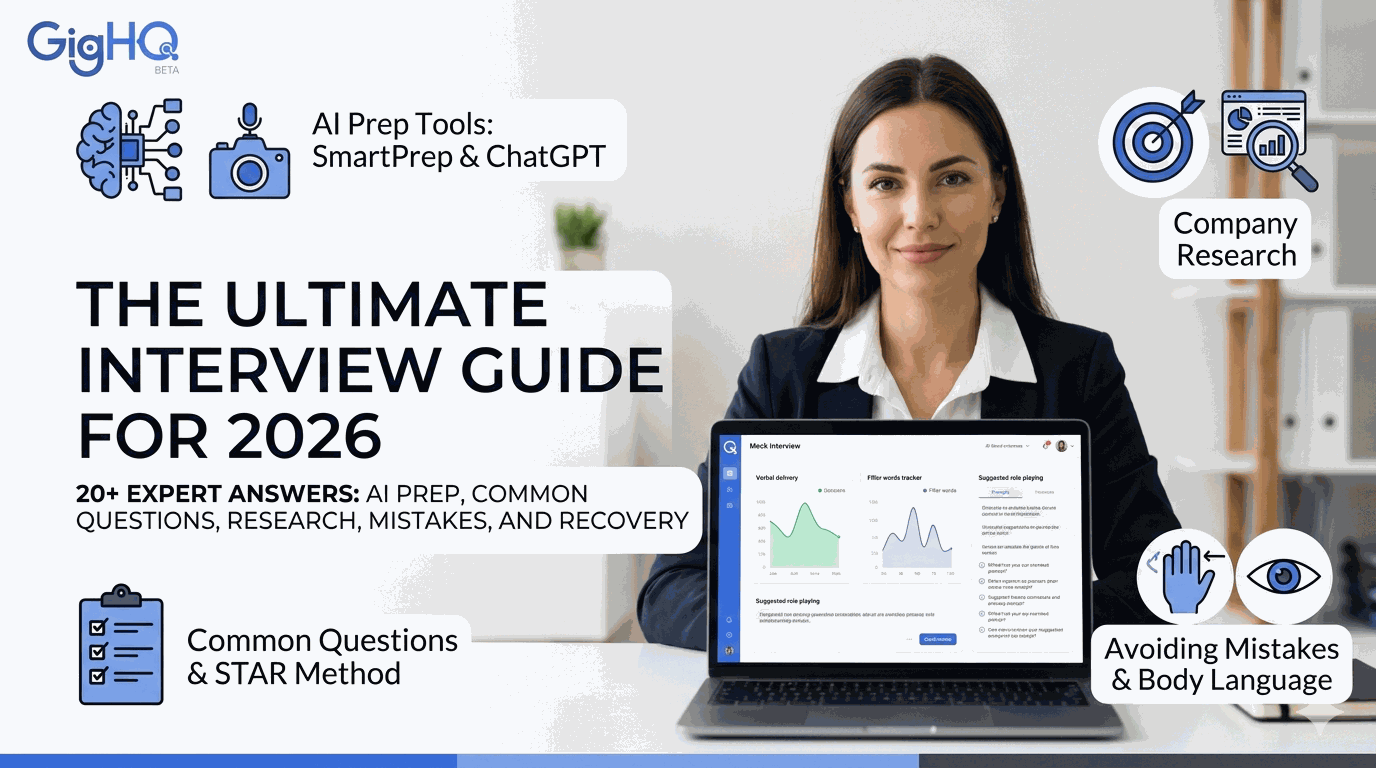
The top AI tools for 2025 include SmartPrep (personalized mock interviews based on your resume), ChatGPT with custom prompts for role-play practice, NotebookLM for resume-based question generation, Perplexity for company research, Google’s Interview Warmup for verbal delivery feedback, and Pramp for peer mock interviews. SmartPrep offers the most targeted preparation by generating questions specific to your background and target role. Learn more about AI interview prep tools.
SmartPrep is an AI-powered mock interview platform that generates personalized questions based on your specific resume and the job description you’re targeting. It simulates realistic interview scenarios, provides immediate feedback on your responses, and tracks your progress across multiple practice sessions. Unlike generic practice tools, SmartPrep’s questions are laser-focused on your actual background and the specific role requirements.
Use both strategically. AI tools like SmartPrep and ChatGPT excel at unlimited practice, immediate feedback, and covering broad question sets. Human mock interviews (via Pramp or mentors) add realistic conversational flow, tone feedback, and the pressure of real-time interaction. Start with AI for volume and skill-building, then graduate to human practice for final polish.
Follow this 4-step practice routine:
(1) Use SmartPrep or similar tools to generate role-specific questions
(2) Record yourself answering to identify filler words and pacing issues
(3) Structure answers using STAR framework (60-90 seconds each)
(4) Get feedback from peers or AI on clarity and impact. Practice 3-5 questions daily rather than cramming before interviews.
Create targeted system prompts like “You are a hiring manager at a B2B SaaS company. Ask me behavioral questions about teamwork and leadership, then critique my answers on clarity, quantifiable results, and storytelling.” After each answer, ask ChatGPT to rate your response and suggest improvements. Iterate multiple times to refine your answers before the actual interview.
Common Interview Questions
The 10 questions you’ll almost always face include:
“Tell me about yourself”
“Walk me through your resume”
“Why do you want to work here?”
“What’s your greatest weakness?”
“Describe a challenge you overcame”
“Where do you see yourself in 5 years?”
“Why are you leaving your current role?”
“Tell me about a conflict with a coworker”
“What are your salary expectations?”
“Do you have any questions for us?”
Master these first.
Use a 60-90 second narrative structured as: brief background (education/early career), relevant experience highlights (2-3 key achievements), why you’re excited about this role (connection to company/position).
Avoid personal details or rambling chronology. Example: “I’m a product manager with 5 years in B2B SaaS. At Company X, I led a feature that increased retention 25%. I’m drawn to your role because of your focus on AI-powered solutions, which aligns with my passion for emerging tech.”
STAR stands for Situation (context), Task (your responsibility), Action (specific steps you took), Result (quantifiable outcome). This framework helps structure behavioral answers concisely.
Example:
Situation: “Our onboarding had 40% drop-off.”
Task: “I was asked to improve completion.”
Action: “I interviewed 20 users, redesigned the flow, and A/B tested changes.”
Result: “Drop-off decreased to 15% within 2 months.”
Choose a real but non-critical weakness, explain what you learned, and demonstrate growth. Avoid clichés like “I’m a perfectionist.”
Good formula: acknowledge the weakness + show self-awareness + describe improvement actions.
Example: “I used to struggle with delegating because I wanted to control quality. I’ve learned to trust my team by setting clear expectations upfront and doing spot-checks rather than micromanaging. This freed up 30% of my time for strategic work.”
Ask strategic questions that demonstrate research and critical thinking.
Strong examples:
“In last quarter’s earnings, the CEO emphasized profitability—how does that affect product roadmap prioritization?”
“What does success look like in the first 90 days?”
“What’s the biggest challenge the team is facing right now?”
“How do you measure performance for this role?”
Avoid asking about basic info available on the website or leading with salary questions.
Company Research
Research like a product manager using this 5-step process:
(1) Understand business objectives through investor relations sites and SEC filings
(2) Map the product portfolio by reviewing feature releases and user reviews
(3) Decode the competitive landscape using comparison sites and reviews
(4) Identify key stakeholders on LinkedIn, especially product leadership
(5) Dive into customer insights through forums, reviews, and case studies. Read our complete company research guide.
For public companies, focus on the CEO’s letter in annual reports highlighting strategic priorities, quarterly earnings calls revealing growth areas, and 10-K/10-Q filings showing market focus. For startups, check Crunchbase for funding rounds and valuations. Look for phrases like “fastest growth came from enterprise” or “expanding internationally”—these signal where they’re investing and what experience they value.
Search the company’s LinkedIn page filtered by relevant titles (hiring manager, team lead, department head). Note their career trajectories—corporate backgrounds may value process, startup experience may prize agility. Look for any public content they’ve produced (articles, talks, podcasts) and reference these insights in your questions: “I saw your Medium post about experimentation frameworks—how does your team balance rigor with speed?”
Interview Mistakes & Body Language
Subtle mistakes that cost jobs include: using excessive filler words (um, like, you know), rambling without structure, poor body language even on Zoom, overemphasizing “I” without acknowledging team collaboration, jumping into answers without clarifying the question, asking about salary too early, dressing inappropriately for company culture, failing to research interviewers, asking generic questions, and letting energy drop at the end.
Position your camera at eye level, sit up straight with shoulders back, and lean slightly forward to signal engagement. Maintain “camera contact” by looking at the lens rather than the screen when speaking. Check your lighting so your face is clearly visible. Practice natural nodding and smiling to show you’re actively listening. Test your setup beforehand and eliminate background distractions.
Replace filler words with intentional pauses. When you feel “um” coming, take a breath instead. Use brief prompts like “Great question” or “Let me think about that” to buy thinking time without fillers. Record yourself practicing answers to identify your filler patterns. Tools like SmartPrep and Google’s Interview Warmup provide real-time feedback on filler frequency. With 3-5 practice sessions, most people reduce fillers by 60-70%.
Aim for 60-90 seconds per answer for most behavioral questions. Set context in 10-15 seconds, focus on your actions for 30-40 seconds, and close with results in 15-20 seconds. Practice with a timer. Answers under 30 seconds seem superficial; over 2 minutes risk losing the interviewer’s attention. Technical answers may run longer if demonstrating problem-solving, but always check if they want more detail.
Post-Interview Recovery
Follow a 5-step reset process:
(1) Acknowledge and name your feelings rather than suppressing them
(2) Conduct a quick “after-action review” within 24 hours noting wins and improvement areas
(3) Do a 10-15 minute physical reset (walk, exercise, creative activity)
(4) Reconnect with your support network for perspective
(5) Refocus on long-term goals by updating your tracker and planning next moves.
Transform disappointment into actionable insight. Read our complete guide to decompressing after interviews.
Yes, send a concise thank-you within 24 hours. Keep it to 3-4 sentences: express appreciation for their time, reference one specific conversation point that excited you, reaffirm your interest, and offer to provide additional information. Avoid generic templates.
Example: “Thank you for discussing the analytics migration project—the experimentation framework you described aligns perfectly with my approach at Company X. I’m excited about the opportunity to contribute to your roadmap.”
Space practice sessions to avoid fatigue: 3-5 mock questions daily rather than marathon sessions. Use SmartPrep for 10-minute focused practice sessions targeting specific question types. Alternate between solo practice (AI tools, recording yourself) and social practice (peer mock interviews, Discord community feedback). Take full days off from prep when you’re actively interviewing to maintain mental freshness.
Our Platform Tools:

ResumeRank
Scan your resume, get a score, fix what matters.

CoverGenius
Generate personalized, AI-powered cover letters in seconds.

OutreachAgent
Craft perfect networking and AI-powered follow-up emails with ease.

CareerCompass
Instantly generate a personal marketing plan from your resume to define your brand and attract the right opportunities.

Smart Prep
Simulates a real interview based on your resume and the job description, giving you real-time feedback to build your confidence.

Profile Spark
Optimize your LinkedIn profile to attract recruiters and opportunities.