We recently published Handshake vs 12Twenty Is the Wrong Debate for Career Outcomes. Our core argument was straightforward: campus Career Management Systems (CSMs) were built to broadcast openings, manage on-campus interview schedules, and compile destination surveys after commencement. They were never architected to tell an advisor what happens immediately after a student clicks Apply.
A June 2026 essay in Work Shift by Kyle Albert, Jeff Strohl, Paul Daniels, and Peter Norlander—“Job Postings Aren’t Jobs”—exposes an even deeper structural flaw:
The “jobs” our campus boards and real-time dashboards count are often just recruitment artifacts.
When university career centers, workforce boards, and policy dashboards treat online job postings as an exact census of labor demand, they build institutional strategy on top of marketing noise.
Here is why that artifact distorts career services—and why advising teams must look past posting counts to the operational reality of the post-apply pipeline.
1. Ads Are a Recruitment Artifact, Not a Vacancy Census
Over the past decade, aggregated online job postings have become the de facto currency of real-time Labor Market Information (LMI). Edtech platforms sell posting feeds as pinpoint, localized demand.
As Albert, Strohl, Daniels, and Norlander point out, however, a posting is simply an ad drafted by a human resources department or recruiting agency to solicit candidates. It is not designed to produce audited economic datasets.
The Missing & Bloated Data Problem
Because postings are advertisements, their structured data is notoriously unreliable:
- Missing educational baselines: Research from Georgetown University’s Center on Education and the Workforce (CEW) shows that only about 40% of online job postings explicitly state an education level.
- Omitted compensation: As economists Steven J. Davis and Brenda Samaniego de la Parra documented in their comprehensive study of online vacancies (Application Flows, NBER Working Paper 32320), a striking 83% of technical postings state no offer wage or wage range at all.
- Unstructured text bloat: Skill requirements are frequently copy-pasted boilerplate, hidden inside freeform text blocks that overstate the daily competencies required for entry-level work.
Ghost Postings and Zero-Vacancy Hiring
The disconnect goes beyond messy formatting. In many instances, a live ad does not correspond to an open desk:
- Résumé Harvesting & Phantom Postings: Employers routinely run perpetual ads to build pipeline benches, gauge applicant pool quality, or comply with procedural posting rules when internal candidates have already been chosen.
- Zero-Vacancy Hires: The reverse is equally true—huge swaths of hiring never touch a job board. Drawing on JOLTS data, Steven Davis and colleagues demonstrated that establishments reporting zero vacancies at the end of a given month still account for more than 40% of total hires the following month.
Perhaps the most damning point highlighted in Work Shift is this: there is virtually no public empirical analysis validating whether online job postings actually result in successful hires.
Yet higher education continues to treat these feeds as gospel.
Harvard’s Project on Workforce and Education Design Lab addressed this directly in their August 2026 playbook, The Agile Community College: Dynamic Labor Market Alignment in an AI-Driven Economy. While identifying career navigation and dynamic alignment as imperative institutional decisions, the playbook acknowledges the documented noise in real-time LMI: phantom postings, lagging signals, and volatile job descriptions. Postings are helpful for spotting macro-occupational shifts. They are not a census of bona fide job vacancies, and they offer zero proof of an eventual hire.
2. Why That Matters on Campus: CSMs Still Start From the Posting
When campus leaders debate whether to switch between Handshake, 12Twenty, or Symplicity, they are arguing over distribution models:
- Handshake-style platforms optimize two-sided marketplace liquidity—one central employer profile broadcasting to hundreds of campuses to drive listing volume.
- 12Twenty-style platforms optimize institutional administrative workflow—bespoke campus permissions, OCI scheduling, and standardized destination reporting.
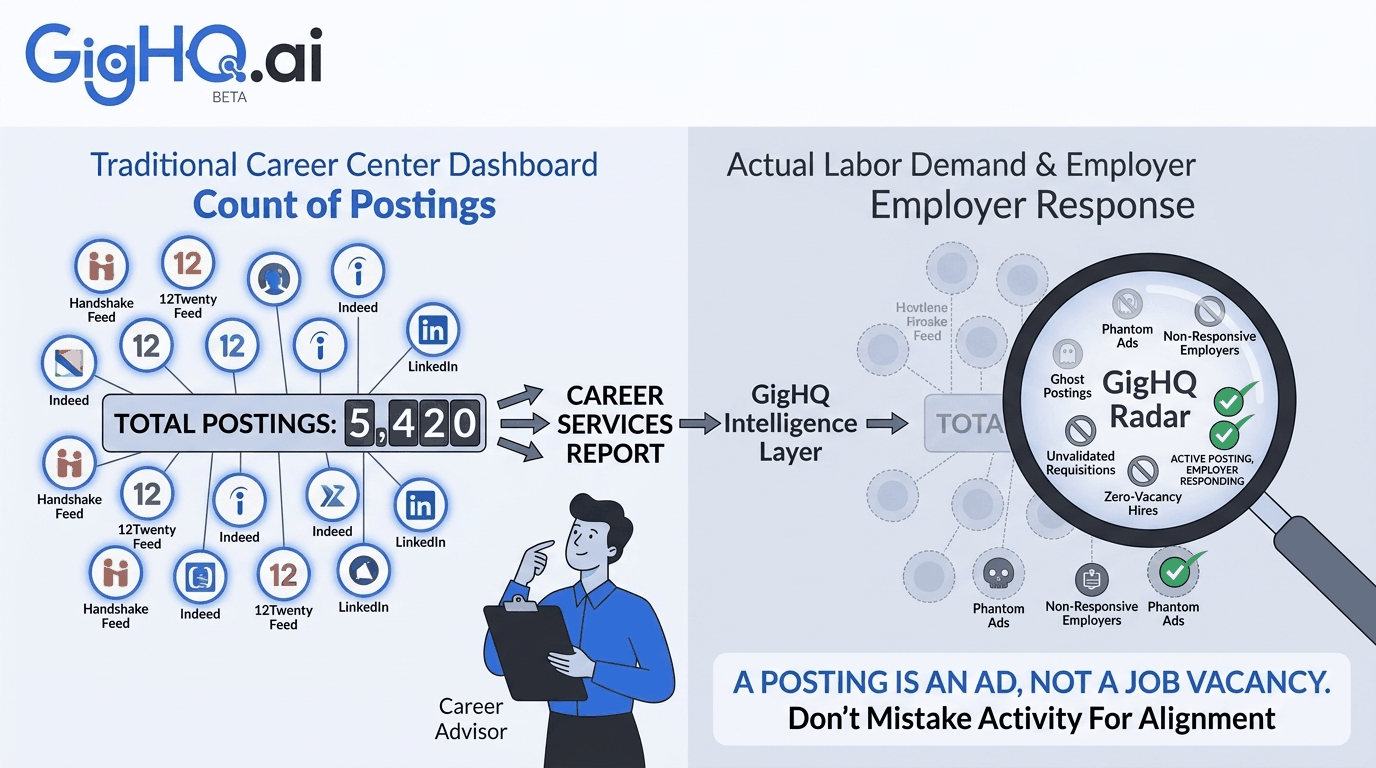
Neither platform, however, tracks whether a posting represents an active, responsive employer. Both start from the posting.
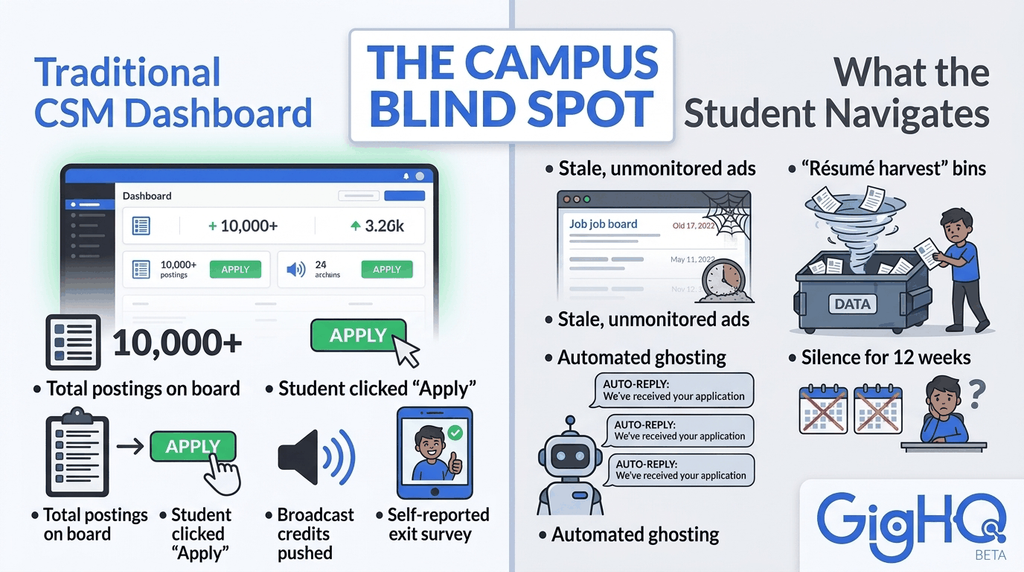
This explains why an advisor’s reporting dashboard can look extraordinarily busy while their students are drowning in silence.
A student can submit 60 applications across institutional boards and commercial aggregators. The CSM records that the student was active and clicked outbound links. What the advisor cannot see is whether any human on the employer side reviewed the file, whether the role was closed weeks ago without being delisted, or whether the requisition was an unbudgeted phantom ad.
Employer marketing spend explains that noise. Promoted job slots and broadcast recruiting credits purchase eyeballs; they do not indicate a verified hiring mandate.
If our incoming operational feed treats ads as genuine demand, increasing the volume of postings on a campus portal is not a placement strategy. It is just a louder funnel.
3. What We Still Don’t Have: Whether the Ad Became a Hire
Higher education’s outcome reporting infrastructure sits at two lagging extremes:
- NACE First Destination Surveys (FDS): Relies on voluntary student self-reporting around graduation and six months out. Response rates are vulnerable to self-selection bias, and six-month-lagged survey data cannot help a senior struggling this Tuesday.
- State Unemployment Insurance (UI) Wage Records: Objective, authoritative, and audit-proof, but lagged by two to four quarters. UI data also suffers from geographic blindness when ambitious students move across state lines or work in non-traditional roles.
Neither tool provides in-semester coaching utility.
The authors of Work Shift rightly challenged labor economists and public workforce agencies to demand transparency, publish error rates, and validate job postings against actual payroll hires. That is the correct agenda for academic and federal research.
Career advisors, however, cannot wait for statistical agencies to overhaul the national LMI stack. Your students are interviewing next week. You need a leading operational indicator that bridges the gap between “the company posted a requisition” and “the graduate shows up on a tax roll nine months later.”
The critical question for student success is not: “How many jobs are on our job board?”
It is: “After this student submitted their application, did an employer respond?”
4. What GigHQ Can—and Cannot—Claim
To build trust across higher education, we must be completely candid about what our technology does and what it does not do.
What GigHQ Cannot Claim
- We are not an official academic hire-validation study. GigHQ does not claim to replace JOLTS, state UI wage matching, or BLS economic censuses.
- We do not replace your campus CSM. GigHQ does not seek to rip out Handshake or 12Twenty. We do not host campus career fairs or manage institutional on-campus interview rooms.
- We do not scrape personal inboxes. GigHQ does not ask students for Gmail OAuth tokens or run inbox scrapers.
- We do not claim our Radar reflects aggregate national hiring volume. The GigHQ Job Market Radar is not a substitute for the monthly national BLS release.
What GigHQ Does Deliver
GigHQ is a free, seeker-first workflow copilot paired with a real-time advisor lens on the post-apply pipeline.
- A Clean Seeker Workflow: Candidates manage their job hunt using their assigned @gighq.ai email address (or their existing email), keeping application trails organized in one hub. Our lightweight browser extensions on Chrome, Firefox, and Microsoft Edge automatically log applications across LinkedIn, Indeed, Handshake, and employer applicant tracking systems (Greenhouse, Workday, Lever).
- The Post-Apply Trail: As employers send application acknowledgments, screening requests, interview invites, or rejections, GigHQ captures the timeline of engagement without manual spreadsheet tracking.
- The Community Signal: By aggregating anonymized post-apply activity across job seekers, GigHQ maps which employers are actively engaging applicants:
- Trustworthy: Indicates that aggregated community data shows active, consistent employer response and interviewing progression.
- Unknown: Indicates there is currently insufficient post-apply data to establish a verified response pattern.
- Suspicious: Highlights listings or employers displaying widespread non-responsiveness, ghost-posting patterns, or potential recruitment scams.
- Actionable Coaching Visibility: Career advisors can view cohort-level conversion funnels. If 40 business graduates are applying heavily but converting zero interviews, an advisor knows to review their resumes immediately—intervening during the semester rather than lamenting poor placement stats a year after graduation.
5. Keep the CSM. Stop Treating Posting Volume as Placement.
Higher education does not need another contentious software procurement battle. Career centers should keep Handshake or 12Twenty for what they do well: employer directory management, campus event registrations, and initial job discovery.
What institutions must discard is the assumption that job posting totals equal real market demand.
As the authors of Work Shift demonstrated, job postings are recruitment advertisements, not vacancies. If we judge our institutional career programs by how many links our students can click, we are setting them up to apply into an echo chamber.
Keep your CSM for top-of-funnel discovery. But give your students and advisors the intelligence layer required to navigate what happens after they apply.
Explore More & See How It Works
- The Architecture Argument: Read our companion piece, Handshake vs 12Twenty Is the Wrong Debate for Career Outcomes.
- Product Walkthroughs: Watch our Platform Overview and see how our Extension Integrates Directly into the Search.
- Live Radar: Explore our public directory of companies and employer engagement at GigHQ Job Market Radar.
- Learn More: Discover our mission at GigHQ About Us.
Sources & Reference Material
- Albert, Kyle, Jeff Strohl, Paul Daniels, and Peter Norlander. “Job Postings Aren’t Jobs,” Work Shift, June 17, 2026.
- Davis, Steven J., and Brenda Samaniego de la Parra. “Application Flows.” National Bureau of Economic Research (NBER), Working Paper No. 32320, April 2024.
- Davis, Steven J., R. Jason Faberman, and John C. Haltiwanger. “The Establishment-Level Behavior of Vacancies and Hiring.” Quarterly Journal of Economics, Vol. 128, No. 2, 2013, pp. 581–622.
- Fuller, Joseph B., Kerry McKittrick, Amanda Holloway, Nathania Silalahi, Chris Mullin, and Mikhaila Sung. “The Agile Community College: Dynamic Labor Market Alignment in an AI-Driven Economy,” Project on Workforce at Harvard & Education Design Lab, August 2026.
- Georgetown University Center on Education and the Workforce (CEW). Research discussions and educational attainment metrics in online job ads, as cited in Work Shift.
- Project on Workforce at Harvard. “Community Colleges Advancing Economic Mobility” Volume and “Data and Technology in Action” Project Series.
Our Platform Tools:

ResumeRank
Scan your resume, get a score, fix what matters.

CoverGenius
Generate personalized, AI-powered cover letters in seconds.

OutreachAgent
Craft perfect networking and AI-powered follow-up emails with ease.

CareerCompass
Instantly generate a personal marketing plan from your resume to define your brand and attract the right opportunities.

Smart Prep
Simulates a real interview based on your resume and the job description, giving you real-time feedback to build your confidence.

Profile Spark
Optimize your LinkedIn profile to attract recruiters and opportunities.