Every spring and fall, career services leaders, workforce directors, and academic deans find themselves re-evaluating their core technology stack. In the campus career management system (CSM) landscape, the evaluation almost inevitably gets framed as a binary showdown: Handshake versus 12Twenty.
Teams debate the merits of open marketplace liquidity against institution-first data sovereignty. They weigh multi-school employer reach against granular outcome reporting for specialized programs.
While that vendor choice matters for institutional operations, framing it around student career outcomes misses the fundamental reality of the modern job search.
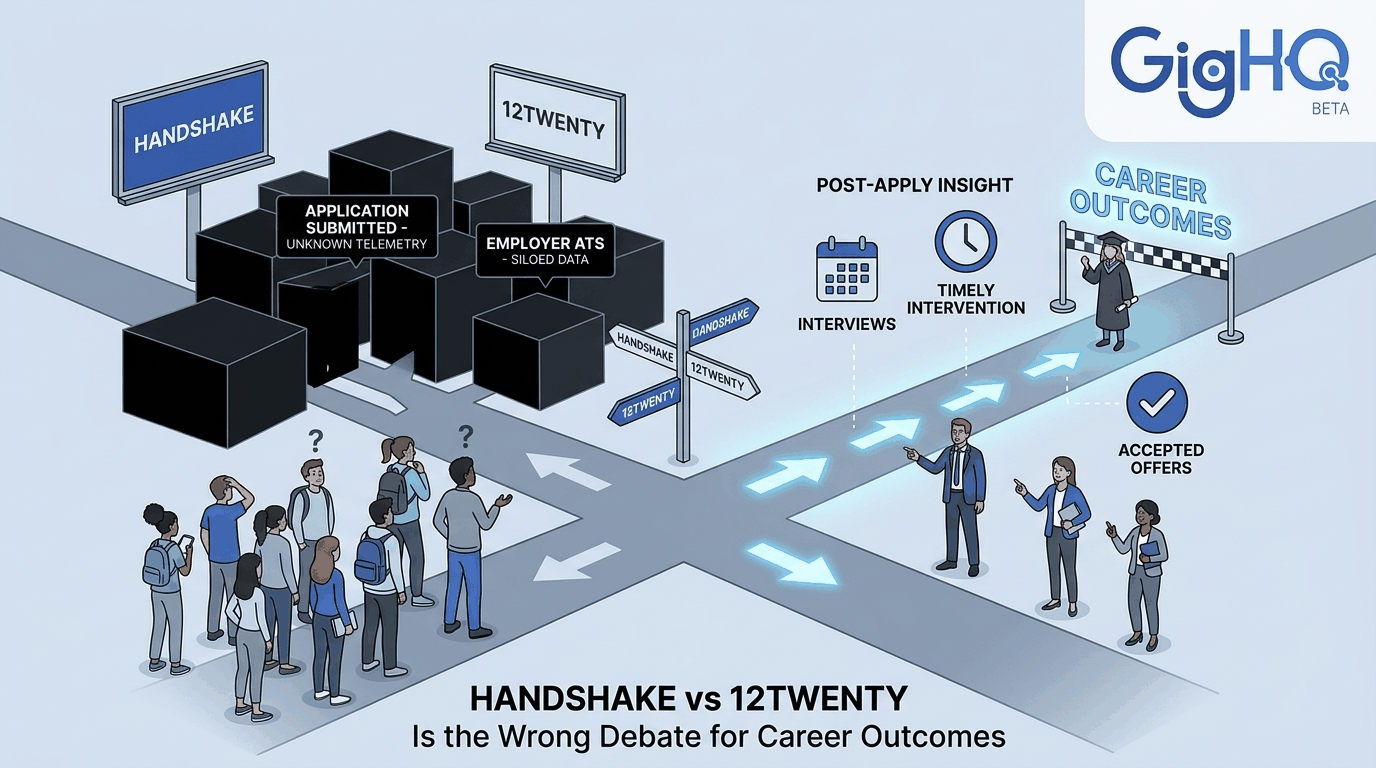
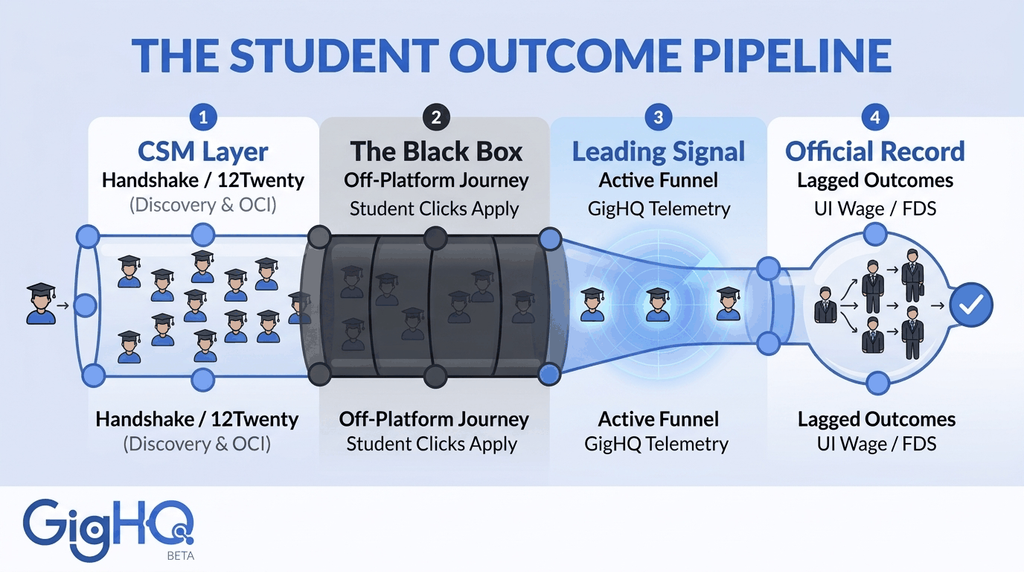
CSMs manage discovery, employer relations, on-campus interviewing (OCI), and administrative reporting. What happens after a student hits “Apply” remains largely invisible to advisors. Debating which platform generates better employment outcomes misses the mark because neither architecture was built to provide a live, post-apply telemetry trail.
1. Two Different Machines Under One “Campus Recruiting” Label
To understand the boundaries of the CSM debate, it helps to examine the architectural philosophy behind each system:
- Handshake (The Open Marketplace): Built as a centralized national talent network connecting over 1,400 higher education institutions with hundreds of thousands of employers. Its strength lies in liquidity: corporate recruiters create a single profile to broadcast opportunities across a massive talent pool, while students access a high-volume, unified discovery engine.
- 12Twenty (The Institution-First System of Record): Engineered around institutional data governance and customized “Career Cloud” portals. It has carved out a particularly strong footprint in graduate, business, and law school environments, where structured OCI scheduling, accreditation metrics, and auditable destination surveys are central workflows.
Both platforms serve vital functions. Handshake optimizes national employer reach and top-of-funnel student discovery; 12Twenty excels at structured on-campus workflows and institutional reporting.
However, choosing between an open marketplace and an institution-centric portal only answers how jobs get posted and how campus events get managed. It does not give advisors visibility into what happens after a student submits their resume.
2. What Employers Buy Explains Inbox Noise, Not Student Success
To evaluate why job boards cannot act as full outcome engines, look at the commercial models underpinning them.
On broad talent marketplaces, basic posting is often free or low-cost, while advanced sourcing tools, applicant tracking system (ATS) sync, and scaled direct messaging require enterprise recruitment packages. On curated institutional networks like 12Twenty, posting directly to an individual school portal is often free for local recruiters, whereas broadcasting listings across multi-school networks utilizes credit-based distributions or package tiers.
These employer-side mechanics serve a clear purpose: helping corporate talent acquisition teams source candidates at scale.
For the campus advisor, however, employer spend explains candidate volume and inbox noise—it does not explain student progress. Whether an employer pays for broadcast credits or sends inbound messages on an open network, that interaction only exists at the top of the funnel. Once the student leaves the portal to apply through the company’s enterprise ATS, the CSM’s trail goes cold.
3. Liquidity vs. Signal: The Real Advisor Dilemma
When career centers compare platforms, they often weigh liquidity against signal:
- Marketplace Liquidity: Broad distribution produces massive listing volume. The trade-off is noise: high application counts, automated messaging blasts, and listings that may no longer be actively monitored by hiring teams.
- Curated Signal: Direct school-by-school approvals and verified program alignment produce tighter institutional relevance, though across a smaller aggregate pool of postings.
Yet, neither model solves the central operational challenge facing high-ratio advisors: After my student hits Apply, did anyone engage?
When an advisor sits down with a student who has submitted 60 applications across both campus boards and public aggregators, the advisor cannot see:
- Which applications resulted in screening calls?
- Which listings were stale or unresponsive?
- Where in the interview loop the student is stalling?
Advisors are left trying to diagnose career readiness from retrospective student recollections rather than live pipeline activity.
4. Where Official Outcomes Still Sit (And Where They Lag)
Institutional accountability is tightening. Whether fulfilling the NACE First Destination Survey (FDS) standards, navigating state performance funding frameworks like Texas HB 8, or aligning with Workforce Innovation and Opportunity Act (WIOA) reporting, institutions are under pressure to demonstrate gainful employment.
However, official compliance measures are inherently retrospective:
- First Destination Surveys (FDS): Typically administered at graduation and 6 months post-exit, capturing self-reported data long after coaching interventions could have altered the outcome.
- State UI Wage Data: Unemployment Insurance wage matching offers objective earnings proof, but reports with a 2-to-4 quarter lag and struggles with graduates who cross state borders.
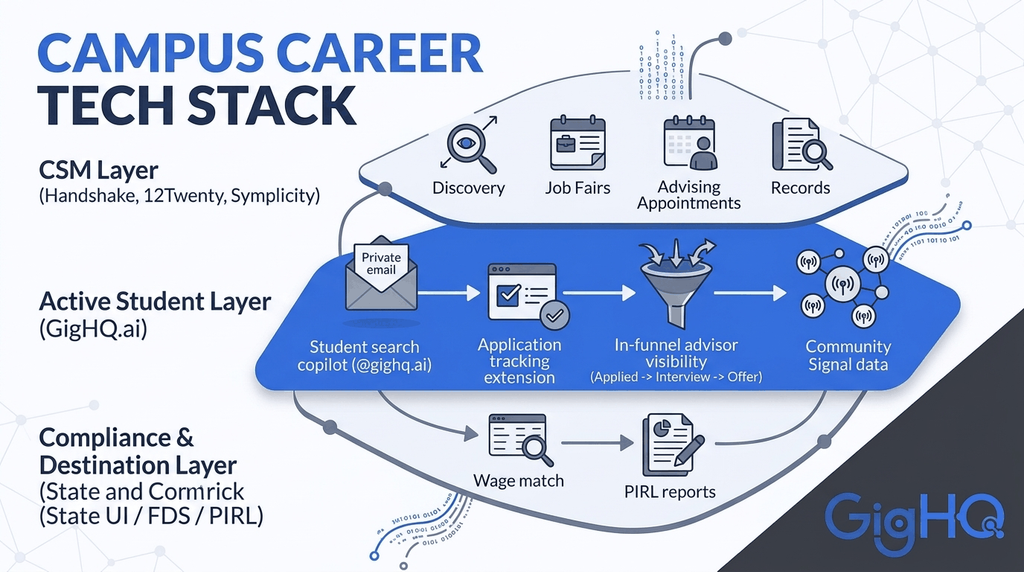
GigHQ does not replace official state wage matching, nor does it claim to prove statutory WIOA placement or NACE knowledge rates. Official outcomes remain the institutional system of record.
Instead, GigHQ provides the in-program operational trail leading up to those endpoints: tracking the live path from initial application to active interview to accepted offer.
Alongside this journey, aggregated and anonymized user activity powers Community Signal indicators—categorizing company and position responsiveness as Trustworthy, Unknown, or Suspicious—helping students avoid unresponsive listings and focus on active employers.
5. What GigHQ Is (and Is Not) in the Higher Ed Stack
As institutions evaluate their tooling, clarifying where software layers sit prevents unnecessary vendor churn.
What GigHQ Is:
- A Free Seeker Copilot: Students manage their search workflow, track application stages, organize interview prep, and log career reflections.
- Flexible Email Tracking: Users can apply via an assigned @gighq.ai routing address or track applications directly via browser extensions across Chrome, Firefox, and Edge.
- Advisor Telemetry: Advisors and workforce coaches gain real-time cohort visibility to identify who is struggling in the application-to-interview stage before graduation arrives.
- A Complementary Layer: Sits alongside your existing CSM without disrupting employer relations or campus scheduling.
What GigHQ Is Not:
- Not a CSM Rip-and-Replace: It does not replace your institutional employer contracts, event management, or campus interview scheduling.
- Not an Employer Job Board: Employers do not buy job posting slots; the data reflects real, student-initiated activity.
- Not an Inbox Scraper: It does not require third-party Gmail OAuth sync or access to personal email credentials.
- Not a Replacement for Federal Reporting: It does not replace statutory UI wage matching or formal NACE compliance workflows.
6. Keep Your CSM. Add Post-Apply Signal.
The debate between open marketplaces like Handshake and institution-first platforms like 12Twenty is an important discussion about campus workflows and employer access. But it is not a complete strategy for driving measurable student outcomes.
Your CSM connects students with opportunity. What happens after the application requires a dedicated, student-centric telemetry layer. By giving students the tools to manage their active pipeline and providing advisors with early leading indicators, career teams can shift from retrospective data collection to proactive, timely coaching.
- To explore real-time employer activity and hiring trends, browse the GigHQ Job Market Radar.
- Learn more about our methodology on the Radar Explainer.
- Discover how advisors leverage leading indicators by connecting with our team at GigHQ.ai.
Our Platform Tools:

ResumeRank
Scan your resume, get a score, fix what matters.

CoverGenius
Generate personalized, AI-powered cover letters in seconds.

OutreachAgent
Craft perfect networking and AI-powered follow-up emails with ease.

CareerCompass
Instantly generate a personal marketing plan from your resume to define your brand and attract the right opportunities.

Smart Prep
Simulates a real interview based on your resume and the job description, giving you real-time feedback to build your confidence.

Profile Spark
Optimize your LinkedIn profile to attract recruiters and opportunities.