Winning the Post-Interview Game: Tackling Tough Questions, Navigating the 48-Hour Window, and Ending the Ghosting Cycle
The interview does not end when the conversation wraps. In a hiring landscape dominated by compressed recruitment cycles, AI-driven screening filters, and rampant candidate ghosting, what you do in the 48 hours following your interview—and how effectively you navigated the trickiest conversation traps—can make or break your offer.

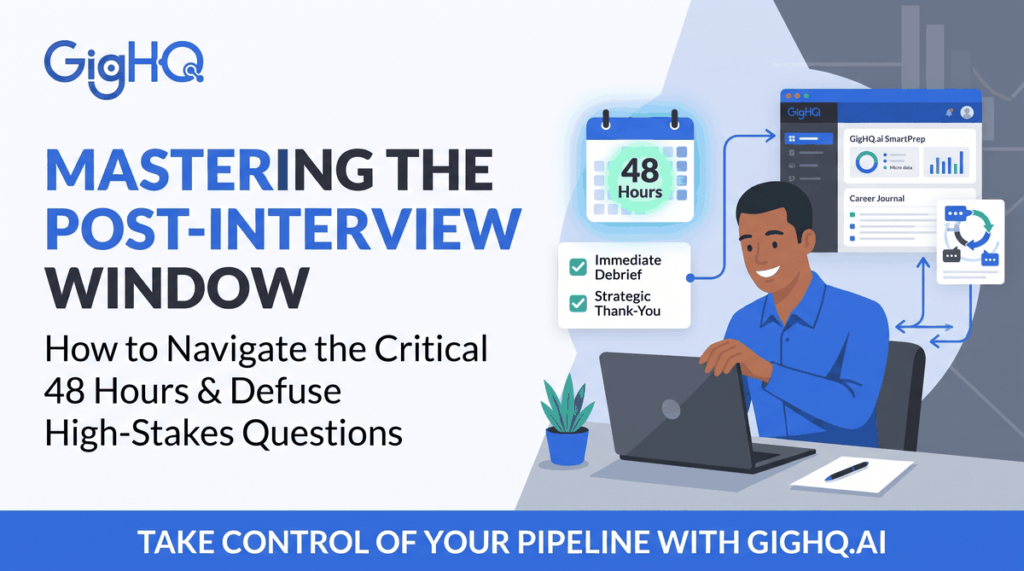
Walking out of an interview room—or clicking “Leave Meeting” on Zoom—brings an instant rush of adrenaline followed by a wave of relief.
Most candidates close their laptops, take a deep breath, and assume the heavy lifting is behind them. They wait.
That is the single biggest mistake in modern job hunting.
The interview does not end when the conversation wraps. In a hiring landscape dominated by compressed recruitment cycles, AI-driven screening filters, and rampant candidate ghosting, what you do in the 48 hours following your interview—and how effectively you navigated the trickiest conversation traps—can make or break your offer.
Drawing on practical frameworks from seasoned executive career coaches Tracy Angona and Mark Zoeller, cross-referenced with labor market data on the candidate lifecycle, here is how to master the critical post-interview window, conquer high-stakes interview questions, and use GigHQ.ai to take control of your career pipeline.
1. The Post-Interview Reality Check: Why 47% of Ghosting Happens Right Now
Before diving into follow-up etiquette, let’s confront an uncomfortable labor market reality. According to recent workforce studies, 47% of job seekers experience recruiter ghosting immediately following the initial recruiter conversation, and another 47% get ghosted right after the hiring manager interview.
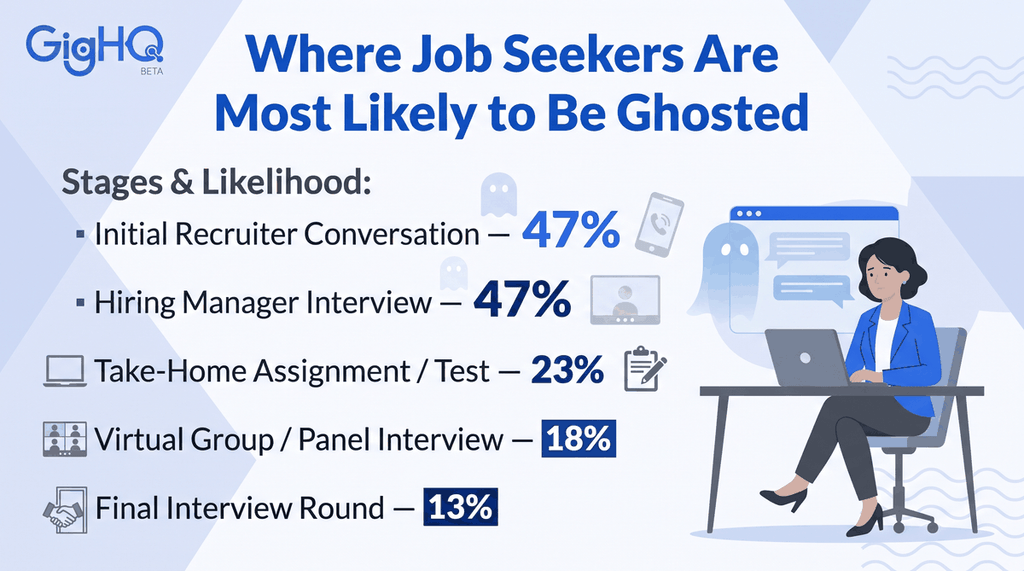
Why does this happen?
- Recruiter bandwidth collapse: Modern corporate lean-staffing models mean talent acquisition teams are buried under hundreds of incoming applications, frequently operating without the administrative capacity to follow up manually.
- Batch screening workflows: Research shows that while job postings may stay online for just 7 to 9 days, the subsequent “selection phase” (screening, multi-round interviews, internal deliberations) routinely stretches out to 40+ days.
- The “Silent Pipeline” trap: When companies stall, applications drift into hiring limbo.
If you don’t anchor your candidacy in their minds during the immediate 48-hour decision window, you become just another entry on an ATS spreadsheet.
2. Step One: The Immediate Debrief (Before You Send a Word)
Tracy Angona stresses that candidates shouldn’t immediately rush to type out a generic “Thank you for your time” email. Before you draft any follow-up, conduct an honest candidate debrief, ideally within 12–24 hours:
- Evaluate your mutual fit: Beyond whether they liked you, do you actually want this role? How did you feel about team dynamics, organizational friction, and leadership priorities?
- Senior stakeholder alignment: For senior or specialized roles, identify who else needs to be looped in. Did you uncover concerns regarding cross-functional friction, product direction, or financial stability?
- Capture the gaps: What did you omit? Did they raise a technical nuance or operational problem you wish you had answered more compellingly?
Pro-Tip with GigHQ: Don’t let your interview reflections evaporate. Open GigHQ.ai and drop raw reflections directly into your Job Application Timeline Notes. Log what the hiring manager emphasized, what metrics they care about, and where you felt friction.
3. The 48-Hour Thank-You Playbook: Moving Beyond the Canned Note
Should you always send a thank-you note? Tracy Angona’s answer is an unequivocal yes. In a live webinar poll, the clear consensus was that top-performing follow-ups hit three criteria: make it impactful, refer directly to specific interview discussions, and deliver it within 48 hours.
The Rules of Strategic Follow-Up:
- Be Hyper-Specific: Generic notes (“Thank you for telling me about Company X’s exciting mission…”) get archived and forgotten. Reference an explicit challenge the interviewer brought up:“I really appreciated our discussion regarding how your engineering team is balancing rapid microservice migrations with cloud cost governance. It got me thinking about…”
- Close the Knowledge Loop: If you forgot to mention an achievement, or if an interviewer voiced skepticism about your experience in a certain area, use the note to clarify—without apologizing or sounding defensive.
- The Power of the Handwritten Note: In an era where AI-generated email boilerplate is flooding recruiter inboxes, Angona notes that a handwritten note can create a human touchpoint that stands out. If that isn’t feasible due to remote setups, a well-crafted, authentic digital message sent to their direct address (or forwarded via the recruiter) achieves the same high-signal outcome.
- Provide Immediate Value: If a technical, strategic, or regulatory topic surfaced during the conversation, follow up with an insightful article, open-source repository, or case study. This shows you are already doing the job in your head.
4. Defusing the “Tripwire” Questions: Field Scripts from Executive Coaches
Certain interview questions consistently trip candidates up because they force a collision between transparency, diplomacy, and value demonstration. Here is how Mark Zoeller and Tracy Angona recommend handling them:
Question 1: “Why are you leaving your current employer?”
- The Coach’s Rule: Honesty is essential, but brevity and forward momentum win the day. Never use this question to vent about micromanagement, corporate politics, or executive chaos.
- The Script:“I’ve had a tremendous experience with my current team—I built deep relationships, took ownership of critical projects, and grew significantly. However, due to broader project realignment and budget consolidation across the division, opportunities for long-term growth in my core domain became constrained. I’m eager to bring what I’ve learned to an organization where I can dive headfirst into [Target Function / Growth Area].”
Question 2: “What are your salary expectations?”
- The Coach’s Rule: This moment is designed for expectation alignment, not final negotiation. Giving a rigid number too early can disqualify you or lock you in below market value.
- The Script (Tracy Angona):“I expect a compensation package that aligns with the current market rate for this role and reflects the technical leadership and quantifiable impact I bring to the table. Given the company’s reputation, I’m confident your bands are competitive. Could you share the approved range budgeted for this position?”
- The Direct Pivot (Mark Zoeller): If pushed directly for a number, remember that salary history bans protect candidates in many jurisdictions. Aim approximately 10–15% above your benchmark, state the figure with confidence, ask how that aligns with their planning, and stop talking. Let them respond. If their reaction is conservative, remain agile: “I’m flexible for the right long-term cultural and strategic fit.”
Question 3: “What is your greatest weakness?”
- The Coach’s Rule: Ditch cliché humblebrags like “I’m a perfectionist” or “I work too hard.” Hiring managers see through them instantly. Instead, reframe weakness as an active development roadmap.
- The Script:“I wouldn’t characterize it as a structural weakness so much as an area where I’ve intentionally focused my professional development over the past year—specifically, delegation in high-velocity sprints. Early in my career, I tended to personally execute edge-case tasks to guarantee speed. Recently, I’ve built structured check-in frameworks and automated documentation so my team has the context they need to execute autonomously, which has freed me to focus on macro architecture.”
Question 4: Senior Leadership & Strategy Traps
For senior professionals, interviewers test your mental models, how you navigate cross-functional friction, and how you articulate business impact.
- Quantification Matters: Never state: “I improved team throughput.” State: “We reduced production deployment cycle time from 14 days to 4 hours while cutting regression defect tickets by 35%.”
- Overcoming Missing “CAR” Stories: If you freeze trying to recall a CAR (Context, Action, Result) or STAR story, Mark Zoeller suggests a simple hack: anchor your memory around your two greatest career wins and your two most significant career failures. For failures, interviewers don’t judge the misstep—they evaluate whether you took ownership, adapted, and built systems to prevent it from happening again.
5. Flipping the Dynamic: The Three Questions You MUST Ask Them
An interview is a two-way business discovery meeting. The caliber of questions you ask tells the hiring manager more about your executive maturity than your rehearsed answers ever could.
Skip basic HR queries about PTO, benefits, or standard holiday schedules—those belong in downstream offer conversations. Instead, deploy these three high-impact questions:
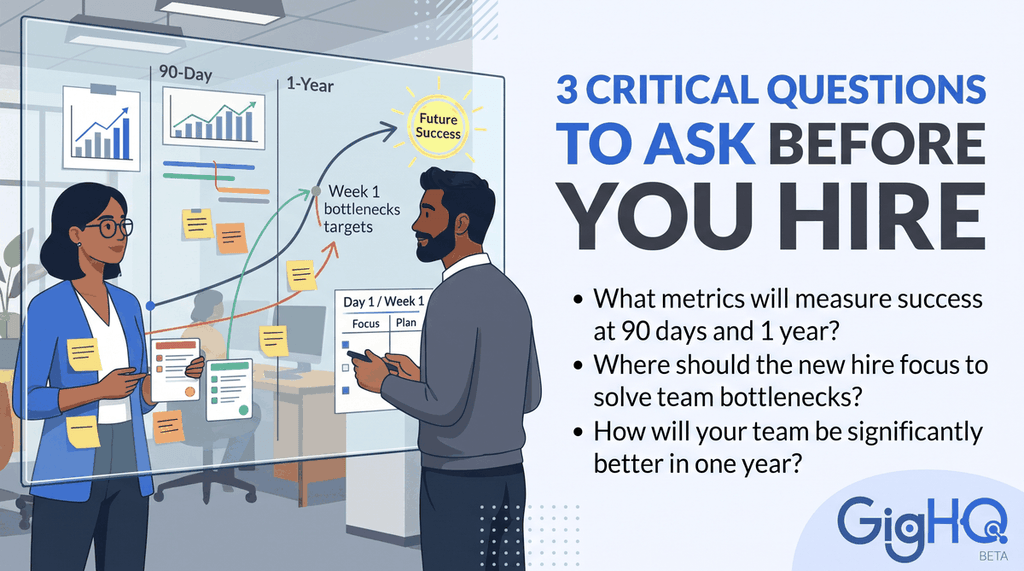
Why does Tracy Angona consider the “fast-forward a year” question absolute gold? Because it bypasses canned corporate PR.
It forces the hiring manager to visualize you solving their daily headaches. Whatever comes out of their mouth gives you their real emotional pain points, enabling you to align your closing statements and 48-hour follow-up directly to their answers.
6. How GigHQ.ai Supercharges Your Interview Lifecycle
Navigating multiple interview loops while tracking follow-ups and company intelligence shouldn’t feel like a secondary full-time job. That’s why we engineered GigHQ.ai as the complete operating system for modern job seekers.
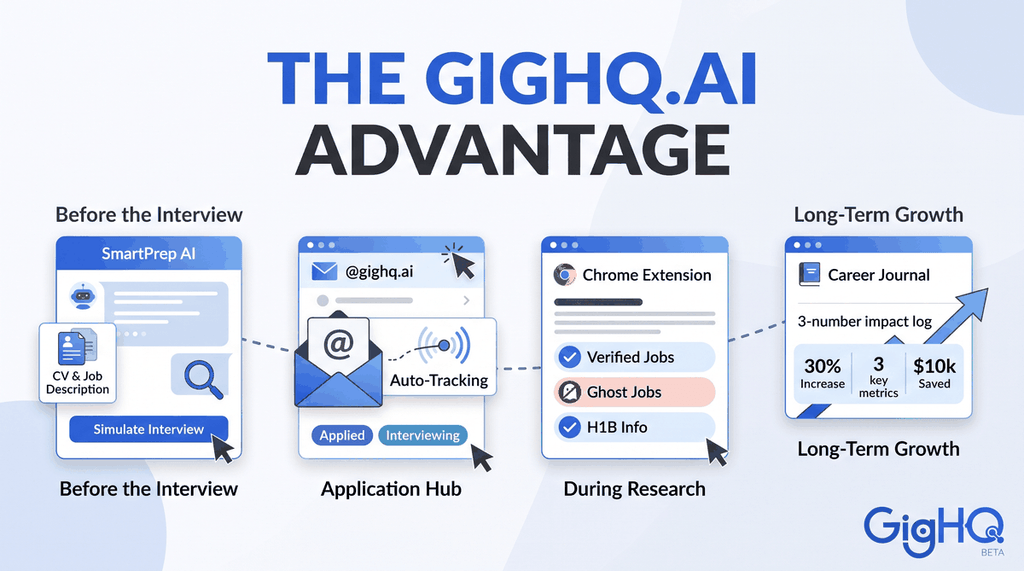
Here is how GigHQ.ai turns interview chaos into strategic clarity:
1. Tailored Interview Practice with SmartPrep
Don’t practice tough questions in the mirror. GigHQ’s SmartPrep tool simulates a live multi-turn mock interview directly against the job description and your specific resume. It assesses your answers across behavioral and technical categories, scores your responses, flags missing keywords, and gives you actionable feedback before you face the real hiring panel.
2. The Career Journal: Your Automated CAR Story Engine
Struggling to remember what you accomplished three quarters ago? GigHQ’s Career Journal acts as your living professional ledger. Whenever you ship a project, resolve a crisis, or master a new technology, log it using GigHQ’s built-in Three-Number Quantification Framework:
- Scale of Action (Scope, budget, team size)
- Direct Result (Conversion lift, latency reduction, revenue preserved)
- Organizational Impact (Business outcome and counterfactual value)
When an interview invite arrives, GigHQ synthesizes your Career Journal entries directly into battle-tested STAR/CAR stories tailored to the company’s exact tech stack and role requirements.
3. Automated Follow-Up & Staleness Alerts
Never lose track of where you stand. When you apply using your custom @gighq.ai email (or BYOE), GigHQ automatically captures recruiter emails, status updates, and interview schedules without manual spreadsheets. If an employer goes quiet past their stated timeline, GigHQ’s staleness alerts nudge you with recommended, context-aware follow-up templates.
4. Direct AI Assistant Integration via Model Context Protocol (MCP)
If you do your deep thinking in Claude or ChatGPT, the GigHQ MCP Server connects your conversational AI directly to your live application pipeline:
- Ask your AI: “What are my active interviews this week, and what specific gaps did my skills analysis highlight for role X?”
- Run a targeted debrief session in Claude Desktop immediately after your call to generate your 48-hour thank-you note draft, grounded in your real career accomplishments.
7. Your Post-Interview Action Checklist
Before your next interview, keep this 5-point execution checklist on your desk:
- Debrief within 12–24 hours: Note hiring manager pain points, team dynamics, red flags, and whether you genuinely want the role.
- Log the conversation in GigHQ: Attach your interview notes and contacts directly to the application card in your GigHQ Dashboard.
- Send a tailored thank-you note within 48 hours: Reference a specific talking point, close any answer loops, and link to relevant insights.
- Rehearse core tripwire answers: Keep your transition story, weakness reframing, and salary boundaries crisp, concise, and future-focused.
- Audit stale pipelines: If a company exceeds their promised follow-up window, deploy a polite, value-additive follow-up before writing it off.
Take the Stress Out of Your Career Search
You don’t need another messy spreadsheet or generic chatbot prompt. Turn your job hunt into a structured, data-driven career strategy.
👉 Get Started Free with GigHQ.ai
👉 Install the GigHQ Chrome Extension