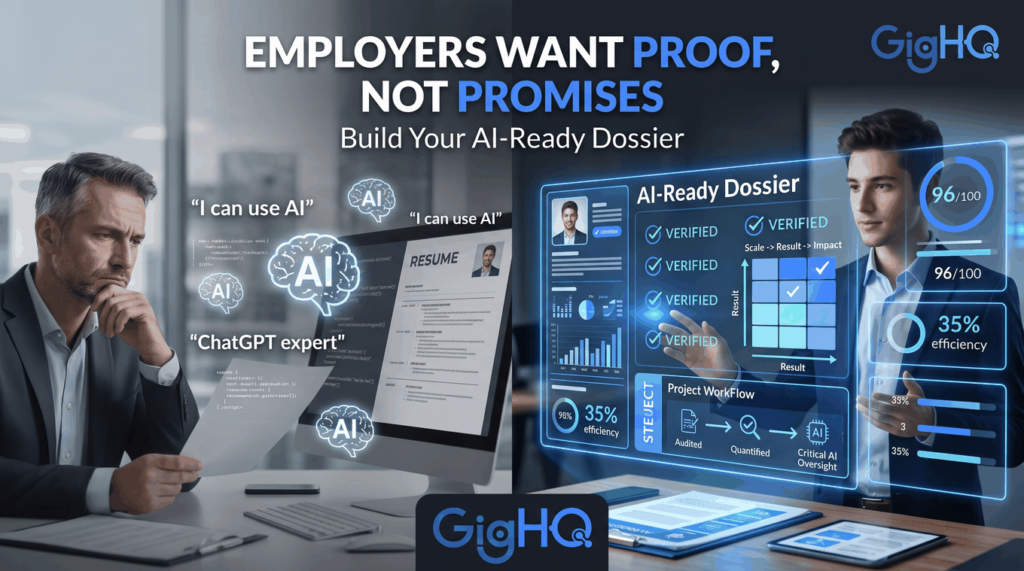
Employers Want Proof, Not Promises: Build Your AI-Ready Dossier
You have used AI tools for your coursework. You have probably used ChatGPT or Claude to polish a cover letter or summarize a syllabus. So has virtually every other person applying for the same entry-level roles. Hiring teams are not screening for tool familiarity—they are screening for applied judgment and verifiable execution.

You have used AI tools for your coursework. You have probably used ChatGPT or Claude to polish a cover letter or summarize a syllabus.
So has virtually every other person applying for the same entry-level roles.
In today’s hiring market, simply knowing how to type a prompt into an AI model does not set you apart. Research from the Pearson and AWS AI Readiness Report 2026 (surveying 2,711 students, university leaders, and employers across six countries) reveals a glaring disconnect between academic perception and workplace reality:
- 78% of university leaders believe their graduates meet employer expectations.
- Yet only 12% of US employers rate recent graduate hires as “excellent” at critically evaluating AI outputs.
The report identifies this gap as “the sharpest instance of a skill deficit in the US data.” Globally, 58% of employers rated graduates’ ability to critically verify and validate AI outputs as their single weakest competency.
The National Association of Colleges and Employers (NACE) reinforces this dynamic in its 2026 Environmental Scan: while 13.3% of entry-level roles now explicitly demand AI competencies, employers are rapidly moving to skills-based hiring models (nearly 70% of organizations use skills-based evaluations during interviews and screening). Hiring teams are not screening for tool familiarity—they are screening for applied judgment and verifiable execution.
What Employers Say Is Actually Missing
Employers do not doubt that college graduates can generate text, summaries, or snippets of code with AI. What they cannot see is evidence of applied, real-world critical judgment.
- The Practical Experience Barrier: 45% of US employers cite a lack of practical experience as a primary hiring barrier. Across global markets, employers point to a lack of hands-on familiarity with professional workflows (42%) and the gap between classroom theory and real workplace practice (41%).
- The “Verification Deficit”: Generative AI has made initial drafts cheap and fast. Consequently, the value of unverified output has cratered. The value of the professional who can catch a subtle hallucination, sanity-check financial figures, or re-engineer flawed logic has skyrocketed.
- The Demand for Durable “Human Skills”: In the Pearson/AWS findings, US employers ranked adaptability (55%), communication and collaboration (53%), and combining human judgment with AI capabilities (47%) as their top hiring criteria.
When you tell an interviewer “I’m proficient with AI,” they hear a promise. What they are desperate for is proof.
The Concept to Steal: A “Dossier of Completed Projects”
In its portrait of the ideal AI-ready hire, the Pearson/AWS report notes that top candidates “enter the workforce with a dossier of completed projects” (global report, p. 19). They demonstrate how they integrate standard AI platforms into end-to-end, accountable execution.
Building a dossier does not require building an elaborate personal website from scratch. It requires a systematic, verifiable record of four things:
- Context & Ownership: What problem were you solving, in what environment, and what was your specific role?
- Measurable Outcome: What moved, what was delivered, or what was quantified?
- AI Integration: Where in the workflow did you deploy AI (research, drafting, data transformation, refactoring)?
- Critical Verification: Where did the model fall short, hallucinate, or misalign—and how did you correct or override it?
Step 4 is the pivot point. It transforms an ordinary class assignment or internship task into ironclad proof of your critical evaluation skills.
Step-by-Step: How to Build Your Living AI Dossier
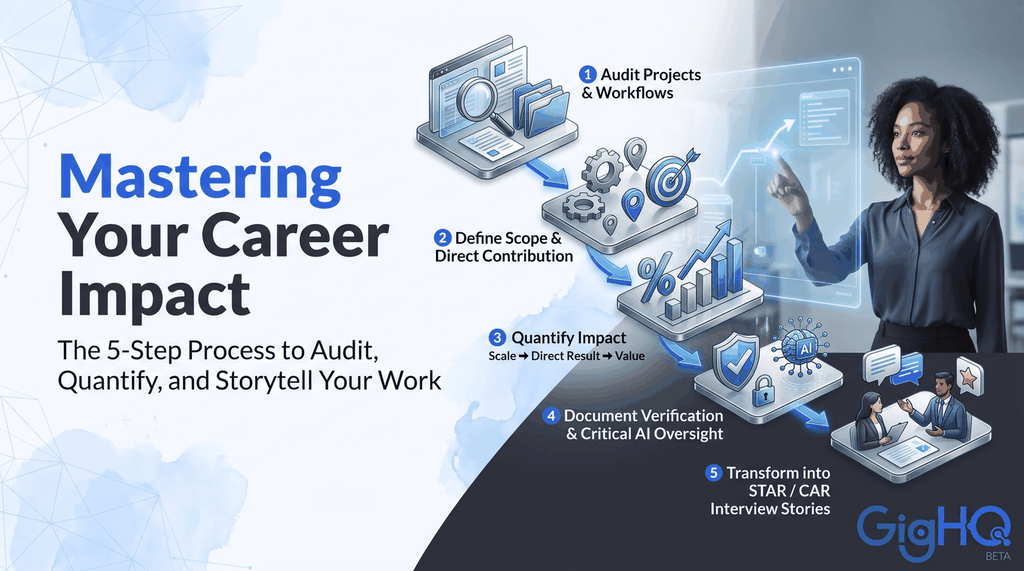
Step 1: Audit Your Raw Material
Collect 5–10 initiatives from the past year. Do not limit yourself to paid employment:
- Coursework capstones and team case studies
- Student club leadership and campus initiatives
- Volunteer initiatives, freelance gigs, or independent software builds
- Internships, practicums, or research lab responsibilities
Step 2: Define Your Individual Contribution
For each project, strip away vague group generalities:
- What was the core business or research objective?
- What was your exact slice of the deliverable?
- What was the friction point or blocker, and how did you resolve it?
Step 3: Quantify Using the Three-Number Rule
Avoid generic statements like “Helped analyze customer survey data.” Instead, enforce three-number quantification:
- Scale of Action: The volume or scope of the input (“Audited 1,200 user feedback responses across 4 product categories”).
- Direct Result: The immediate output (“Extracted 8 recurring friction themes and built a consolidated root-cause matrix”).
- Organizational Impact: The downstream value (“Cut product team triage time by 35% and informed 2 sprint priorities”).
Step 4: Disclose Your AI Workflow Honestly
Detail exactly how artificial intelligence played a role—and where you exercised editorial control:
- Did you catch an unverified citation, inaccurate statistical calculation, or outdated library reference?
- Did you prompt a model for an outline, discard 40% of the sections because they missed operational nuance, and rewrite the remainder?
- Did you deliberately choose not to use AI for sensitive data or specific strategic steps?
Step 5: Convert Entries into CAR / STAR Interview Answers
When an interviewer asks, “How do you use AI in your day-to-day workflow?”, pivot away from vague assurances. Pull a structured story straight from your dossier:
- Context (or Situation/Task): The project constraints and objectives.
- Action: What you executed, what AI accelerated, and how you audited the output.
- Result: The validated outcome, backed by metrics and lessons learned.
The Difference: Unverified Claim vs. AI Dossier Entry
| Evaluation Dimension | Standard Resume Claim (Promises) | AI Dossier Record (Proof) |
| Project Summary | “Conducted competitor research for local marketing clients using generative AI.” | Led competitor benchmarking of 6 local retail competitors for a capstone client; synthesized 45 public service reviews per brand. |
| AI Role | “Prompted LLMs to write industry reports and summary memos.” | Deployed an LLM to categorize recurring customer sentiment tags across raw review dumps. |
| Verification & Oversight | None mentioned (assumes AI output was flawless). | Audited 30 sample outputs manually; discovered the model conflated product lines between two competitors due to similar naming; re-ran analysis on isolated, cleaned JSON inputs. |
| Quantified Impact | “Helped team achieve high grade on client presentation.” | Produced a 14-page verified benchmark report adopted by the client to restructure local pricing; presentation scored 96/100. |
| Competency Proved | Basic prompt generation. | Critical thinking, data hygiene, error detection, and cross-functional communication. |
How GigHQ.ai Turns Your Work into an Audit-Ready Dossier
Building an ongoing dossier manually in disconnected notes or spreadsheets rarely lasts. Details fade, prompt records get lost, and when interview day arrives, you are left scrambling.
GigHQ.ai provides a dedicated, free ecosystem designed to capture your professional trajectory in real time:
1. The Career Journal (Your Structured Vault)
Rather than waiting for a stressful job hunt to reconstruct what you did six months ago, GigHQ’s Career Journal prompts you to document wins, projects, and reflections as they occur.
- Context-aware prompts enforce the three-number quantification framework (Scale > Direct Result > Organizational Impact).
- Built-in capture for skills exercised, tools applied, and critical oversight steps taken.
- Works seamlessly across both the web application and conversational clients through the GigHQ Model Context Protocol (MCP) Server for Claude and ChatGPT.
2. Tailored Application & Interview Synthesis
When you encounter an open position, GigHQ’s tools draw directly from your journaled dossier:
- ResumeRank & Skills Gap Analysis: Compare your actual logged achievements against ATS job descriptions to identify matches and bridge gaps before applying.
- SmartPrep Interview Simulator: Generates dynamic mock interviews based on the exact job description and your documented project history, formatting answers into clear STAR or CAR responses.
- Automated Application Tracking: Apply using your dedicated
@gighq.aiemail address or BYOE (Bring Your Own Email) to automatically track outreach, screening stages, and offer letters without messy manual logs.
Watch the Platform in Action
Explore our deep-dive video walkthroughs to see how GigHQ powers modern job search workflows:
- Watch: Smart Interview Preparation & Mock Sessions
- Watch: Advanced Application Tracking & Status Management
- Watch: Resume Optimization & Skill-Alignment Deep Dive
- Watch: Uncovering Ghost Jobs and Real Market Signals
- Watch: The GigHQ Browser Extension Workflow
For Career Services & Workforce Leaders: Closing the Verification Gap
Higher education and workforce development organizations face unprecedented pressure under outcomes-based frameworks—including Workforce Pell, Financial Value Transparency (FVT), and updated state accountability standards (such as Iowa HSB 550 and CPHE Standard 19).
- The Problem: Traditional First Destination Surveys (FDS) suffer from severe lag time and low response rates (often 20–30%), leaving career centers blind to real-time student friction in the labor market.
- The Reality: According to NACE, although employers affirm the value of degrees, they require clear proof of workforce-aligned capabilities. Chasing alumni months after graduation via phone calls and forms is an unsustainable model.
- The GigHQ Solution: GigHQ acts as an operational AI copilot for learners while providing career teams with passive, privacy-preserving outcomes analytics. Career coaches gain real-time visibility into application-to-interview conversion rates, ghost job hazards, and cohort milestones.
Read more about modernizing institutional outcomes on our blog:
Shifting the AI Narrative in Career Services | Explore the GigHQ Job Market Radar