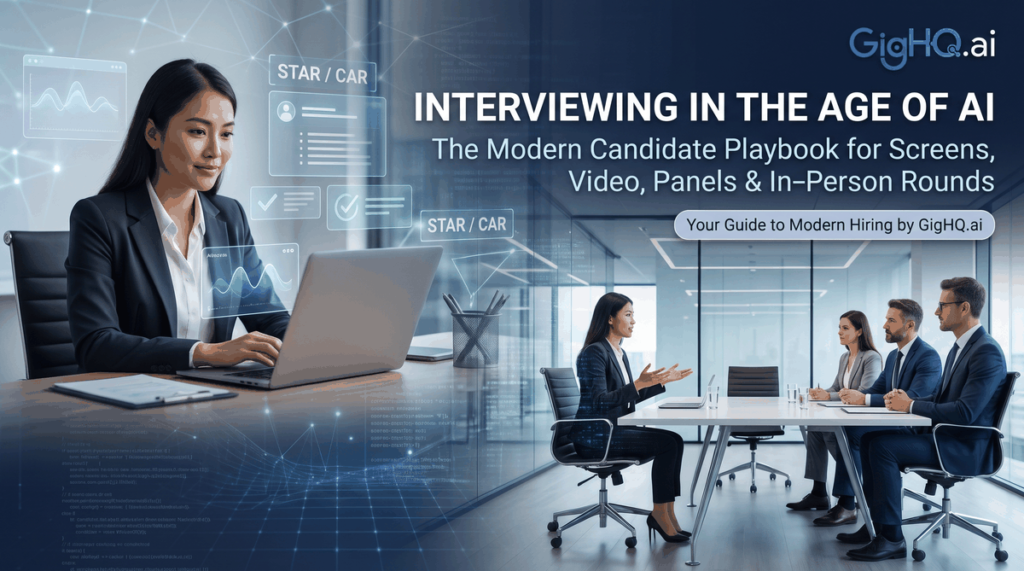
Interviewing in the Age of AI: The Modern Candidate Playbook for Screens, Video, Panels, and In-Person Rounds
Whether you're facing a one-way bot screen or an executive panel, here is how modern hiring works, how to prepare for every stage, and how to turn AI from a recruiter hurdle into your greatest competitive advantage.

The first “person” who interviews you for your next job might not be a person at all.
Recruiting has undergone a massive transformation. According to NACE and employer surveys, skills-based hiring is now practiced by nearly 70% of organizations, and more than 85% of employers assess candidate abilities right at the interview stage. At the same time, companies are battling an influx of AI-generated candidate spam and fraudulent applications—prompting Gartner to project that up to 1 in 4 candidate profiles could be fake by 2028.
To manage this avalanche of noise, employers have re-engineered the hiring funnel. The interview loop is no longer a single conversation—it is a multi-tier gauntlet ranging from asynchronous AI screening bots to rigorous, fraud-checked video calls, behavioral panels, and high-stakes in-person rounds.
Whether you’re facing a one-way bot screen or an executive panel, here is how modern hiring works, how to prepare for every stage, and how to turn AI from a recruiter hurdle into your greatest competitive advantage.
1. AI-Powered Screens: Beating the Knockout Filters
Whether it’s an automated conversational chatbot, an asynchronous one-way video assessment, or written questionnaire screening, the goal of the AI screen is simple: triage and filtration.
Recruiters configure automated screens with “knockout” parameters to immediately filter out applicants who miss fundamental baseline requirements (certifications, required years of specific tech stack experience, location, or travel constraints).
How to Pass:
- Deconstruct the Job Description: Mandatory requirements are almost always where knockout filters live. Audit your background against the exact competencies in the posting.
- Match Context, Not Just Keywords: Modern AI screeners don’t just count keyword frequency; they look for contextual evidence. If a requirement is “cross-functional stakeholder management,” back it up with a tangible example, not just the raw phrase.
- Speak and Write Like a Human: Avoid sounding like a canned LLM script. Systems are increasingly tuned to flag generic, buzzword-heavy responses that lack personal nuance.
- Maintain Live-Interview Standards: Test your microphone, set up good lighting, dress professionally, and treat the screen with the same gravity as an executive meeting.
💡 Copilot Advantage: Before stepping into any automated evaluation, run your resume through the GigHQ App to uncover keyword gaps and see how your profile scores against the target role.
2. Phone Interviews: Mastering the “Open-Book” Conversation
Usually conducted by an internal recruiter or talent acquisition specialist, phone screens gauge culture alignment, communication clarity, and whether your salary and timeline expectations match reality.
How to Pass:
- Leverage the Open-Book Advantage: You have complete control over your environment. Keep your resume, job description notes, and talking points right in front of you.
- Inflection and Energy Carry the Day: Without visual cues, monotone delivery will kill your candidacy. Stand up, pace, or smile while you talk—physical energy translates directly through the microphone.
- Avoid Reading Scripts: Bullet points work; long, word-for-word scripts sound robotic and detached. Keep your responses conversational and punchy.
3. Video Interviews: Navigating Eye Contact and Fraud Checks
Virtual interviews remain the backbone of remote and hybrid hiring, but the stakes have risen. With hiring teams hyper-aware of synthetic personas, virtual backgrounds hiding teleprompters, or external coaching aids, video rounds now carry implicit and explicit verification checks.
How to Pass:
- Calibrate Your Eyeline: Position your camera at eye level. Looking at the lens creates the perception of direct eye contact with the interviewer, whereas looking at their video feed on the bottom corner of your screen makes you appear disengaged.
- Dress Head-to-Toe: Never wear professional attire only from the waist up. If an emergency forces you to stand or adjust equipment, you don’t want an awkward wardrobe malfunction on camera.
- Expect Environment Verification: Don’t be surprised if interviewers request that you disable virtual backgrounds or briefly pan your workspace. A clean, uncluttered physical background signals transparency and readiness.
- Active Engagement: Compensate for screen detachment with deliberate active listening: nods, smiles, and conversational confirmations.
4. In-Person Interviews: The Re-Emergence of the Face-to-Face Standard
As a countermeasure to remote hiring fraud and automated spam, major employers are increasingly bringing back mandatory in-person rounds for final hiring decisions. As veteran career coaches emphasize: an in-person interview is a two-way conversation, not an interrogation.
How to Pass:
- The Interview Begins in the Parking Lot: How you treat the security guard, receptionist, and elevator companions is noticed and frequently reported back to hiring managers. Treat every person you encounter with professional warmth.
- Master the Logistics Buffer: Map parking, security badges, and transit schedules days in advance. Plan to arrive in the lobby 10 to 15 minutes before your scheduled start time.
- Read the Room: In-person meetings reveal non-verbal subtleties that virtual calls mask. Match the conversational pacing of your interviewers, ask clarifying questions, and showcase genuine curiosity about the team’s culture.
5. Panel Interviews: Engaging the Room
Panel interviews—often humorously dubbed “firing squad” interviews—evaluate how you navigate multiple perspectives, competing priorities, and varied communication styles under pressure.
How to Pass:
- The “Anchor and Sweep” Technique: When answering a question, address the panelist who posed it first. Then, consciously sweep your eye contact across the rest of the room to pull every panelist into the narrative before returning to the asker to close.
- Structure Your Stories with CAR/STAR:
- Use CAR (Context → Action → Result) for executive-level, fast-paced summaries.
- Use STAR (Situation → Task → Action → Result) when deep technical context is required.
- Calibrate Depth on the Fly: Some panelists care about high-level strategic ROI; others want to hear the exact code library or operational workflow you built. Deliver the outcome first, then offer: “I can go deeper into the technical execution if the team would like.”
- Recover Gracefully: If you stumble on a question or misspeak, pause, take a breath, smile, and say: “Let me reframe that to make sure I address the core priority.” Poise under pressure is an explicit evaluation metric in panel interviews.
The Proactive Playbook: Turning AI into Your Interview Advantage
Rather than dreading AI filters, high-performing candidates use intelligent tools to out-prepare the competition.
Here is how you can use GigHQ.ai to streamline your journey from application to offer:
1. Build a Living Record of Your Achievements
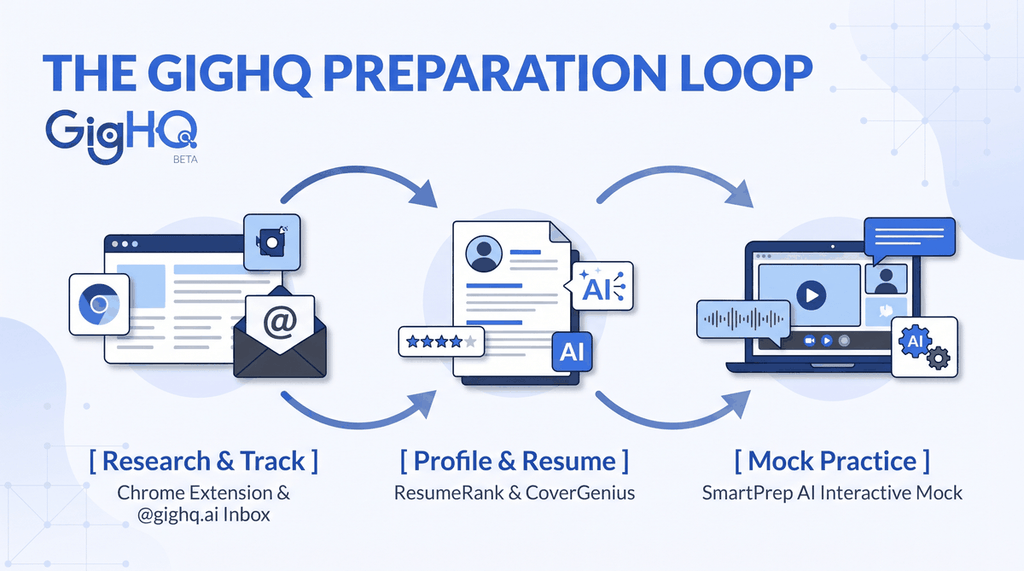
Most candidates freeze during behavioral questions because they can’t remember specific metrics from two jobs ago. GigHQ’s Career Journal acts as your professional memory bank. By documenting wins using the Three-Number Quantification Rule (Scale of action, direct measurable result, and organizational impact), you build an instant library of audit-proof CAR/STAR stories ready for any interview.
2. Practice Real Scenarios Before Step One
Nervous about unpredictable questions? GigHQ’s SmartPrep tool simulates role-specific mock interviews tailored to the target job description and your background. It evaluates your spoken or written responses in real time, scoring your clarity and highlighting gaps before you face a live interviewer.
Check out our walkthroughs to see how smart tools transform the process:
- Watch GigHQ Feature Demos & Workflows on YouTube
- Explore Automated Application Tracking and Interview Prep
- See Live Candidate Matching in Action
3. Track Applications Seamlessly
Forget messy spreadsheets. Applying with your dedicated @gighq.ai email automatically logs confirmation emails, updates interview statuses, and organizes next steps in your GigHQ Dashboard.
- Want to run your search from your browser? Install the GigHQ Chrome Extension.
- Power user of AI assistants? Connect directly to your job pipeline using the GigHQ MCP Server, or run your prep directly in ChatGPT and Claude.
- Learn more about our mission to bring transparency to the job market on the GigHQ About Us page.
Interview Day Checklist
- Job Description Audit: Identify top 3 mandatory qualifications and prepare a verified CAR story for each.
- Technical Run-Through: Test camera, audio levels, lighting, and software updates 30 minutes prior to screen/video rounds.
- The “Three Numbers” Ready: Have concrete metrics prepared for your key career achievements.
- Panel Engagement Strategy: Address the asker first, then engage the room.
- In-Person Logistics: Map route, parking, and building access; arrive in the lobby 10–15 minutes early.
- Network Warm Handoff: Whenever possible, pair your application with an internal referral to put a human advocate in the loop.
Ready to transform your job search from chaos to strategy? Stop applying blind and start interviewing with confidence. Create your free account today at GigHQ.ai.