Most career content assumes you’re starting from a full tank: pick up a new skill, revamp your resume, network harder, adopt this AI tool, adapt to that market shift. What it rarely accounts for is that a lot of people reading it are not starting from a full tank. They’re starting exhausted, uncertain whether their role will even exist in a year, and quietly wondering if they’re the only one who feels behind.
You’re not.
The Moment Someone Said It Out Loud
At the close of a recent Harvard Project on Workforce webinar on how institutions are adapting to a fast-changing labor market, Rachel Kahn, Strategic Impact Director at Education Design Lab, did something most speakers in that kind of session don’t do. Instead of ending on more tactics, she paused to name the condition of the room itself.
She was talking to community college leaders about to head back to campus for a new academic year, about to ask their staff to absorb yet another shift in how they work. But listen to how she described the people she was asking this of — because it doesn’t read like advice for administrators. It reads like a description of almost anyone navigating a career right now:
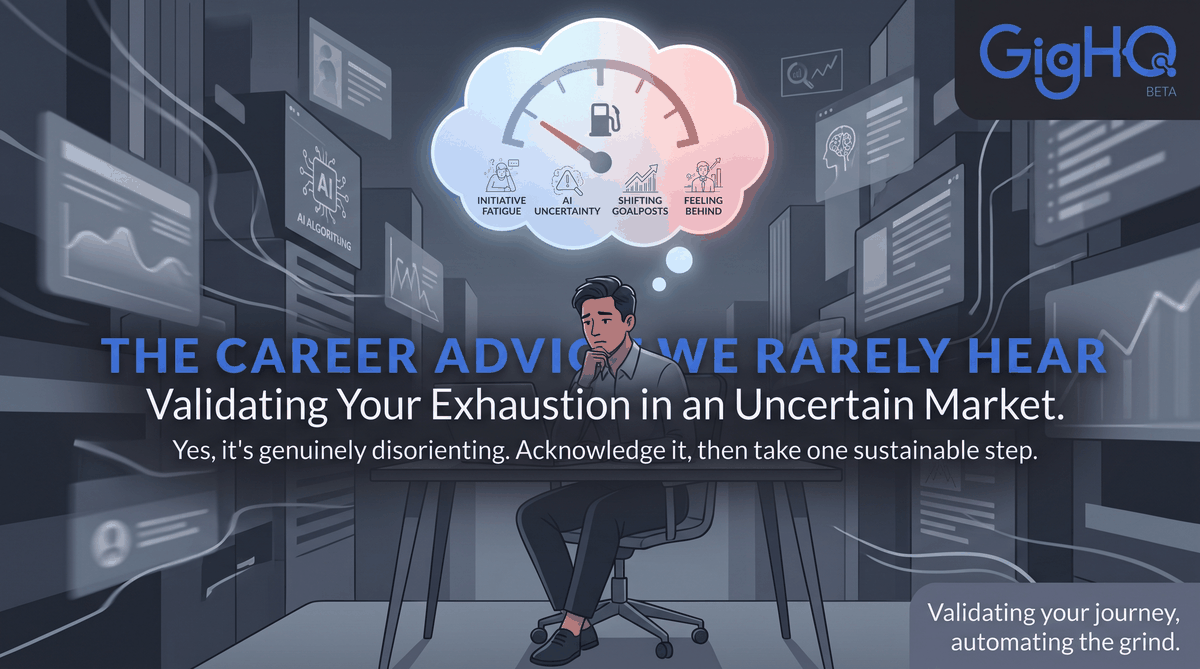
Just remembering some of them are already with initiative fatigue, right? This is going to feel like yet another thing. They’re already not sure what AI is going to mean for them, what technology looks like. How that is going to change their day-to-day work? What are you asking of them? Is their job going to be eliminated?
She went further, naming the layers underneath: “any sort of spectrum of concern and different levels of excitement,” people who might already be running on empty before you’ve asked them for anything new, all of it happening against a backdrop of “budget cuts, open positions we’re not able to fill.”
Nobody was asking these people to change careers. She was describing what it feels like to just show up to work right now. If that description lands harder than the average LinkedIn post about “embracing AI,” it’s because it’s honest about something most career advice skips past entirely.
Why This Feels Different if You’re Job Searching
If showing up to an existing job carries that weight, a job search adds more of it. You’re not just uncertain about whether your current role is safe — you’re actively trying to prove your value to strangers, in a market where the goalposts for what counts as “AI fluent” or “future-proof” seem to move every few months. You’re absorbing rejection, or silence, which is often worse than rejection. And you’re doing all of this while everyone around you seems to have either already figured it out or isn’t talking about how hard it actually is.
That combination — real uncertainty about the market, plus the isolating feeling that you should already have this handled — is a genuinely heavy thing to carry into a search. It’s not a personal failing that it feels heavy. It’s an accurate read of the moment. Shifting the AI narrative in career services starts with acknowledging this reality.
What This Isn’t
This isn’t a suggestion to lower your expectations of yourself, or to treat exhaustion as a reason to stop moving entirely. Kahn’s own talk didn’t end on “so rest and do nothing” — it ended on “what’s one conversation you can have to get the ball moving.” The point isn’t that effort doesn’t matter. It’s that effort built on top of unacknowledged exhaustion tends to snap, and effort that starts by naming the exhaustion tends to actually hold.
There’s a real difference between “push through it without naming it” and “name it honestly, then take one step anyway.” The second one is sustainable. The first one is usually just delayed burnout with a to-do list attached.
What Naming It Actually Changes
Kahn’s framing does something practical, not just comforting: it resets the size of the ask. If you assume someone (or yourself) is starting from full capacity, “just update your resume and start networking more” sounds reasonable. If you’re honest that the starting point might already be running low, the same advice needs a different shape — smaller, more forgiving, more willing to count something as progress even if it’s not dramatic.
That’s a useful check to run on your own search right now. Are you evaluating your progress against what a rested, fully-resourced version of you could do? Or against where you’re actually starting from? Those are different bars, and holding yourself to the wrong one is its own quiet source of the exhaustion Kahn was describing.
It’s also worth saying plainly: if what you’re carrying feels like more than ordinary search stress — if it’s sitting with you in a way that’s affecting your day-to-day beyond the usual frustration of a hard market — that’s worth talking through with someone qualified to help, not something to try to reason your way out of alone. Career anxiety and mental health are related, but they’re not the same thing, and it’s fine to treat them differently.
The Version of This Most Tools Don’t Say Out Loud
Most career platforms are built around a transactional promise: upload this, we’ll optimize that, apply faster, get more interviews. There’s nothing wrong with that promise — speed and efficiency genuinely help. But it quietly assumes the person on the other end just needs better tools, not any acknowledgment that the process itself might be wearing them down.
That’s the gap worth naming. A search built entirely on optimization, with no room to acknowledge that the person running it might be tired, uncertain, or discouraged, isn’t actually built for the person using it — it’s built for an idealized version of them who never runs low.
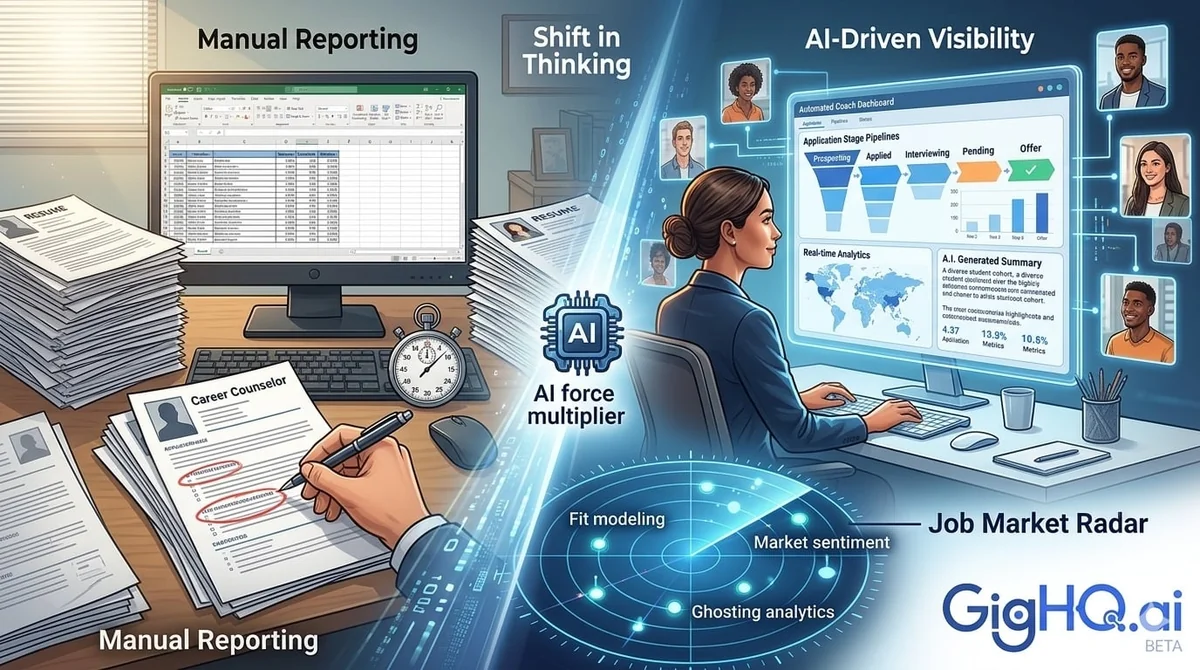
Real support means holding both things at once: yes, here’s a way to move forward, and also, it’s reasonable that this is hard, and you don’t have to pretend otherwise to keep going. This is the philosophy behind GigHQ.ai. We know that managing the process shouldn’t be a full-time job. Whether you use our Chrome Extension to quickly gauge a job’s viability, check our Job Market Radar for real-time insights, or leverage our tools within ChatGPT or Claude (powered by our MCP Server), our goal is to automate the grind so you can focus on the human elements of your search.
You’re Not Behind. You’re in a Moment That’s Genuinely Disorienting for Almost Everyone.
If you take one thing from Kahn’s framing, let it be this: the uncertainty you’re feeling about AI, about whether your skills still hold their value, about whether you’re moving fast enough — none of that means you’re behind. It means you’re paying attention to something that’s genuinely in flux, in a market that hasn’t finished settling. The people who look like they’ve got it figured out are, more often than not, managing the same uncertainty a little more quietly.
You don’t need a full plan today. You need one honest look at where you’re actually starting from — and one small step from there. That’s not a lesser standard. It’s the only standard that actually accounts for what this moment is really asking of people.
To learn more about how GigHQ.ai is building tools to navigate this transition, read About Us or explore our YouTube demos to see the platform in action.
Our Platform Tools:

ResumeRank
Scan your resume, get a score, fix what matters.

CoverGenius
Generate personalized, AI-powered cover letters in seconds.

OutreachAgent
Craft perfect networking and AI-powered follow-up emails with ease.

CareerCompass
Instantly generate a personal marketing plan from your resume to define your brand and attract the right opportunities.

Smart Prep
Simulates a real interview based on your resume and the job description, giving you real-time feedback to build your confidence.

Profile Spark
Optimize your LinkedIn profile to attract recruiters and opportunities.