Career services leaders are facing a reality that is no longer aspirational: the need to be fully accountable for institutional student success. The question of “value and impact” is at the center of how campuses talk about workforce relevance and return on investment (ROI).
For many, this pressure is mounting just as budgets feel tighter and the demand for early-stage career intervention grows. With 2 in 3 students reporting high levels of stress about their future and 66% demanding more personalized career support, the traditional model—the isolated, transactional office that kicks into gear near graduation—is no longer enough.
But the answer isn’t just “more programming.” It is a fundamental shift toward a Career Ecosystem Model.
The Strain of the Transactional Model
The transactional model is breaking under the weight of an expectations-to-resource mismatch. While career readiness is everyone’s priority, the staffing models have not evolved to meet the demand.
Consider the current reality documented by NACE’s “Value of Career Services” data:
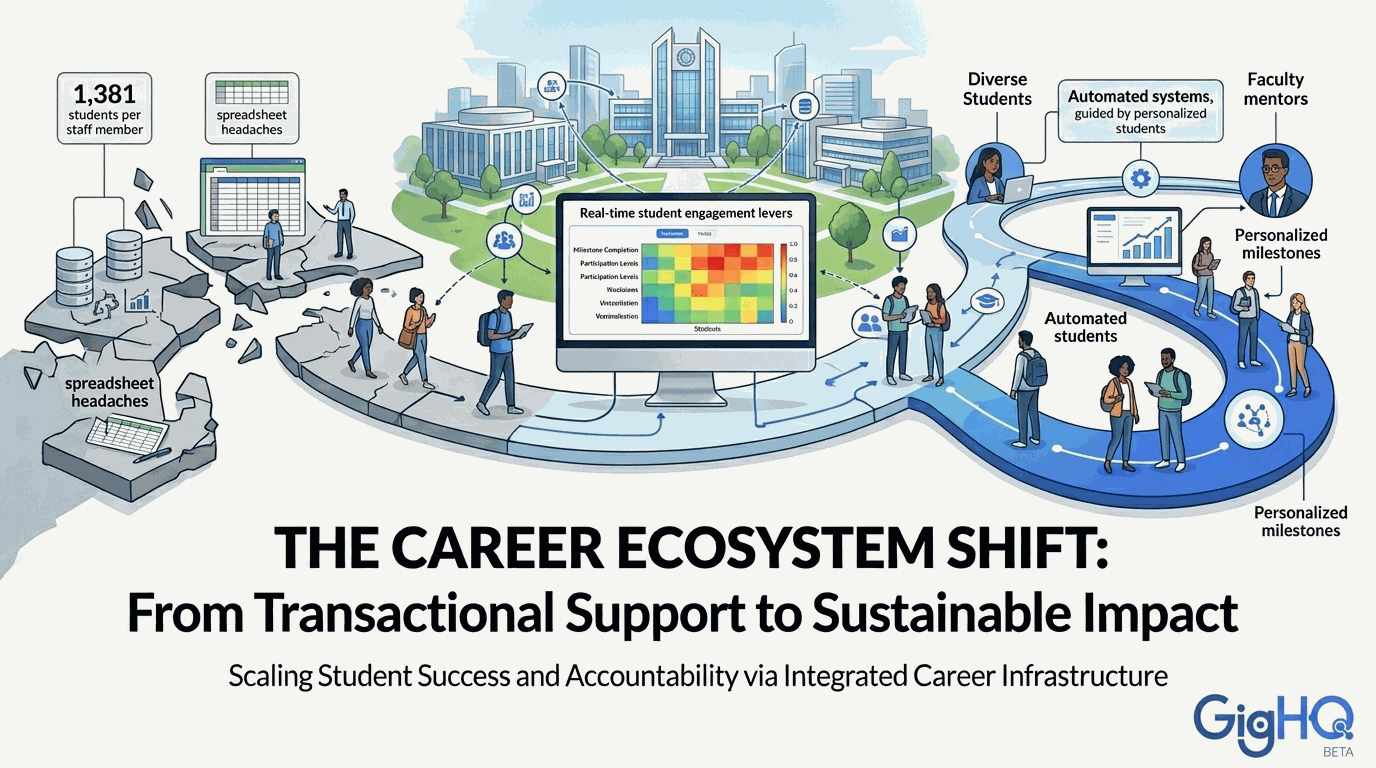
- The Staffing Gap: The median total office FTE stands at 7.0, but when looking specifically at professional staff, the median drops to just 4.5. This translates to an overwhelming ratio of 1,381 students per professional staff member.
- The Budget Trap: While median overall budgets have increased by 21% over the last two years, 87% of those budgets are tied up in personnel costs.
This leaves virtually zero room for the flexible infrastructure or operational redesign needed to support students across their entire journey. Many offices are caught in a cycle of high-volume, high-complexity work:
- Isolation: Career support feels like a series of disconnected workshops rather than a continuous developmental journey.
- Diffuse Responsibility: Career readiness is everyone’s priority but often nobody’s explicit ownership.
- Technological Friction: Campuses are managing too many disconnected platforms, spreadsheets, and manual workarounds.
- Outcome Obsession: Offices count jobs at the end, but struggle to measure the engagement levers (participation, exploration, milestones) that actually drive those outcomes.
The Four Pillars of a Career Ecosystem
Moving from a fragmented office to a connected ecosystem requires deliberate design. As outlined in our How It Works guide, here is where the work begins:
1. Design Around the Student Journey
Career support should be organized around critical decision points—first-year exploration, major confirmation, internship readiness—rather than institutional boundaries.
- How GigHQ helps: Using tools like CareerCompass, institutions can help students identify their goals earlier, moving career work from “end-stage support” to “journey-long engagement.”
2. Clarify Ownership and Partnership
Shared importance doesn’t create shared accountability. A stronger ecosystem makes roles explicit: what career services owns, where faculty collaborate, and what requires administrative support.
- The goal: Stop making students guess where to go for help. Build a routing model that documents follow-through and makes collaboration operational, not just aspirational.
3. Choose Infrastructure That Reduces Friction
Technology should simplify, not complicate. If your systems force manual workarounds, they are part of the problem. Modernizing infrastructure is also critical for compliance. Automated tracking is no longer a luxury—it is a requirement for maintaining federal compliance and demonstrating program ROI.
- How GigHQ helps: Our Chrome extension and platform automate the tracking of job search activity. This removes the “spreadsheet headache” for students and gives staff real-time visibility into student progress without requiring constant manual check-ins. See how this works for students here.
4. Measure Engagement, Not Just Outcomes
Placement rates are a lagging indicator. A mature ecosystem measures movement: appointment follow-through, milestone completion, and participation levels by cohort.
- How GigHQ helps: By capturing the “Community Signal” of real-time application data, our platform allows you to see how your students are interacting with the labor market. You get to see the engagement levers that lead to successful placement long before the student walks across the graduation stage.
The Role of Technology in a Connected Model
This moment requires institutions to organize what already exists and identify where students are falling through the cracks. This is where tools like ResumeRank, CoverGenius, and OutreachAgent become essential. They aren’t “stand-alone fixes”; they are the infrastructure that preserves human judgment while scaling the delivery of support.
When you connect the parts of the work that remain separate—student journey, shared ownership, infrastructure, and measurement—career support becomes easier for students to navigate and easier for staff to deliver.
It becomes more visible to leadership, more scalable, and a more reliable driver of student success.
Are you ready to move your career services model from reactive to proactive?
Schedule a demo with GigHQ.ai to see how our AI Career Copilot and institutional infrastructure can unify your career ecosystem.
Our Platform Tools:

ResumeRank
Scan your resume, get a score, fix what matters.

CoverGenius
Generate personalized, AI-powered cover letters in seconds.

OutreachAgent
Craft perfect networking and AI-powered follow-up emails with ease.

CareerCompass
Instantly generate a personal marketing plan from your resume to define your brand and attract the right opportunities.

Smart Prep
Simulates a real interview based on your resume and the job description, giving you real-time feedback to build your confidence.

Profile Spark
Optimize your LinkedIn profile to attract recruiters and opportunities.