For decades, national workforce policy operated under an unspoken consensus: workforce training is for non-degreed, entry-level workers, while college-educated professionals need only occasional updates.
That consensus has officially shattered.
As highlighted in a compelling analysis published by Inside Higher Ed, the U.S. spends billions annually across federal programs like the Workforce Innovation and Opportunity Act (WIOA) and the newly expanded Workforce Pell Grants. Employers spend over $100 billion more on workplace training. Yet, almost the entirety of this massive apparatus is calibrated for entry-level access, rapid short-term certificates, and sub-baccalaureate credentials.
The blind spot? Degree-holding professionals in the prime of their careers.
Mid-career engineers, healthcare administrators, data analysts, research scientists, and team managers aged 35 to 50 are experiencing a tectonic disruption. Driven not just by generative AI, but by biotech acceleration, advanced automation, and complex regulatory technologies, the modern knowledge worker’s day-to-day workflow is shifting faster than traditional degree governance can adapt.
To prevent an unprecedented productivity stall, we must rethink both how we reskill adult professionals and how we track, measure, and validate their transition into modern roles.
The Degree Dilemma: Foundational Value vs. Tool Velocity
Holding a bachelor’s or master’s degree remains a vital indicator of analytical ability, critical inquiry, and persistent problem-solving. But in today’s labor market, degrees alone are no longer sufficient.
By the time an academic department revises its syllabus through institutional review committees, employer job descriptions have already integrated new AI frameworks, updated API orchestration workflows, or novel compliance standards.
When experienced workers fall behind this curve, the economic fallout is swift:
- Institutional Capacity Shrinks: Organizations slow down when experienced managers cannot effectively deploy new tools.
- Mid-Career Stagnation: Seasoned professionals face extended bouts of underemployment or find themselves screened out by automated applicant tracking systems (ATS).
- The “Broken Marketplace” Deepens: While companies lament acute skill deficits, 45% of recent bachelor’s graduates remain underemployed six months post-graduation, and prime-age displaced workers struggle to translate their legacy experience into modern job titles.
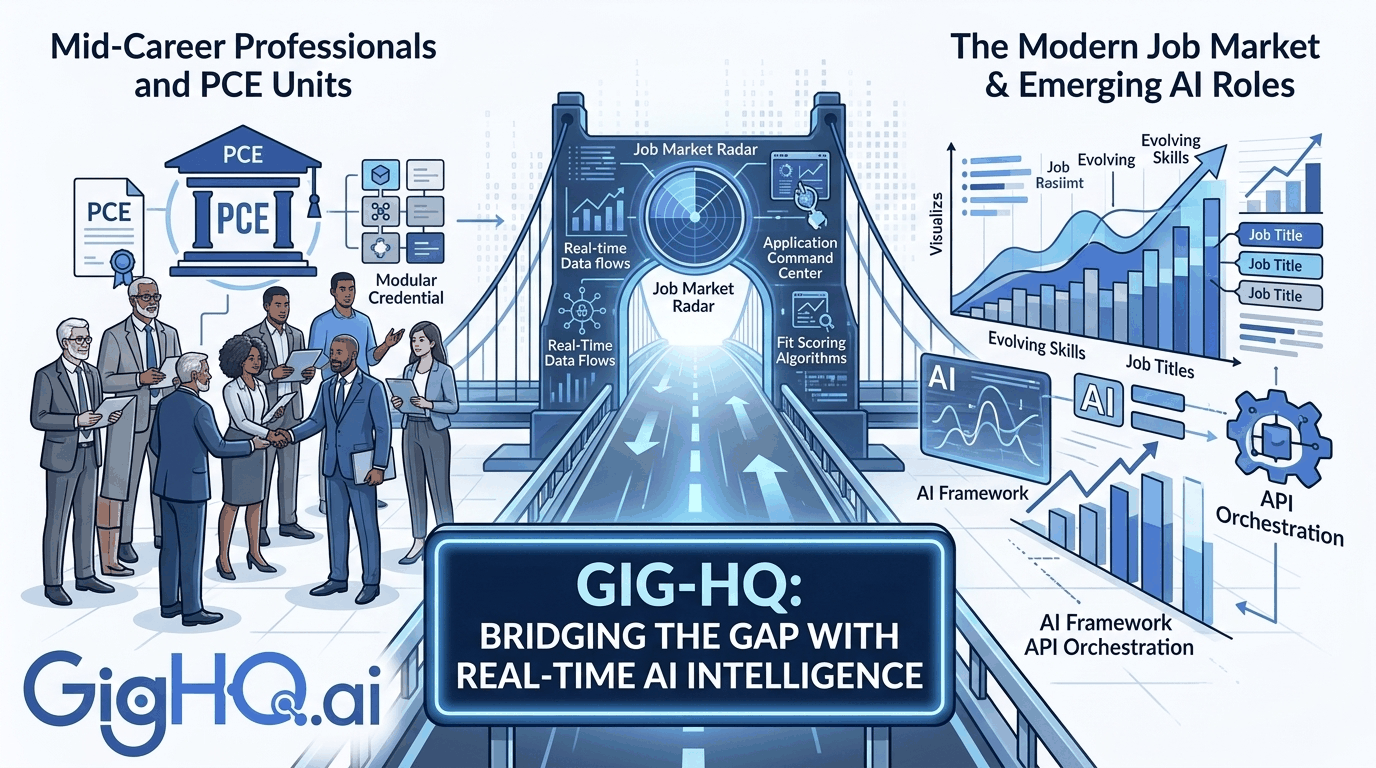
The Missing Partner: University Professional & Continuing Education (PCE)
While community colleges provide crucial regional mobility and private bootcamps offer tactical sprint-training, neither is designed to deliver the research-infused, domain-specific rigor demanded by a 42-year-old regulatory scientist or a senior systems architect.
This is where Professional and Continuing Education (PCE) units at research universities come into play.
PCE divisions sit at the unique intersection of cutting-edge academic research and applied industry practice. They possess the flexibility to:
- Translate frontier knowledge into modular, stacked credentials without waiting for multi-year degree re-accreditations.
- Co-design applied curricula directly alongside regional enterprise partners.
- Offer institutional brand credibility, signaling the deep rigor that hiring executives look for when staffing leadership and specialized technical roles.
Yet, despite their strategic advantage, PCE units are routinely sidelined in federal funding frameworks. Programs like Workforce Pell remain overwhelmingly tethered to entry-level transitions, often imposing statutory requirements that ignore the modular upskilling needs of workers who already hold advanced degrees.
The Information Asymmetry: Why Reskilling Fails Without Market Signals
Even when higher education institutions and PCE units build agile, top-tier upskilling tracks, they confront a shared barrier: a lack of real-time visibility into the job search ecosystem.
Once an adult learner completes a credential or an experienced worker embarks on a mid-career pivot, they enter what workforce professionals call the “Black Box” of hiring:
- Ghost Postings and Noise: Up to one-third of online job listings are stale or inactive, draining weeks of effort from job seekers.
- Flawed Signal Proxies: Resume screening bots scan for verbatim keyword strings rather than evaluating transferable competency.
- Lagging Outcome Data: Universities and Workforce Development Organizations (WDOs) still rely on retrospective surveys and delayed state wage records that arrive 6 to 12 months after graduation—far too late to guide curriculum updates or assist struggling alumni.
If higher ed is to become a true lifelong learning engine, it must pair institutional instruction with live labor market intelligence.
Enter GigHQ.ai: The Real-Time Intelligence & Outcome Layer
At GigHQ.ai, we are bridging this gap between talent education, career navigation, and institutional accountability.
We believe that career resilience in an AI-accelerated economy requires continuous alignment. Our platform serves both sides of the workforce development table:
1. For Mid-Career Professionals & Learners
The modern job hunt is a sales process where you are the product. Instead of forcing professionals to manage spreadsheets and blindly submit hundreds of “Easy Apply” applications, GigHQ acts as an AI-Powered Job Search Copilot:
- The Application Command Center: Applying through your dedicated @gighq.ai email automatically tracks submissions, recruiter replies, and interview milestones in one unified dashboard.
- Skills Gap Analysis & Fit Scoring: Before applying, our tools analyze the job description against your background, identifying matching strengths, missing keywords, and strategic angles to reframe legacy experience.
- Living Career Journal: Capture quantifiable wins, projects, and impact metrics while on the job, transforming daily work into ready-to-use resume bullets and interview stories.
- AI-Powered Browser Assistance: The GigHQ Chrome Extension surfaces community hiring signals, ghost-job flags, and application timelines directly across LinkedIn, Indeed, and over 50 ATS boards.
For a look at how GigHQ streamlines career workflows, explore our platform walkthroughs:
- Application Tracking & Pipeline Management Demo
- Real-Time Job Market & Company Insights
- Job Search Copilot
2. For PCE Units, Career Centers, and WDOs
Under shifting accreditation mandates (such as CPHE Standard 19) and WIOA accountability rules, institutions must prove return on investment (ROI) and verified employment outcomes.
GigHQ transforms career teams from reactive survey collectors into proactive talent partners:
- Leading vs. Lagging Indicators: Coaches see exactly which cohort members have high application volume but low interview conversion, allowing for immediate resume intervention before learners drop out.
- Passive Verification: Eliminate manual phone surveys. GigHQ provides auditable, time-stamped proof of job placement and offers.
- Dynamic Labor Market Alignment: Monitor our Job Market Radar to see which skills, credentials, and employer partners are actively hiring in real time.
Integrating AI Directly Into Your Workflow
Whether you are a job seeker analyzing your skills or a career counselor running diagnostic audits, GigHQ connects with your daily productivity stack.
Through our MCP Server integration, you can interact with your job pipeline directly inside conversational AI environments:
- Connect through GigHQ in ChatGPT
- Connect through GigHQ in Claude
- Learn more about our philosophy on career enablement in Shifting the AI Narrative in Career Services
The Path Forward: A Call for Comprehensive Workforce Agility
Federal policy must evolve past the binary view that workforce development begins and ends with entry-level training. A healthy innovation economy requires active preservation and renewal of the seasoned professionals who design our systems, oversee clinical governance, lead engineering squads, and manage organizational strategy.
Higher education’s professional and continuing education divisions are ready to lead this charge. By equipping learners and institutions with real-time labor market analytics, automated outcome tracking, and transparent skill matching, we can ensure no segment of the workforce is left navigating technological disruption in the dark.
Ready to bring clarity and control to your career or your institution?
- Explore the GigHQ.ai Platform
- Read our latest insights on our Blog
- Learn more About Us and join the movement toward transparent, outcome-driven hiring.
Our Platform Tools:

ResumeRank
Scan your resume, get a score, fix what matters.

CoverGenius
Generate personalized, AI-powered cover letters in seconds.

OutreachAgent
Craft perfect networking and AI-powered follow-up emails with ease.

CareerCompass
Instantly generate a personal marketing plan from your resume to define your brand and attract the right opportunities.

Smart Prep
Simulates a real interview based on your resume and the job description, giving you real-time feedback to build your confidence.

Profile Spark
Optimize your LinkedIn profile to attract recruiters and opportunities.