
We’ve all seen the bullet points on resumes that sound impressive but say absolutely nothing. You know the ones:
“Led cross-functional initiatives to drive operational efficiency.”
It sounds professional. It uses “power words.” But if you’re a hiring manager, what does that actually tell you? How many initiatives? What kind of efficiency? Did the company save five dollars or five million?
When you write in generalities, you aren’t telling a story—you’re just taking up space.
The hiring algorithm—and the tired hiring manager scanning your profile—doesn’t have time to guess. They are pattern matchers, and they are looking for signal, not prose. And in the world of modern recruiting, numbers are the highest-density signal you can provide.
The uncomfortable truth is this: if you and another candidate have identical experience, titles, and tenure, the one with quantified, data-backed bullet points wins the interview almost every time. Hiring managers consistently tell us the same thing: they can hear a candidate talk all day about how great things were, but they need to see the proof. Numbers are that proof.
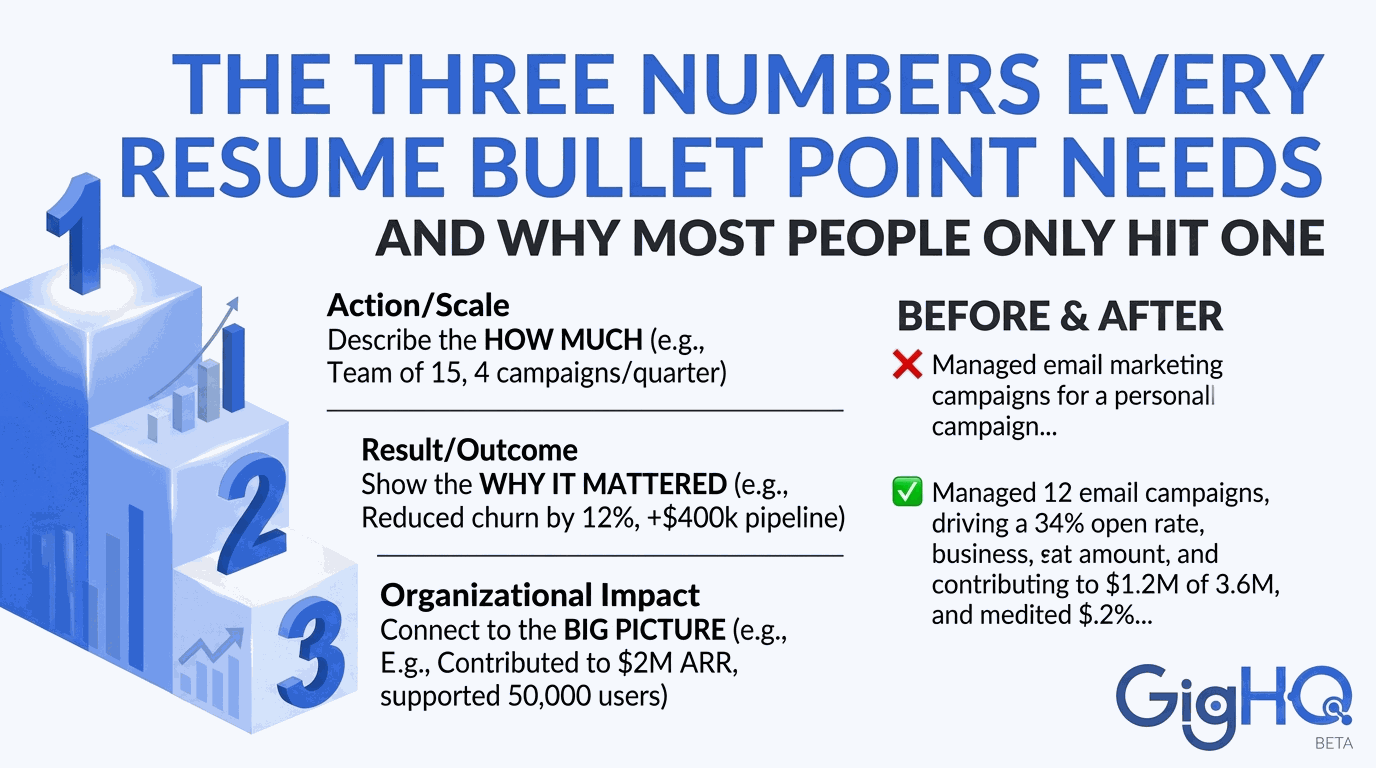
Every great resume bullet point needs exactly three numbers. Here is how to find them.
The Three Numbers Defined
Most candidates hit one number—often just the action’s scope. To stand out, you need to layer in the other two.
1. The Action (Scale)
This describes the “how much” of your daily grind. It tells the reader the size of the arena you played in.
- Examples: Managed a team of 15, ran 4 campaigns per quarter, reviewed 50+ applications per week.
- The Mistake: Describing what you did without conveying the volume or complexity of the work.
2. The Result (Outcome)
This is the direct, measurable change caused by your specific action. This is the “why it mattered” in the short term.
- Examples: Reduced churn by 12%, increased qualified pipeline by $400k, cut processing time by 10 hours/week.
- The Mistake: Stopping at the action (“Led the initiative”) and failing to report what happened because of it.
3. The Organizational Impact (The “So What?”)
This number shows you understand the big picture. It links your result to the business’s bottom line or overall goals.
- Examples: Contributing to $2M in ARR, supporting a user base of 50,000, enabling 15% of total annual revenue.
- The Mistake: Leaving this on the table. This is the number that tells the hiring manager, “I am a business-minded professional who understands our goals.”
Why Most People Only Get One (Or Zero)
If these three numbers are so critical, why is the average resume bullet so vague?
- The Memory Trap: We write from memory and emotion, not data. We remember the stress of the project, but not the metrics it moved.
- Fight-or-Flight Mode: Job searching is inherently stressful. When you’re underwater, it’s nearly impossible to step back and interrogate your own story objectively.
- The Modesty Trap: You were one part of a larger team. You feel uncomfortable claiming a number that wasn’t solely yours. Stop it. You don’t need to have done it alone to claim your contribution. Hiring managers want to see that you understand the scale of the impact you contributed to.
- “I don’t have the data”: You have more than you think. Old reports, Slack messages, performance reviews, or even rough, honest estimates are better than vague, empty adjectives.
How to Mine Your Own Numbers
Don’t panic if you don’t have a spreadsheet of your achievements. Follow this framework to excavate your impact:
- Start with the Action: How many times a week, month, or quarter did you do this thing? How large was the scope? (e.g., How many accounts were involved?)
- Chase the Result: What changed because of what you did? Pick the metric that was most directly moved: Revenue, retention, speed, cost, headcount, or satisfaction scores.
- Zoom Out to Impact: What did that result enable for the business? Did it help land a funding round? Did it free up capacity for a team to focus on new product launches?
Pro-tip: If you genuinely can’t find an exact number, use a qualifier like “~$2M,” “approximately 40%,” or “3–5x.” Approximate specificity still outperforms vague language every single time.
Before and After: Seeing It in Practice
| Before (Vague) | After (The 3-Number Powerhouse) |
| Managed email marketing campaigns to improve engagement across the customer base. | Managed 12 email campaigns/quarter (Action) across 45,000 subscribers (Action), driving a 34% open rate improvement (Result) and contributing to $1.2M in pipeline attributed to marketing (Impact). |
| Improved customer support response times for the support team. | Managed 500+ tickets/week (Action) for a team of 10, reducing average response time from 24h to 6h (Result), directly increasing customer satisfaction scores by 18% year-over-year (Impact). |
The Bigger Picture: Thinking in Outcomes
Quantified bullets don’t just feed the ATS; they send a meta-message to the employer: I pay attention. I measure what matters. I think in outcomes, not just outputs.
That is exactly the kind of professional a hiring manager wants to interview.
Going back through your work history to find three numbers per bullet is hard work. It takes time. But it is one of the highest-leverage things you can do for your job search.
Ready to audit your resume?
If you aren’t sure where your bullet points stand, head over to ResumeRank and get a score. It’s the perfect way to see which of your bullet points are hitting the mark—and which ones are just taking up space.
Once you build the habit of tracking your impact, you’ll never have to scramble for it again. You’ll be ready to land the perfect role.
Need help defining your brand or aligning your resume with your target job? Explore our CareerCompass tool to define your positioning today.
Our Platform Tools:

ResumeRank
Scan your resume, get a score, fix what matters.

CoverGenius
Generate personalized, AI-powered cover letters in seconds.

OutreachAgent
Craft perfect networking and AI-powered follow-up emails with ease.

CareerCompass
Instantly generate a personal marketing plan from your resume to define your brand and attract the right opportunities.

Smart Prep
Simulates a real interview based on your resume and the job description, giving you real-time feedback to build your confidence.

Profile Spark
Optimize your LinkedIn profile to attract recruiters and opportunities.