For state workforce administrators, the Governor’s Reserve Allotment is the strategic “oxygen” of the system. It is the flexible funding that allows states to pilot innovative programs, respond to sudden economic shifts, and support statewide rapid response activities.
However, under the Workforce Innovation and Opportunity Act (WIOA), this oxygen can be abruptly thinned.
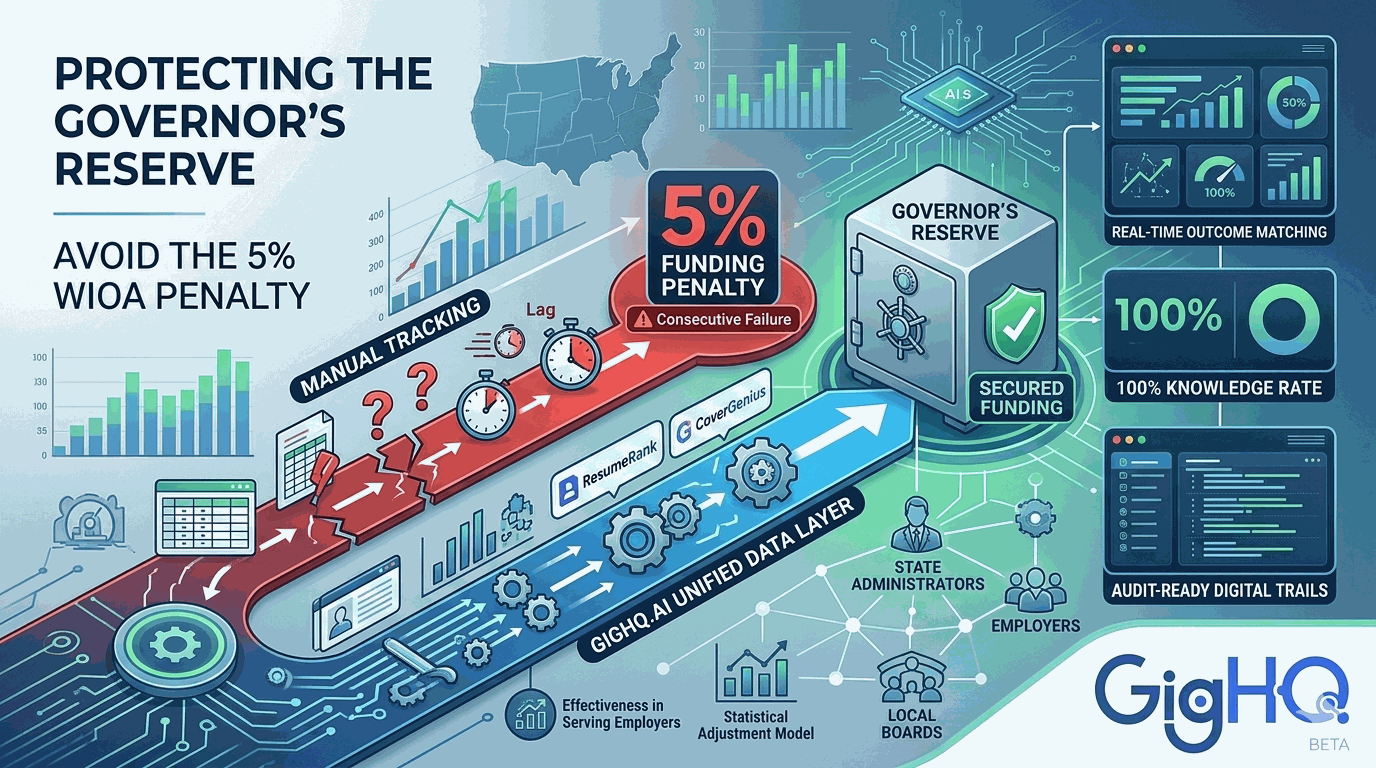
If a state fails to meet its adjusted levels of performance for the same primary performance indicator(s) for two consecutive years, the Secretaries of Labor and Education are mandated to reduce the Governor’s Reserve Allotment by five percent (5%) of the maximum available amount for the succeeding program year (20 CFR § 677.195).
As states move into the 2026 reporting cycles, the business case for a unified, statewide enterprise deployment of GigHQ.ai has never been more urgent. To protect the Governor’s Reserve, states can no longer afford to let local boards rely on fractured, manual tracking systems.
The “Consecutive Failure” Trap: Why Manual Systems are a Liability
The 5% penalty is a compounding risk. Under WIOA Section 116, the federal government uses a Statistical Adjustment Model to set performance benchmarks based on the actual economic conditions of the state. Because these benchmarks are dynamic, states that rely on lagged, manual data reporting are essentially flying blind.
1. The Reporting Lag vs. Real-Time Intervention
Traditional outcome reporting often relies on “Frankenstein” spreadsheets and self-reported alumni surveys. By the time a state administrator sees that a specific Local Workforce Development Area (LWDA) is trending toward failure on Q2 Employment Rate or Median Earnings, it is often too late to intervene.
- The GigHQ Advantage: By deploying GigHQ.ai as a unified data layer across all LWDAs, states gain real-time visibility. Administrators can see exactly where participants are applying, who is hiring them, and what specific interventions (e.g., ResumeRank or CoverGenius) are moving the needle.
2. The Credibility of Evidence
Under 20 CFR § 677.190, sanctions are applied when states fail to submit “accurate and complete” performance reports. Manual systems are prone to human error, missing Social Security Numbers (SSNs), and lost contact with participants.
- The GigHQ Advantage: GigHQ converts the job search into a passive, objective, and auditable data stream. Because participants use their unique
@gighq.aiemail to track every confirmation and offer, the evidence of “Effectiveness in Serving Employers” is verified at the source, not reconstructed from memory six months later.
The Business Case: ROI of Protecting the 5%
Consider a state with a $100 million total Title I allotment. A 5% reduction in the Governor’s Reserve isn’t just a loss of $5 million in innovation capital; it’s a loss of the state’s ability to maintain “Sustained Fiscal Integrity” (WIOA Sec. 106).
A statewide enterprise deployment of GigHQ.ai standardizes the “Outcome Data Matching” process. Instead of 20 different local boards using 20 different manual tracking methods, the state creates a Unified Signal.
Key Quantifiable Benefits of Statewide GigHQ Deployment:
- Elimination of “The Black Box”: Achieve a 100% “Knowledge Rate” by seeing participant application activity in real-time.
- Audit Readiness: Every reported placement is backed by a digital trail of applications, interviews, and offer letters.
- Standardized Performance: LWDAs that are underperforming can be automatically identified for technical assistance before the first failure year concludes, preventing the second-year failure that triggers the 5% penalty.
Conclusion: From Passive Reporting to Active Defense
WIOA was designed to shift the focus from “training” to “outcomes.” In this new regulatory environment, data is not just a reporting requirement—it is a defensive asset.
Protecting the Governor’s Reserve requires a shift from manual tracking to an AI-driven copilot system that empowers the job seeker while verifying the result. Don’t wait for a federal sanction to realize your data system is broken.
Ready to standardize your state’s outcome tracking?
Schedule a Consultation with our Workforce Development Team to see how a statewide enterprise deployment can secure your funding and validate your impact.
Our Platform Tools:

ResumeRank
Scan your resume, get a score, fix what matters.

CoverGenius
Generate personalized, AI-powered cover letters in seconds.

OutreachAgent
Craft perfect networking and AI-powered follow-up emails with ease.

CareerCompass
Instantly generate a personal marketing plan from your resume to define your brand and attract the right opportunities.

Smart Prep
Simulates a real interview based on your resume and the job description, giving you real-time feedback to build your confidence.

Profile Spark
Optimize your LinkedIn profile to attract recruiters and opportunities.