Tale of Two Searches: Rachel vs. Sarah
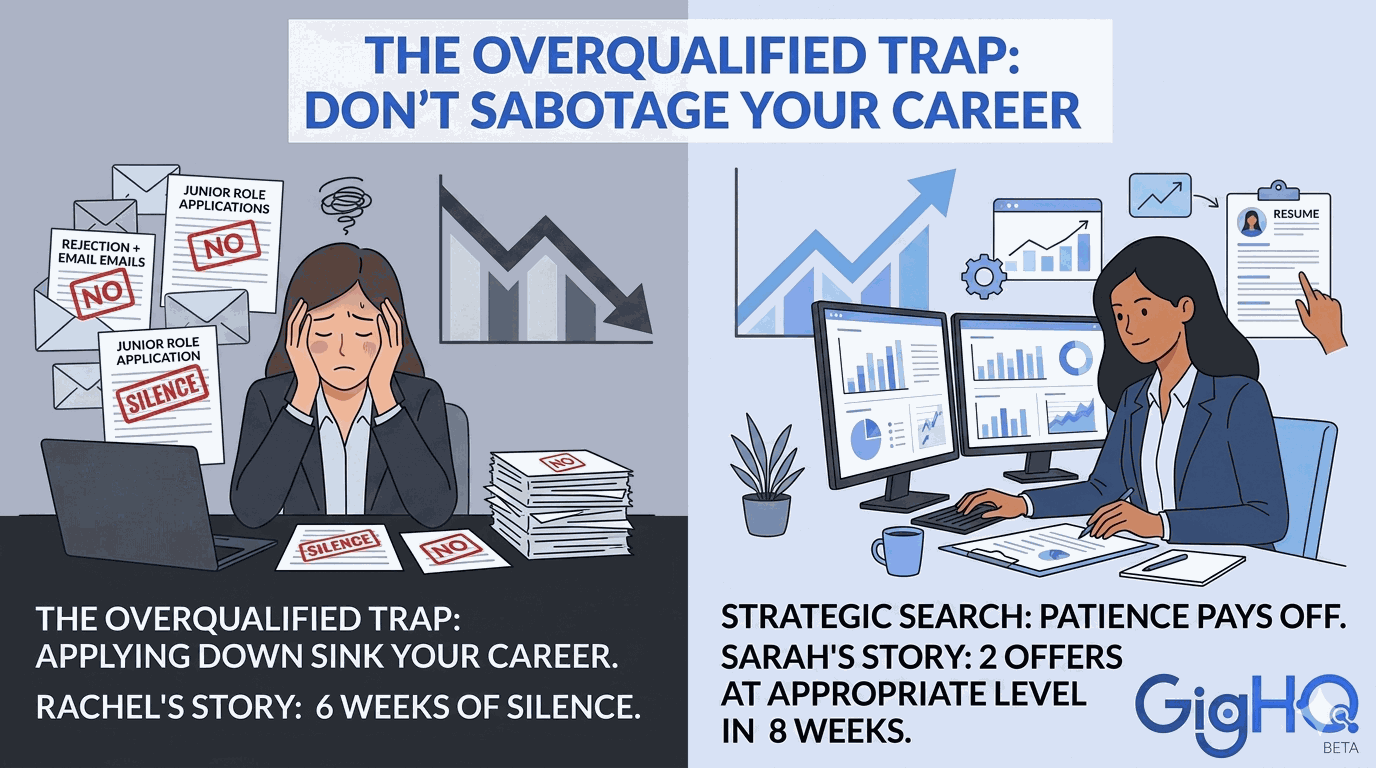
Rachel’s Strategy: After 3 months without interviews for senior analyst roles, she panicked. “Maybe I should apply for junior positions,” she thought. “Companies will love getting someone with my experience for entry-level pay.”
She spent 6 weeks applying for marketing associate and junior analyst roles—positions she’d held 6 years earlier.
Result: Complete silence from employers, plus growing confusion about her market value.
Sarah’s Strategy: After 3 months of similar struggles, she analyzed her approach. Response rate too low? Optimize applications. Wrong companies? Research genuine hiring activity. Skill gaps? Address them strategically.
Result: Two offers at appropriate levels within 8 weeks of strategy adjustment.
The difference? Sarah understood that career regression rarely solves career challenges.
Why the “Overqualified Trap” Backfires Every Time
Reason #1: Employers Spot Desperation Immediately
Hiring managers know that overqualified candidates are either:
- Desperate (red flag about hidden issues)
- Temporary (will leave when better opportunities emerge)
Neither makes you an attractive hire.
Reason #2: Budget Misalignment Creates Problems
Even if you’re willing to accept lower pay, hiring someone whose market value exceeds the role budget creates:
- Internal equity issues with existing team members
- Future retention problems when you inevitably seek appropriate compensation
- Management headaches when you outgrow the role quickly
Reason #3: Skills Atrophy Accelerates
Research shows that 30% of job seekers leave positions within 90 days—often because underemployment creates frustration that forces another job search within months, but now with skill gaps from working below your level.
The Real Reasons Your Appropriate-Level Search Isn’t Working
Before considering career regression, diagnose the actual problems:
Problem #1: Market Intelligence Gaps
- You’re targeting roles with 200+ applicants while similar positions elsewhere get 20 applicants
- You’re applying to companies not actually hiring versus those with genuine immediate needs
- Your industry has seasonal patterns you’re not accounting for
Solution: Use GigHQ’s market intelligence to understand real competition levels and hiring patterns.
Problem #2: Positioning Problems
- Your resume doesn’t clearly communicate value for target roles
- You’re not customizing applications for specific company needs
- Your LinkedIn profile doesn’t match what recruiters search for
Solution: Optimize your resume for ATS and real people rather than lowering your standards.
Problem #3: Timeline Misalignment
- You expect results in 4-8 weeks when professional searches average 4-6 months
- You panic at normal timeline markers instead of staying strategic
Solution: Align expectations with market realities instead of abandoning appropriate targeting.
The Strategic Alternative: Lateral Optimization
Instead of moving down levels, consider strategic lateral moves:
Industry Transition
Move to a growing industry at your current level rather than declining within your current industry.
- Example: Marketing manager in retail → Marketing manager in healthcare tech
- Benefit: New growth opportunities without career regression
Function Expansion
Add complementary skills while maintaining your level.
- Example: Data analyst → Business intelligence analyst with visualization skills
- Benefit: Increased marketability without starting over
Company Quality Upgrade
Sometimes joining a better company at a slightly lower level provides superior long-term prospects.
- Criteria: Clear advancement paths, strong company reputation, industry leadership
- Timeline: 12-18 month plan to return to previous level
When Bridge Roles Actually Make Sense
Occasionally, strategic bridge roles can work—but only with strict criteria:
The Bridge Role Checklist:
✅ Maintains industry positioning and professional network access
✅ Uses 70%+ of your core skills rather than completely underutilizing capabilities
✅ Provides clear advancement timeline (12-18 months max)
✅ Comes with documented growth plan from hiring manager
✅ Allows continued skill development relevant to your career goals
If fewer than 4 criteria are met, keep searching at your appropriate level.
The 4-Week Overqualified Recovery Plan
If you’ve been applying below your level, here’s how to recover:
Week 1: Market Reality Assessment
- Stop all applications below your appropriate level immediately
- Research actual competition and hiring patterns for appropriate-level roles
- Calculate your real response rates for strategic applications
Week 2: Positioning Optimization
- Analyze why appropriate-level applications aren’t generating responses
- Build your job search marketing plan based on market feedback
- Optimize resume and LinkedIn profile for target roles
Week 3: Strategic Application Resume
- Apply to 8-10 appropriate-level roles with optimized materials
- Focus on companies with genuine hiring activity
- Practice interviewing for confidence rebuilding
Week 4: Momentum Building
- Track response rate improvements from optimized approach
- Connect with professional communities for support and accountability. Try the GigHQ discord, Never Search Alone, or LinkedIn’s AHF
- Plan sustainable search approach for realistic timelines
Quick Confidence Rebuilders
When you’re tempted to apply below your level:
Review your accomplishments: List 10 specific achievements from your most recent role with metrics and outcomes.
Research salary data: Confirm that your experience commands appropriate compensation in current market.
Connect with peers: Talk to people at your level who’ve successfully changed jobs to normalize the timeline and process.
Skill development: Instead of career regression, address any genuine skill gaps through strategic learning.
The Opportunity Cost of Going Backwards
Consider what you lose by accepting roles below your level:
- Immediate: 20-40% salary reduction, benefit cuts, longer commutes often come with “easier” roles
- 1 year: Skill atrophy, reduced network access, potential need to job search again
- 5 years: Hundreds of thousands in lost lifetime earnings, damaged career trajectory
- 10 years: Professional identity confusion, reduced advancement opportunities
Compare this to extending your strategic search by 2-3 months to find appropriate opportunities.
Your Anti-Regression Mantras
When desperation tempts you toward underemployment:
“My experience has value that the right employer will recognize and pay for.”
“Career regression rarely solves career challenges—it usually creates bigger ones.”
“Strategic patience now prevents years of career recovery later.”
“The right opportunity at my level is worth waiting for.”
Moving Forward: Patience With Your Professional Worth
The overqualified trap promises immediate relief from job search frustration, but it typically creates far bigger problems than it solves. With 30% of people leaving jobs within 90 days, desperate decisions often force additional job searches within months—except now with career regression to explain.
Your experience, skills, and professional development represent years of investment. Don’t abandon that investment due to temporary search challenges that fall within normal market timelines.
The sustainable job search approach emphasizes building systems that work for realistic timelines rather than forcing quick results through professional compromise.
The most successful professionals don’t avoid search challenges—they develop the resilience to navigate them without compromising their career trajectory. Extended searches at appropriate levels ultimately lead to better outcomes than quick fixes through underemployment.
Your next role should advance your career, not retreat from the progress you’ve already made. Stay focused on opportunities that recognize and reward your actual capabilities, and resist the temptation of “easier” roles that are neither easier to get nor beneficial to accept.
The right opportunity at your appropriate level is worth the strategic patience required to find it.
Our Platform Tools:

ResumeRank
Scan your resume, get a score, fix what matters.

CoverGenius
Generate personalized, AI-powered cover letters in seconds.

OutreachAgent
Craft perfect networking and AI-powered follow-up emails with ease.

CareerCompass
Instantly generate a personal marketing plan from your resume to define your brand and attract the right opportunities.

Smart Prep
Simulates a real interview based on your resume and the job description, giving you real-time feedback to build your confidence.

Profile Spark
Optimize your LinkedIn profile to attract recruiters and opportunities.