The regulatory ground beneath higher education just fractured.
Under a federal accountability test rolling out from the U.S. Department of Education, colleges and universities face a deceptively simple standard: leave your graduates financially better off than if they had never enrolled, or risk losing access to federal student loans entirely.
Dubbed the “Do No Harm” test—codified as part of the broader transparency and gainful employment framework under recent federal legislation—the rule draws a stark line in the sand:
- Undergraduate programs must prove their graduates earn more than typical high school graduates who never attended college (setting a benchmark floor between $30,000 and $41,000 per year depending on the state).
- Graduate programs must show alumni earn more than those holding only a bachelor’s degree.
- Programs that fall below the earnings threshold for two out of three consecutive years face disqualification from Title IV federal student aid.
As Under Secretary of Education Nicholas Kent plainly stated:
“If a program cannot show that it leaves its graduates financially better off than if they had never enrolled, it should not be underwritten by federal taxpayers.”
While the Department of Education begins calculating graduate earnings in early 2027—with the first public designations of “low-earning outcome programs” landing in the 2028–2029 award cycle—higher education leaders, career service directors, and workforce programs cannot afford to wait.
The policy has ignited a fierce national debate over the core mission of higher education, but it exposes a far deeper, immediate crisis: institutions are being audited on employment outcomes they currently have almost no real-time visibility into.
The Collateral Damage: Why the Creative and Care Economies Are on Edge
Federal estimates indicate that more than 800,000 students currently attend programs projected to fail this threshold. While roughly half of those are concentrated in predatory for-profit certificates, the fallout reaches directly into traditional public and nonprofit campuses:
- 18% of undergraduate certificate programs (especially in cosmetology, culinary, and wellness) are projected to miss the floor.
- 6% of associate degree programs, led by early childhood education, are at high risk.
- 4% of master’s degree programs, particularly in essential mental and social health services, face severe scrutiny.
- 14% of bachelor’s degree music programs—including storied institutions like The Juilliard School, the New England Conservatory, and Indiana University Bloomington’s Jacobs School of Music—are projected to fail.
Consider Cindy Flores, a Mexican American mariachi teacher in Oregon featured by NPR. Flores utilized federal student loans to attend Portland State University (PSU) and earn her educator’s license. Today, she mentors students in Salem-Keizer Public Schools, earning a living wage and performing vital cultural and community work. Yet, because starting arts educator wages often ramp slowly, PSU’s music program is among those projected to fail the new federal calculation.
Advocates like Lee Ann Scotto Adams and Doug Dempster from the Strategic National Arts Alumni Project (SNAAP) have sounded the alarm: artists and community educators experience non-linear career trajectories. Their wages often start modestly and stabilize or climb over five to ten years.
Yet, Washington’s new ruler is rigid. If colleges respond by preemptively slashing humanities, studio arts, music, and social service degrees, our cultural and civic fabric will be severely diminished.
The Real Crisis: Flying Blind in a Rearview-Mirror System
Beyond the philosophical debate over whether college is “just about money,” colleges and career services face an existential operational obstacle: they cannot prove graduate success using obsolete tools.
Today, higher ed institutions evaluate post-graduation success through two deeply flawed mechanisms:
1. The Broken First Destination Survey (FDS)
Most universities still chase alumni using emails, text blasts, and phone calls months after commencement. National response rates rarely exceed 20% to 30%. Unemployed or struggling grads avoid responding due to stigma, while high earners self-select in. The result? Skewed, unreliable data that fails federal data validation standards.
2. Lagging, Blind Unemployment Insurance (UI) Records
State wage records seem objective, but they harbor fatal blind spots:
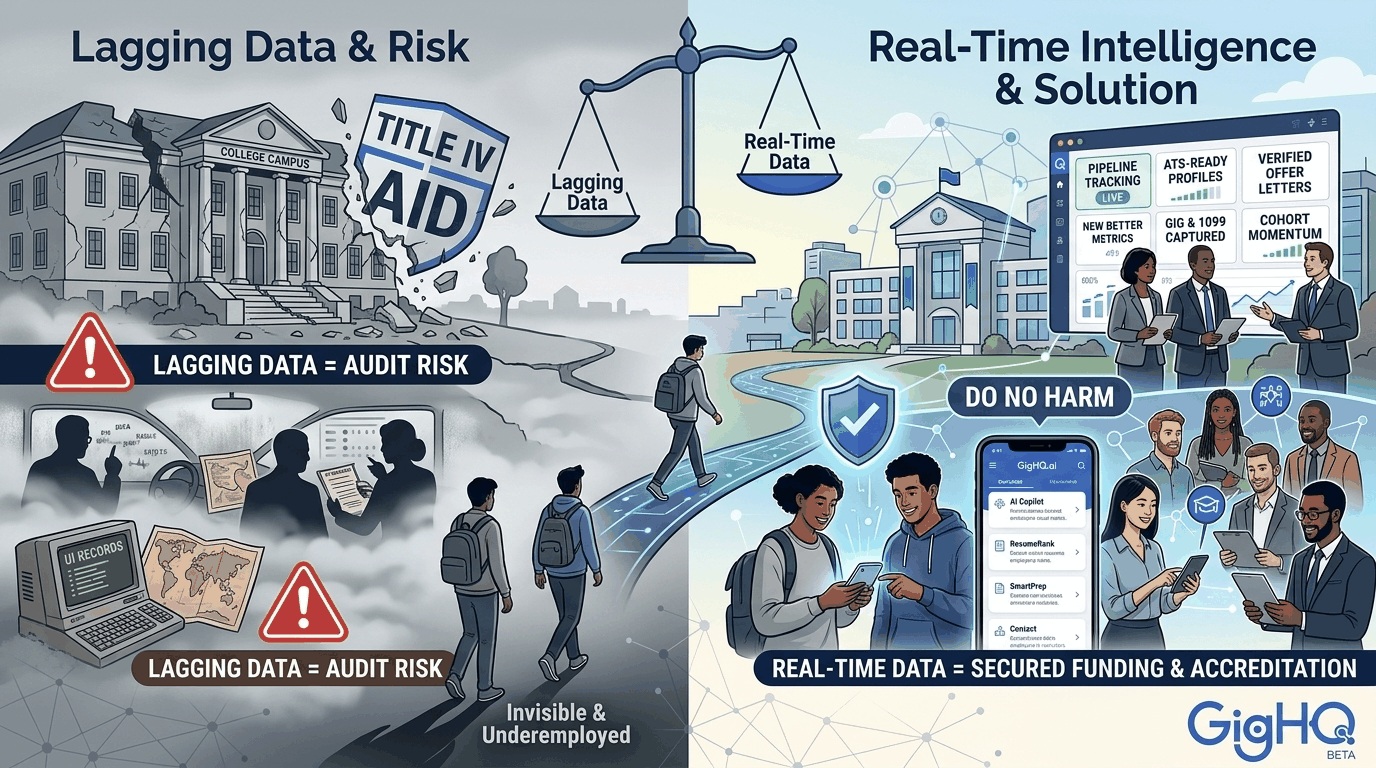
- Severe Time Lag: UI records typically lag by two to four quarters. They tell university deans what happened a year ago—far too late to intervene.
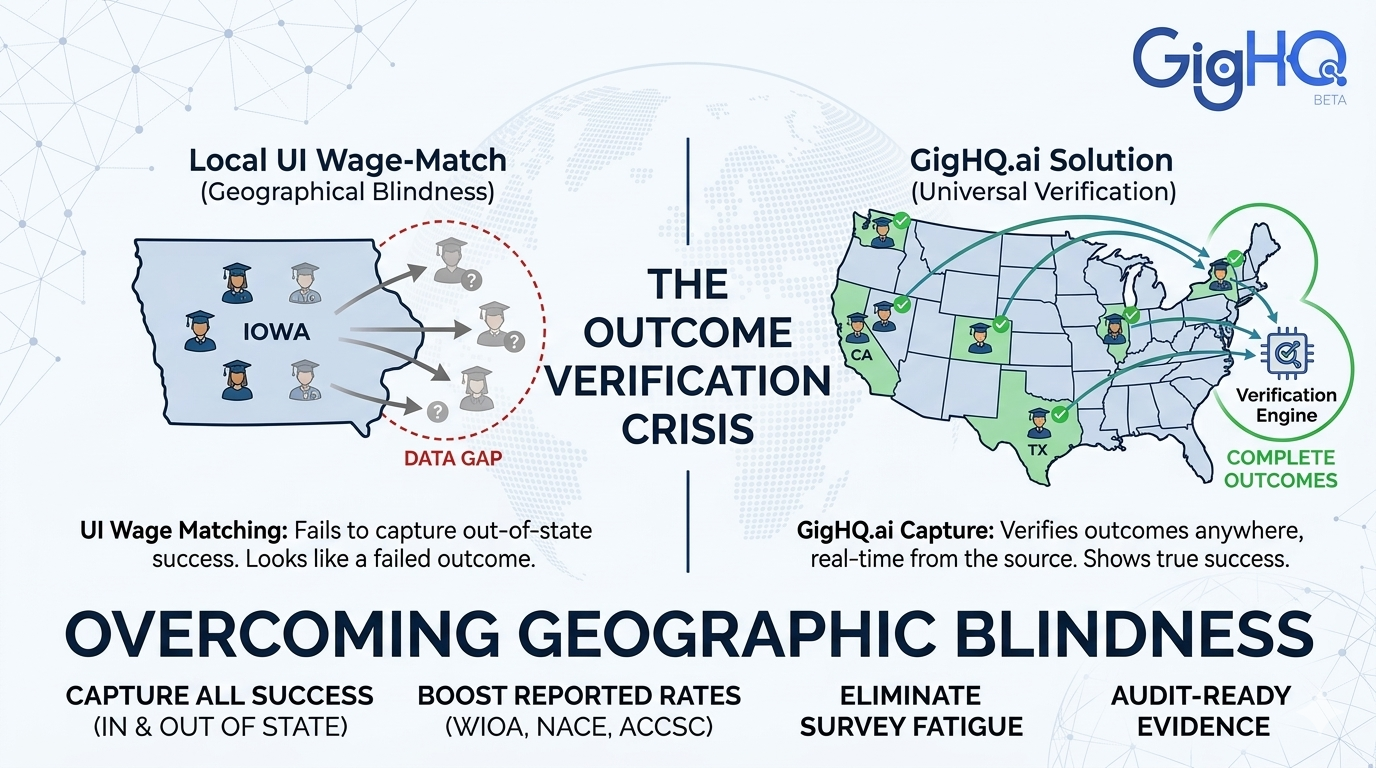
- State “Brain Drain” Blindness: State UI datasets cannot see across state borders. When top engineering, business, or arts graduates move from Iowa or Texas to New York, Chicago, or San Francisco, state databases often record them as “unemployed.”
- The Gig & 1099 Economy Black Box: UI records only capture standard W-2 payroll. Freelancers, studio artists, digital media creators, contract instructors, and gig economy professionals are completely invisible.
If an institution relies on outdated surveys and lagging state databases, they are driving toward a federal compliance cliff with grease on their windshield.
From Panic to Precision: Measuring Leading vs. Lagging Indicators
To survive the “Do No Harm” era and state-level ROI mandates (like Texas HB 8 or emerging Commission for Public Higher Education standards), higher ed must stop acting like a retrospective call center.
Waiting until two years post-graduation to discover that 25% of your cohort never found living-wage employment is institutional negligence. Institutions need leading indicators during the job search itself:
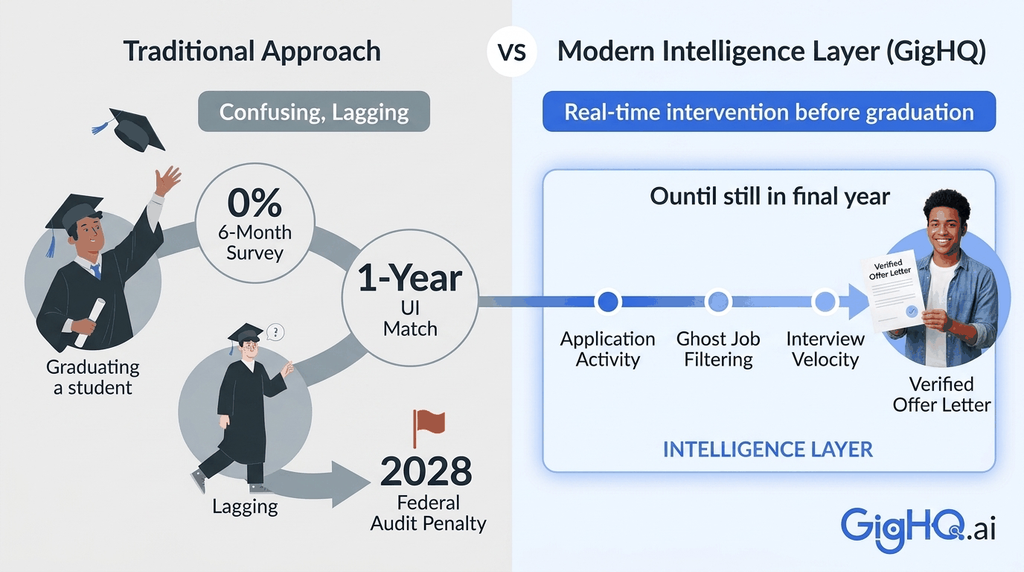
When career centers and academic departments know in real time:
- Which majors are sending hundreds of resumes without interview requests,
- Which job postings are unresponsive “ghost jobs” that burn student momentum, and
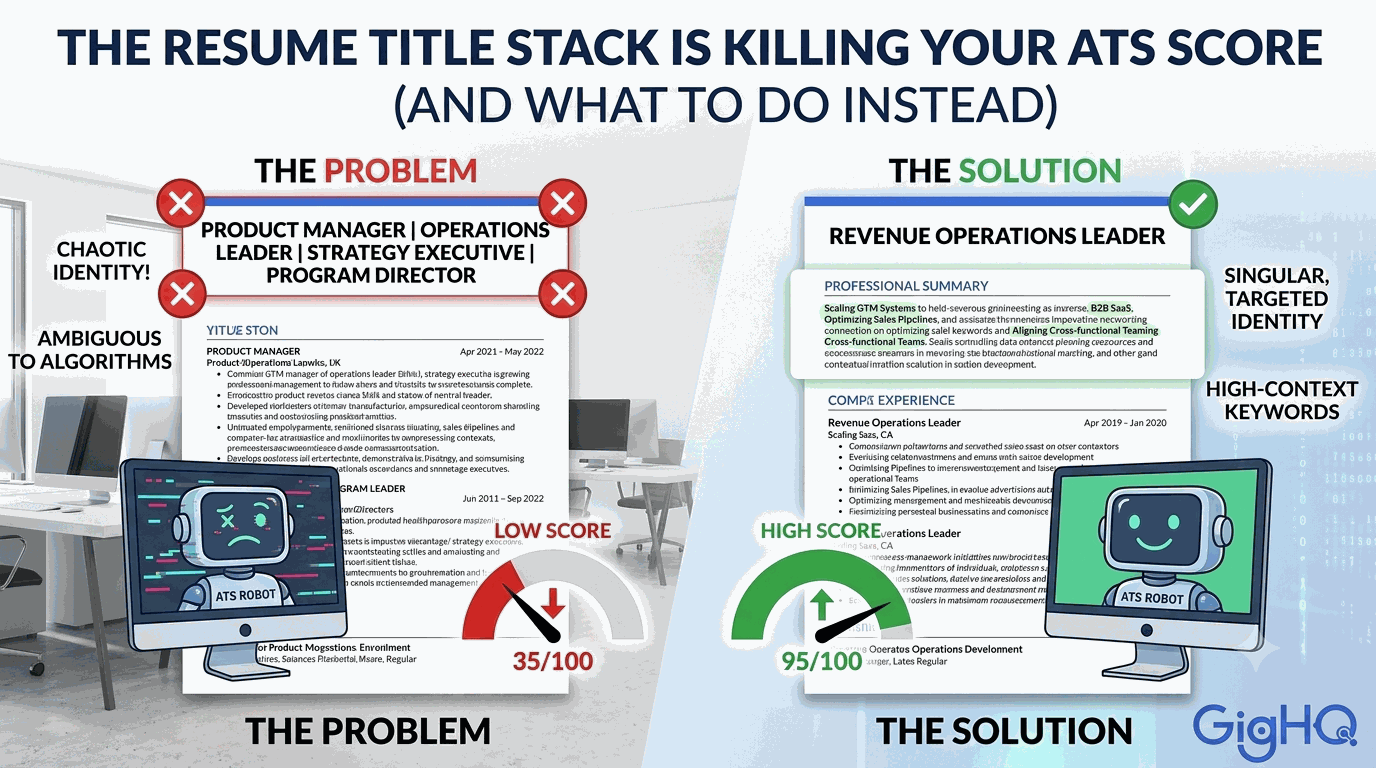
- Which specific skill and keyword gaps are triggering automated ATS rejections…
…advisors can intervene before the student graduates into underemployment.
How GigHQ.ai Turns the Job Search into Auditable Outcome Evidence
At GigHQ.ai, we believe the solution begins by empowering the student first. You cannot solve the institutional data crisis by burdening graduates with more surveys; you solve it by giving students tools they actually want to use.
GigHQ.ai bridges the gap between student success and institutional compliance through a dual-sided ecosystem:
1. For Students: The AI-Powered Job Search Copilot
Job hunting should not feel like an unguided second full-time job. GigHQ equips students and alumni with:
- Automated Pipeline Tracking: By applying with a dedicated @gighq.ai email address, every application, status change, and recruiter response is organized automatically—no spreadsheets required.
- The GigHQ Chrome Extension: Provides instant “heads-up display” intelligence across LinkedIn, Indeed, Handshake, and 50+ ATS platforms, identifying company hiring trends and exposing unvetted ghost jobs.
- Intelligent Application Tools: Students can match their resumes against real job requirements with ResumeRank, generate tailored positioning with CoverGenius, and rehearse behavioral scenarios with SmartPrep.
- Living Career Journaling: An ongoing log that translates academic achievements, performances, and projects into quantifiable STAR/CAR stories for interviews.
(Curious how it works in action? Watch our walkthrough of automating your job search tracking or explore our integrations with ChatGPT and Claude.)
2. For Career Services & Workforce Leaders: The Institutional Data Layer
While students gain a world-class copilot, career centers and workforce development organizations (WDOs) gain the structured, verifiable intelligence they need to protect accreditation and Title IV eligibility:
- Passive, Real-World Outcome Capture: GigHQ automatically identifies confirmed offer letters, company names, job titles, and compensation baselines directly from verified correspondence—creating audit-ready documentation without survey fatigue.
- Real-Time Intervention Dashboards: Counselors see cohort momentum live. If an entire arts or human services cohort is struggling to convert applications into interviews, coaches can immediately diagnose whether it’s a portfolio presentation issue or a regional market shift.
- Next-Gen AI Integrations: Through native support for tools like the GigHQ MCP Server, students can collaborate with career copilots directly in Claude and ChatGPT, keeping career development aligned with modern workflows.
As highlighted in our deep dive on shifting the AI narrative in career services, artificial intelligence shouldn’t be used to flood recruiters with spam; it should provide high-signal clarity to both candidates and institutions.
The Bottom Line: Accountability Demands Action
The “Do No Harm” standard signals a permanent transition in American education policy: trust is being replaced by verification.
Whether you lead a large public university, an arts conservatory, a community college, or a career training bootcamp, the clock toward the 2027 earnings evaluation has started. The institutions that survive and thrive won’t be those that slash valuable cultural programs in fear. They will be the institutions that modernize their career infrastructure, eliminate the “black box” between graduation and employment, and empower their students with data-driven career navigation.
Stop relying on retrospective surveys. Equip your students, de-risk your programs, and validate your outcomes.
Ready to Transform Your Institution’s Career Outcomes?
- For Universities & Workforce Boards: Request a Demo to discover how GigHQ’s Coach Portal and verifiable outcome engine protect Title IV funding and drive placement.
- For Students & Job Seekers: Take control of your career today. Sign up for GigHQ.ai and install the Chrome Extension—free forever.
Our Platform Tools:

ResumeRank
Scan your resume, get a score, fix what matters.

CoverGenius
Generate personalized, AI-powered cover letters in seconds.

OutreachAgent
Craft perfect networking and AI-powered follow-up emails with ease.

CareerCompass
Instantly generate a personal marketing plan from your resume to define your brand and attract the right opportunities.

Smart Prep
Simulates a real interview based on your resume and the job description, giving you real-time feedback to build your confidence.

Profile Spark
Optimize your LinkedIn profile to attract recruiters and opportunities.