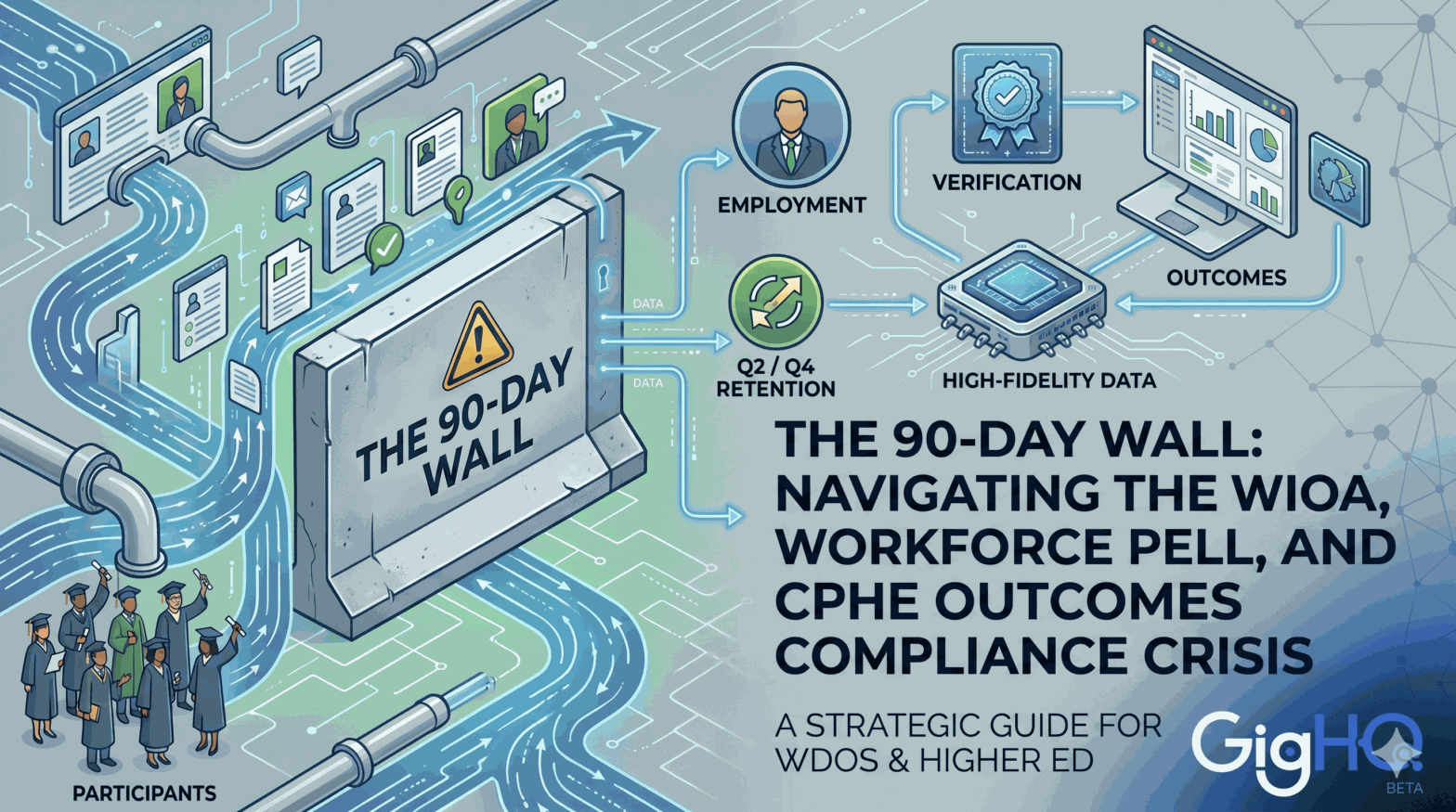
For Workforce Development Organizations (WDOs), higher education institutions, and career-focused vocational programs, the transition from enrollment to employment represents an existential, high-stakes milestone. Historically, these institutions have operated in a “black box” or what is commonly known as the “90-Day Wall.” The moment a participant exits a program, WDOs often lose immediate, high-fidelity visibility into their job search activities.
Yet, under mounting bipartisan pressure, federal agencies and state boards are enforcing rigid definitions of “data validity.” Funding, accreditation, and institutional survival are now directly tied to verified post-exit outcomes.
Into this compliance gap steps a new class of technology platforms. By transforming the job search process into a continuous “Community Signal” of passive, objective data, GigHQ.ai replaces lagging retrospective surveys with real-time, compliance-grade analytics.
1. The Regulatory Shockwaves of 2026
The compliance landscape has shifted dramatically. Under recent federal mandates and bipartisan legislative efforts in the 118th and 119th Congresses, the public workforce development system is tightening performance accountability.
1.1 The 50% Direct Training Mandate
Under H.R. 6655 (A Stronger Workforce for America Act), local workforce boards must dedicate at least 50% of WIOA Title I funds for Adults and Dislocated Workers directly to “upskilling” activities, such as Individual Training Accounts (ITAs) and On-the-Job Learning (OJL).
This mandate places immense pressure on states to maintain a high-quality Eligible Training Provider List (ETPL). Under these updated standards, training providers can no longer simply self-attest to their placement rates; they must report verifiable outcome metrics for all students—not just those funded by WIOA. If a provider’s placement rates drop below strict performance thresholds (often requiring a minimum of 70% placement), they risk being stripped of federal eligibility.
1.2 Executive Order 14278 and Workforce Pell
The pressure has been amplified by Executive Order 14278, “Preparing Americans for High-Paying Skilled Trade Jobs of the Future.” This directive mandates that the U.S. Departments of Labor, Education, and Commerce coordinate deep system integrations to prepare for Workforce Pell—which expands federal Pell Grant eligibility to high-quality, short-term career programs (between 8 and 15 weeks in duration).
To qualify, programs must rigorously document “Gainful Employment” metrics. Because states are required to submit their two-year WIOA Unified and Combined State Plan modifications for Program Years (PY) 2026 and 2027, local workforce boards and colleges are urgently looking for systems that can automatically collect, map, and export compliance-grade student data.
2. The Retention and Verification Crisis
Measuring whether a student landed a job is no longer enough. The modern regulatory regime demands proof of long-term employment stability and wage progression.
       [ Program Exit ]
              │
              ▼
   ⚡ THE 90-DAY SOFT EXIT WALL ⚡  <-- Traditional systems lose contact here
              │
              ├──► Q2 (Quarter 2 Post-Exit): Verified Employment & Earnings
              │
              └──► Q4 (Quarter 4 Post-Exit): Same-Employer Retention (ESE)
2.1 The “Effectiveness in Serving Employers” (ESE) Mandate
The U.S. Departments of Labor and Education have finalized the Effectiveness in Serving Employers (ESE) primary indicator of performance. Transitioning as a baseline metric in the PY 2026-2027 state plans, this indicator explicitly tracks “Retention with the Same Employer” in both the second (Q2) and fourth (Q4) quarters after program exit.
For a training provider, placing a candidate in a low-quality, temporary job that they leave within six months is now actively penalized. To maximize funding allocations and avoid state performance improvement plans, WDOs must prioritize long-term hiring fit over raw placement volume.
2.2 The “Brain Drain” and Out-of-State Wage Record Gap
Traditional compliance systems rely almost exclusively on State Unemployment Insurance (UI) wage matching via the State Wage Interchange System (SWIS). However, this creates a major structural blind spot:
- The Out-of-State Problem: If an Iowa graduate moves to Chicago, or a Texas graduate secures a remote role for a California company, state UI records register a “$0$ wage” outcome for that individual.
- The Manual Tracing Burden: Case managers are forced to manually track down out-of-state graduates to collect pay stubs or offer letters to prevent data attrition.
- The Missing SSN Gap: Many program participants do not supply Social Security Numbers (SSNs), making automated SWIS matches impossible.
Under TEGL 23-19 Change 1 and TEGL 26-16, WDOs are permitted to submit supplementary wage documentation to prove outcomes. However, collecting pay stubs and offer letters manually is highly labor-intensive and error-prone, leaving WDOs highly vulnerable during federal data validation audits.
3. Strategic Analysis: How GigHQ.ai Solves the Compliance Void
GigHQ.ai sits upstream of traditional compliance systems, functioning as an AI-driven career copilot for the job seeker and an automated outcomes data layer for the institution.
3.1 The “Student-First” Ingestion Strategy
Legacy career platforms (such as Handshake or 12twenty) rely on retrospective, self-reported exit surveys sent months after graduation, yielding notoriously low response rates.
GigHQ.ai takes a different approach: it provides students with high-utility, day-to-day search tools that they actually want to use.
- The
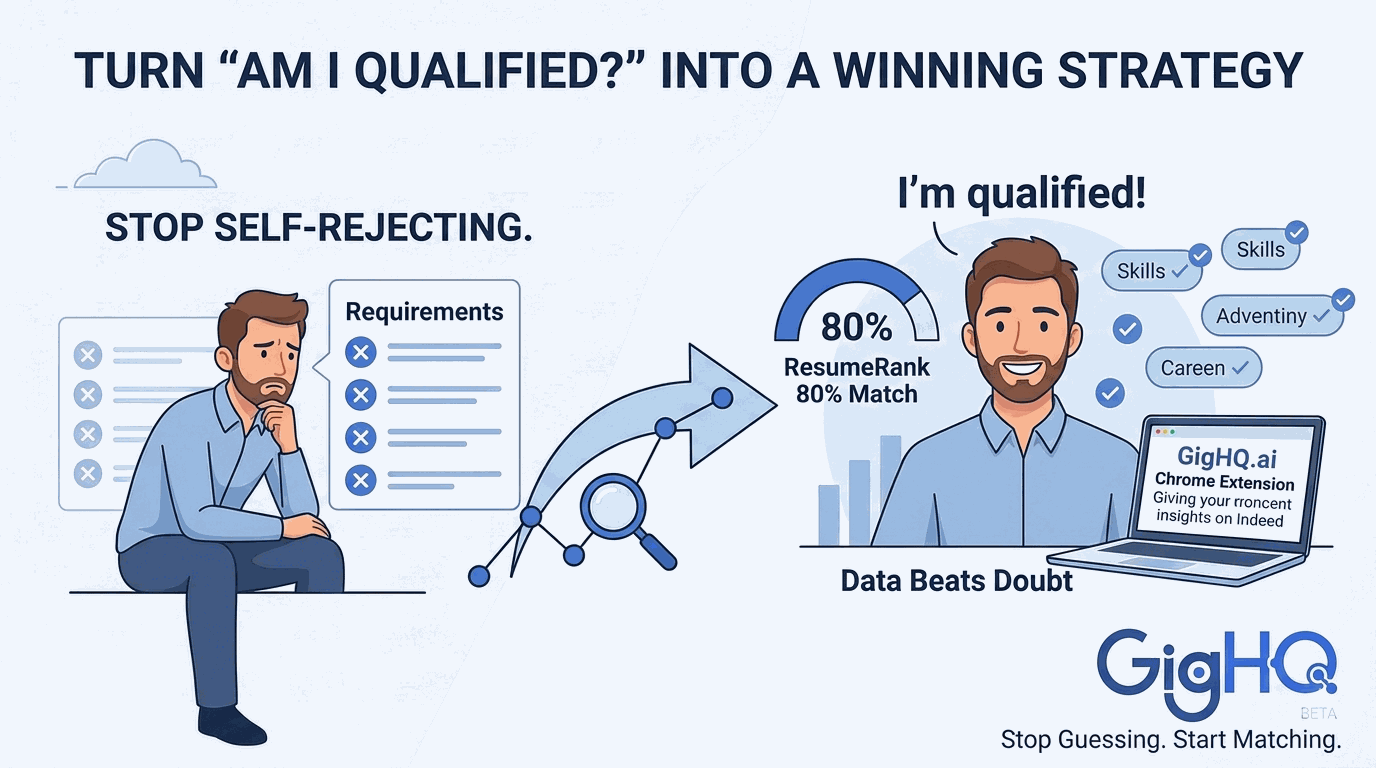
@gighq.aiEmail Layer: GigHQ issues each user a dedicated email alias for job applications. When confirmation emails, interview invitations, and job offers land in this inbox, the system automatically tracks and logs the application timeline. See how to track job applications without a spreadsheet. - The GigHQ Chrome Extension: This browser-based command center sits directly on top of platforms like LinkedIn, Indeed, and Handshake, surfacing “Ghost Job” alerts, resume match scores, and hiring timelines in real-time. Check out the Chrome extension demo.
- AI-Powered Suite: Users instantly leverage ResumeRank to identify skills gaps, CoverGenius to craft tailored, high-intent applications, OutreachAgent for networking, and SmartPrep for interactive mock interviews.
By acting as the student’s daily workflow tool, GigHQ.ai passively captures high-fidelity, time-stamped employment data—including offer letters, job titles, start dates, and wages—long before retrospective surveys are sent.
3.2 The “Community Signal” vs. Traditional Databases
| Feature | Handshake / Symplicity | Retrospective Surveys | GigHQ.ai |
| Data Ingestion | Self-reported or employer-posted | Manual outreach (phone/email) | Passive, automated tracking via @gighq.ai email & extension |
| Metrics Captured | Trailing outcomes | Trailing outcomes | Real-time leading indicators (application volume, interview rates) |
| Out-of-State Tracking | Low / Incomplete | Poor response rates | High (captured directly from digital offer letters) |
| Audit Defense | Low (self-attestation) | Very low (verbal confirmation) | High (auditable digital record with document verification) |
| Compliance Support | Minimal | None | Directly maps to PIRL, TEGL 23-19, and CPHE Standard 19 |
4. Unlocking Leading Indicators: Moving Beyond Lagging Data
Relying solely on trailing UI wage data is like driving a car by only looking in the rearview mirror. By the time a WDO learns that a cohort failed to meet its Q2 employment metrics, the program has already ended, and federal funding is already at risk.
GigHQ.ai shifts workforce leaders from a lagging posture to a predictive, leading posture:
[ Real-Time Data Flow: From Search to Verification ]

   Student Activity          AI Funnel Analysis        Predictive Alerts
 ┌──────────────────┐      ┌──────────────────┐      ┌───────────────────┐
 │ Applications Sent│ ───► │  Interview Rates │ ───► │ Counselor Alert:  │
 │  & Customizations│      │   & Ghost Jobs   │      │ At-Risk Candidate │
 └──────────────────┘      └──────────────────┘      └───────────────────┘
                                                               │
   Auditable Verification                                      ▼
 ┌──────────────────┐      ┌──────────────────┐      ┌───────────────────┐
 │ Secure Pay Stub  │ ◄─── │ Digital Offer    │ ◄─── │ Guided Career     │
 │  & Offer Upload  │      │ Letter Captured  │      │  Placement & Fit  │
 └──────────────────┘      └──────────────────┘      └───────────────────┘
- Intervention Alerts: Counselors can monitor real-time dashboards to identify at-risk students (e.g., those with 50+ applications but zero interview requests) and intervene with resume updates before they exit the program.
- The “Ghost Job” Audit: GigHQ aggregates user data to flag fake or stagnant job postings, preventing job seekers from wasting valuable search hours on listings that never convert to interviews.
- Advanced LLM Integrations: Through the GigHQ MCP Integration, students can connect their local Claude.ai or ChatGPT clients directly to their GigHQ account to perform customized skills-gap analyses, avoiding the need to manually copy-paste their resumes or job description data. See how to connect Claude to GigHQ.
5. Strategic Recommendations for Institutional Leaders
To protect federal funding, maintain compliance, and optimize student outcomes in this new regulatory environment, workforce and higher education leaders should adopt the following strategies:
5.1 Shift Budgets to “Programmatic Activity” Costs
Many WDOs are constrained by WIOA’s strict $10\%$ administrative cost limit. To bypass this barrier, work with legal counsel to classify your GigHQ.ai enterprise subscription as a direct program cost (workforce preparation/career services) rather than administrative overhead. Because the platform provides direct, active job-hunting tools for the student, it qualifies as an allowable programmatic resource.
5.2 Build a “Compliance Locker” for Supplemental Verification
Relying solely on retrospective, self-reported placement data is a significant regulatory risk under TEGL 23-19 Change 1. WDOs should establish digital “compliance lockers” within their data workflows. By prompting students to securely upload digital offer letters and pay stubs directly to their profile upon landing a job, GigHQ provides the machine-readable, auditable evidence required to satisfy federal auditors.
5.3 Adopt “Standard 19” Best Practices for CPHE Accreditation
As public universities transition to outcomes-based accreditors like the Commission for Public Higher Education (CPHE), they must show systematic, “best practices” alignment with local workforce needs (Standard 19). Implement tools like GigHQ to measure application-to-interview velocity by major and document out-of-state career successes, shielding your institution from regional “brain drain” penalties.
Conclusion: The Future of Workforce Development is Proven
The era of manual surveys, anecdotal guidance, and unverified outcomes is coming to a close. As state plans under PY 2026-2027 demand precise, long-term employment retention metrics, and programs transition to outcomes-based accreditors, the winners of the next decade will be those who integrate real-time student support with robust, verifiable data pipelines.
By deploying GigHQ.ai as an active copilot for students, institutions finally gain the real-time visibility they need to influence job searches while they are still happening—proving, beyond a shadow of a doubt, that their programs deliver life-changing economic mobility.
Interested in seeing how GigHQ.ai can transform your organization’s compliance tracking and placement rates? Schedule a consultation with our partnerships team today.
Works Cited & Further Reading
- U.S. Department of Labor (DOL) Performance Guidance: TEGL 23-19 Change 1 – Data Validation Guidelines
- WIOA Joint Final Rule: Performance Accountability Guidance for Core Programs
- A Stronger Workforce for America Act (H.R. 6655): Congress.gov Legislative Text
- National Association of Colleges and Employers (NACE): First Destination Survey Standards and Protocols
- CPHE Initiatives: The Commission for Public Higher Education Accreditation Standards
Our Platform Tools:

ResumeRank
Scan your resume, get a score, fix what matters.

CoverGenius
Generate personalized, AI-powered cover letters in seconds.

OutreachAgent
Craft perfect networking and AI-powered follow-up emails with ease.

CareerCompass
Instantly generate a personal marketing plan from your resume to define your brand and attract the right opportunities.

Smart Prep
Simulates a real interview based on your resume and the job description, giving you real-time feedback to build your confidence.

Profile Spark
Optimize your LinkedIn profile to attract recruiters and opportunities.