The hybrid approach to the modern job search.
At some point in almost every job search, a well-meaning mentor or industry peer will give you one of two pieces of advice.
The first: “Forget online applications. Nobody gets hired through the portal anymore. It’s all about who you know. Put down your laptop, get out of the house, go to events, call your contacts, and work your network. That’s how jobs are filled—relationships, not resumes.”
The second: “You have to learn how to beat the Applicant Tracking System (ATS). Keywords, formatting, direct tailoring—that’s the only way. The algorithm is the gatekeeper, and until you learn to get past it, none of your networking matters because you’ll never make it through the formal process anyway.”
Here is the hard truth: Both of these people are right. But if you follow either of their advices exclusively, you are going to stay stuck.
The modern job search doesn’t reward people who are great at just one channel. It rewards candidates who understand that these two tracks aren’t in competition—they are complementary. The job seekers who treat them as a unified workflow are the ones consistently winning interviews and closing offers, while everyone else is arguing over which approach is better on Reddit.
Here’s why neither strategy works alone, and what it actually looks like to execute the ultimate dual-track job search using GigHQ.ai.
The Case for Networking—And Why It’s Not Enough on Its Own
Everything you’ve heard about the power of networking is true. A significant majority of roles are filled through relationships before they are ever posted publicly. A referral from an insider moves your application to a completely different pile—both in the system and in the mind of the hiring manager.
When you have an advocate inside the company, the entire dynamic of the hiring process shifts. You gain “inside baseball” context:
- What the team is actually struggling with.
- What pain point the hiring manager is trying to solve.
- Language that should appear in your resume but isn’t written in the job description.
These advantages are real, and they compound over time. A strong professional network is the most durable asset you can build in your career.
But here is what networking cannot do on its own:
- It cannot scale. Your network has structural limits. There are only so many people you know, only so many companies where you have a warm connection, and only so many roles open at any given moment. If you are in a career transition or targeting a new industry, you cannot manufacture warm introductions on demand.
- It doesn’t bypass the formal process. In modern corporate recruitment, even a direct referral has to go through the ATS. Your resume will still be parsed. You still have to clear the same screening hurdles. A referral gets you looked at; it does not get you hired. Your materials still have to carry their own weight.
- It makes you passive. Relying solely on networking means you are waiting for the right conversation to happen, rather than actively targeting the companies you want.
The Case for “Beating the Bots”—And Why It’s Not Enough on Its Own
The data supporting ATS optimization is equally clear. Candidates who tailor their resumes, align keywords, and clean up their formatting win interviews at dramatically higher rates. The gap between a generic application and a highly optimized one is the difference between a $6\%$ response rate and a $33\%$ response rate.
That is a massive edge, and it’s entirely within your control regardless of your network size.
Optimization gives you access to the entire market. You can target companies where you don’t know a single soul. You can apply the second a listing goes live.
But here is what optimization cannot do on its own:
- It cannot overcome the “Ghost Job” epidemic. Here is a terrifying statistic from our platform: up to $73\%$ of job listings on major platforms (including LinkedIn Premium and Handshake) are actually “ghost jobs”—postings that companies keep active with zero active intent to hire. No amount of resume optimization will get you an interview for a job that doesn’t actually exist.
- It can’t replace human judgment. At some point, a human being will read your resume, look at your portfolio, and sit across from you in an interview. The ATS gets you to the room; the human connection closes the deal.
- It has a hard ceiling. If you are a marginal fit on paper, even a perfectly tailored resume can’t explain your potential the way a warm introduction can.
Why People Choose One Track (and Fail)
Running both tracks simultaneously is hard. It requires a level of emotional and analytical energy that most job seekers simply don’t have when they are operating at their stress ceiling.
- Networking requires vulnerability—reaching out to old contacts, admitting you are looking, and showing up even when you don’t feel like it.
- Optimization requires deep discipline—slowing down to tailor your resume, interrogating your past work for metrics, and treating your application like a precise engineering project.
Because running both is exhausting, most people unconsciously pick whichever track feels more comfortable.
- The Networkers feel productive because they are having coffee chats, but their pipeline stays thin because they aren’t generating formal applications.
- The Optimizers feel productive because they are hitting “Apply” fifty times a day, but they are throwing their resumes straight into a digital void where $95\%$ of applications go completely unanswered.
Both groups are working incredibly hard. Neither is playing the full game.
The Hybrid Approach: How the Two Tracks Feed Each Other
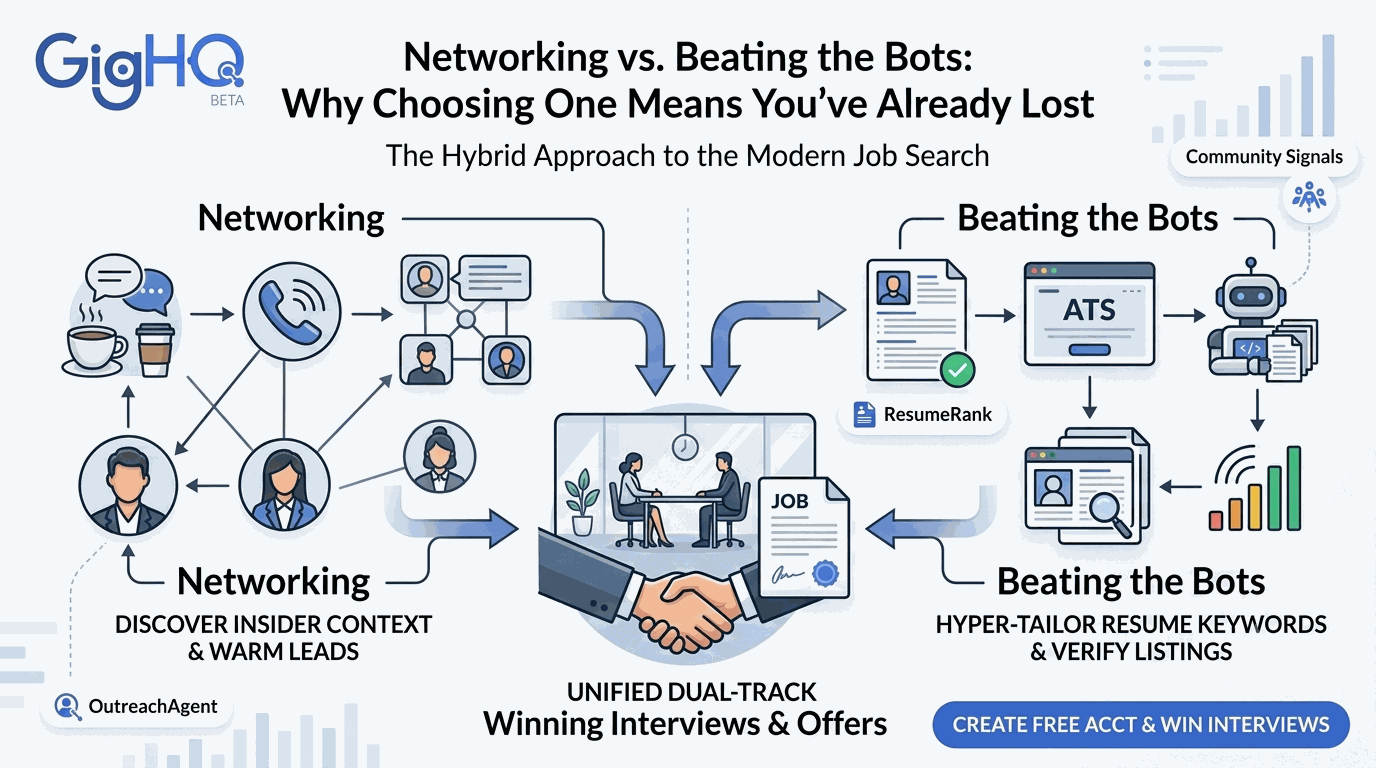
The hybrid approach isn’t about splitting your week $50/50$ between two separate strategies. It’s about building a workflow where networking feeds your applications, and your applications sharpen your networking.
   [Networking Track]                  [Application Track]
  Discover insider context  =======>  Hyper-tailor resume keywords
  & identify warm leads                 using ResumeRank
         ||                                    ||
         \/                                    \/
   OutreachAgent drafts     <=======   Verify listing is real with
  personalized warm intros             GigHQ Community Signals
Here is how you operationalize this dual-track search with GigHQ.ai, step-by-step:
1. Let the “Community Signal” Filter the Noise
Stop applying to ghost jobs. When you are browsing job boards, use the GigHQ Chrome Extension (see how it works in this short video demo) to instantly see real-time application trends and authenticity indicators. If our system flags a role as highly inactive, don’t waste your energy on it. Focus your efforts where there is actual hiring signal.
2. Turn Your Application Tracker on Auto-Pilot
Spreadsheets are where job searches go to die. Stop copy-pasting your job search data into messy templates or chasing ChatGPT prompts. When you apply to a job, use your custom @gighq.ai email address. GigHQ will automatically log the application, the company, the job description, and track every single follow-up email, rejection, or interview invite.
(Curious how it works? Watch How to Track Job Applications Without a Spreadsheet!)
3. Let Networking Inform Your Resume Optimization
Once you identify an active, high-signal job listing:
- Use ResumeRank to score your resume directly against the job description. This ensures your keywords are perfectly aligned with the ATS.
- At the exact same time, use the Chrome Extension to identify relevant contacts at that company.
- Run OutreachAgent to automatically draft a tailored, non-spammy outreach message to those contacts. Mention specific, high-value keywords you uncovered during your resume analysis.
4. Close the Loop with Smart Interview Prep
When the dual-track strategy works and you land the interview, your prep shouldn’t be generic. Use SmartPrep to run an AI-powered mock interview tailored specifically to your resume and that exact job description. It simulates the real conversation, asks behavioral questions, and gives you actionable feedback before you ever walk into the room.
The Mindset Shift
A typical job search is a fundamentally passive, reactive experience. You send an application, and then you sit back and wait.
The hybrid approach changes your entire posture.
When you network actively, you aren’t waiting for an algorithm to find you—you are actively sourcing information and building relationships in the “hidden” job market.
When you optimize your applications with GigHQ, you aren’t hoping for a lucky break—you are systematically controlling the variables you can control, removing friction, and treating your job hunt like a professional sales pipeline.
If you focus only on networking or only on beating the bots, you’ve already lost.
Don’t choose. Run both. Let GigHQ handle the tracking and the heavy lifting, so you can focus on making the human connections that land the offer.
Ready to transform your job search from chaos to strategy?
Create your free GigHQ.ai account today and get your automated job search copilot.
Our Platform Tools:

ResumeRank
Scan your resume, get a score, fix what matters.

CoverGenius
Generate personalized, AI-powered cover letters in seconds.

OutreachAgent
Craft perfect networking and AI-powered follow-up emails with ease.

CareerCompass
Instantly generate a personal marketing plan from your resume to define your brand and attract the right opportunities.

Smart Prep
Simulates a real interview based on your resume and the job description, giving you real-time feedback to build your confidence.

Profile Spark
Optimize your LinkedIn profile to attract recruiters and opportunities.