Now that you understand why you need a marketing strategy, here’s how to build one that actually works.
In our previous article, we covered why treating your job search like a marketing campaign is the difference between landing a role in 3 months versus 9. Now it’s time to get tactical.
Most job seekers skip the planning phase and jump straight into applications. That’s like launching a product without knowing who your customers are or what problem you’re solving. It’s a recipe for wasted time, energy, and missed opportunities.
Your marketing plan is the strategic foundation that will guide every decision in your job search. Here’s exactly how to build one.
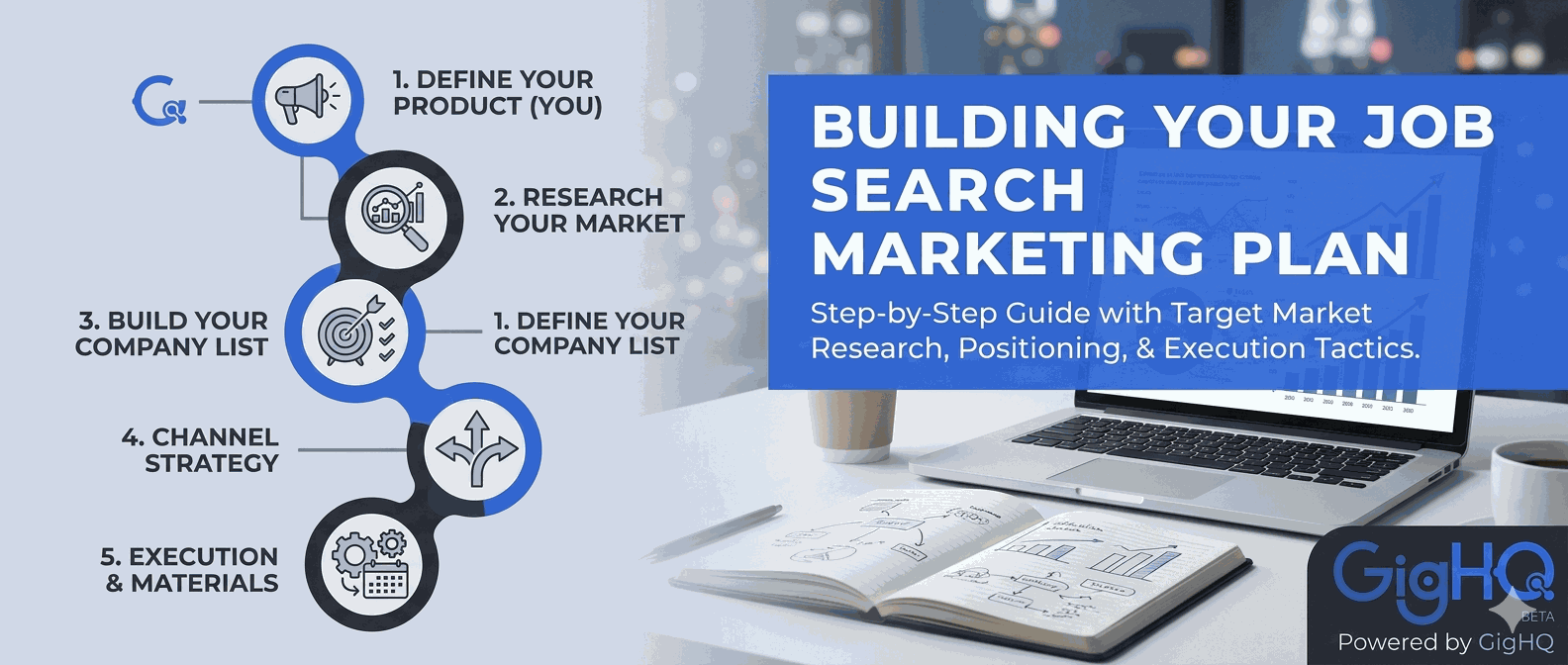
Step 1: Define Your Product (You)
Before you can market yourself, you need crystal clarity on what you’re selling.
Your Professional Objective
Start with a single sentence that defines the role you want: “Senior leadership role in client services within a dynamic, growing technology company.”
This isn’t just wishful thinking—it’s your north star for every decision that follows.
Your Positioning Statement
This is your value proposition. Answer: What unique combination of skills, experience, and results do you bring?
Framework: “I am a [your professional identity] with proven skills in [key capabilities] who delivers [specific value/results] for [target customer type].”
Example: “A solutions-oriented, client-facing services leader with proven skills in creating and growing professional services teams. I create effective client services teams, profitable service offerings, and valuable, long-lasting customer relationships, with a history of 100+ successful projects delivered on time and on budget.”
Notice the specificity: not just “I’m good at customer service” but “100+ successful projects delivered on time and on budget.”
Your Core Competencies
Organize your skills into three categories that align with what employers actually care about:
| Domain Expertise | Leadership/Management | Technical/Tools |
|---|---|---|
| Customer Success | P&L Responsibility | Cloud Services |
| Professional Services | Team Development | Data Analytics |
| Sales & Business Dev | Organizational Development | Agile Project Management |
This isn’t just a list—it’s your feature set organized by customer benefit.
Step 2: Research Your Market Like a Growth Marketer
Here’s where most job seekers go wrong: they research companies, not markets. Smart job seekers research market dynamics first.
Understanding Market Reality
Before you target any company, you need to understand:
- Which industries are actually hiring (not just posting jobs)
- Competition levels for your target roles (how many people are you competing against?)
- Ghost job rates by company and industry (which companies waste your time?)
- Average hiring timelines (how long do these processes actually take?)
This is where GigHQ becomes your secret weapon. Instead of guessing, you get real data:
- Exact competition metrics: See how many people applied before you even submit
- Ghost job intelligence: Our data shows which companies actually hire vs. just collect resumes
- Hiring pattern insights: Understand when companies typically respond and make decisions
- Real-time market intelligence: Know which roles and companies are actively filling positions
Industry and Company Targeting
Define your target market with the same precision a B2B marketer uses:
Geographic Scope: Be specific about location preferences
- Primary: Austin, TX metro area
- Secondary: Remote-friendly companies in Southwest/Southeast US
- Tertiary: Willing to relocate for the right opportunity
Industry Types: Where does your experience translate best?
- Enterprise Software/SaaS companies
- Technology consulting firms
- Healthcare technology
- Financial services (fintech focus)
Company Size: Different sizes need different things
- Startups ($5M-$50M): Need generalists, high growth potential, equity upside
- Mid-size ($50M-$500M): Need specialists, proven processes, scaling expertise
- Enterprise ($500M+): Need enterprise experience, stakeholder management, complex project leadership
Culture Indicators: What environment do you thrive in?
- Customer-centric companies (check their reviews, customer success stories)
- Data-driven decision making (look for analytics teams, measurement culture)
- Growth-oriented (recent funding, expansion plans, new product launches)
- Collaborative work style (team-based compensation, cross-functional projects)
Step 3: Build Your Target Company List
Start with 20 companies that match your criteria. This isn’t arbitrary—it’s the sweet spot between focus and options.
Research Framework for Each Company:
Business Intelligence:
- Recent funding, acquisitions, or major announcements
- Growth indicators (new offices, team expansions, product launches)
- Pain points your skills could solve (check their job postings for patterns)
Hiring Intelligence:
- Use GigHQ to see their actual hiring patterns: Do they follow through on posted jobs? What’s their average response time? How competitive are their openings?
- Current team size in your target department
- Recent hires (check LinkedIn for new team members)
- Hiring manager identification (who would you actually report to?)
Cultural Intelligence:
- Employee reviews on Glassdoor (look for themes, not individual complaints)
- LinkedIn content from current employees (what do they post about?)
- Company blog and social media (what do they value and celebrate?)
Prioritization Matrix
Rank each company on:
- Opportunity fit (1-10): How well does the role match your goals?
- Experience match (1-10): How well do your skills align with their needs?
- Hiring likelihood (1-10): Based on GigHQ data, how likely are they to actually hire?
- Cultural fit (1-10): How well do you align with their environment?
Focus your energy on companies scoring 30+ out of 40.
Step 4: Channel Strategy That Actually Works
Remember: 75% of jobs are found through networking, and 75% are never posted. Your channel strategy should reflect this reality.
Primary Channel: Direct Relationship Building (70% of effort)
Informational interviews with people in your target companies
Industry networking through professional associations and events
Content engagement (thoughtful comments on LinkedIn posts from target companies)
Warm introductions through your existing network
Secondary Channel: Strategic Applications (20% of effort)
GigHQ-verified opportunities: Apply only to roles where data shows real hiring activity
Referral applications: Apply with an internal connection who can champion your candidacy
Timing-optimized applications: Use GigHQ’s data to apply when companies are most responsive
Tertiary Channel: Brand Building (10% of effort)
LinkedIn optimization: Your profile should reflect your positioning statement
Thought leadership: Share insights relevant to your target market
Professional visibility: Speak at events, participate in industry discussions
Step 5: Create Your Marketing Materials
Resume as Marketing Collateral
Your resume isn’t a job history—it’s a marketing brochure. Use GigHQ’s AI resume matching to optimize for each specific role:
- Headline: Your positioning statement in action
- Summary: Three key value propositions with quantified results
- Experience: Stories that prove your competencies
- Achievements: Numbers that demonstrate impact
Cover Letters as Sales Pitches
Use GigHQ’s AI cover letter generation to create personalized pitches that:
- Reference specific company intelligence you’ve gathered
- Connect your experience to their specific challenges
- Demonstrate you’ve done your homework on their business
- Include a clear call to action for next steps
LinkedIn as Your Company Website
Your LinkedIn profile should be optimized for your target audience:
- Headline: What you do + who you help + key differentiator
- Summary: Your positioning statement with social proof
- Experience: Achievement-focused descriptions with metrics
- Activity: Regular engagement with your target market’s content
Step 6: Execution System
Weekly Planning Cycle
Monday: Review target company updates, plan outreach for the week
Tuesday-Thursday: Networking conversations, strategic applications, relationship building
Friday: Follow-up activities, pipeline review, plan adjustment
Monthly Review Process
- Pipeline analysis: How many active conversations in each stage?
- Channel effectiveness: Which approaches are generating the best opportunities?
- Market intelligence update: What’s changed in your target companies?
- Strategy refinement: Based on data, what should you adjust?
Key Metrics That Matter
Don’t just track applications sent. Track:
- Quality conversations per week (informational interviews, networking calls)
- Response rate to personalized outreach (should be 30%+ with good targeting)
- Interview conversion rate (from application to interview)
- Pipeline velocity (time from first contact to offer)
GigHQ’s dashboard helps you track what actually predicts success, not just vanity metrics.
The Compound Effect
Here’s what happens when you execute this systematically:
Month 1: You’re building your pipeline and having quality conversations
Month 2: Referrals start coming in, you’re getting interviews for roles that aren’t posted yet
Month 3: You’re choosing between multiple opportunities instead of hoping for any opportunity
This isn’t theory—it’s the proven approach that gets job seekers hired 67% faster than average.
Your Marketing Plan Template
Ready to build your own? Start with these exercises:
- Write your positioning statement using the framework above
- Define your target market criteria across all four dimensions
- Research and list 20 target companies using GigHQ’s intelligence tools
- Plan your channel strategy with specific weekly activities
- Set up your tracking system for the metrics that matter
The difference between successful and unsuccessful job searches isn’t luck or timing—it’s strategy and execution.
Your marketing campaign starts now.
Ready to execute your job search marketing plan with data-driven precision? Use GigHQ.ai to get the market intelligence, AI tools, and authenticity verification that turn job searching into a competitive advantage.
Our Platform Tools:

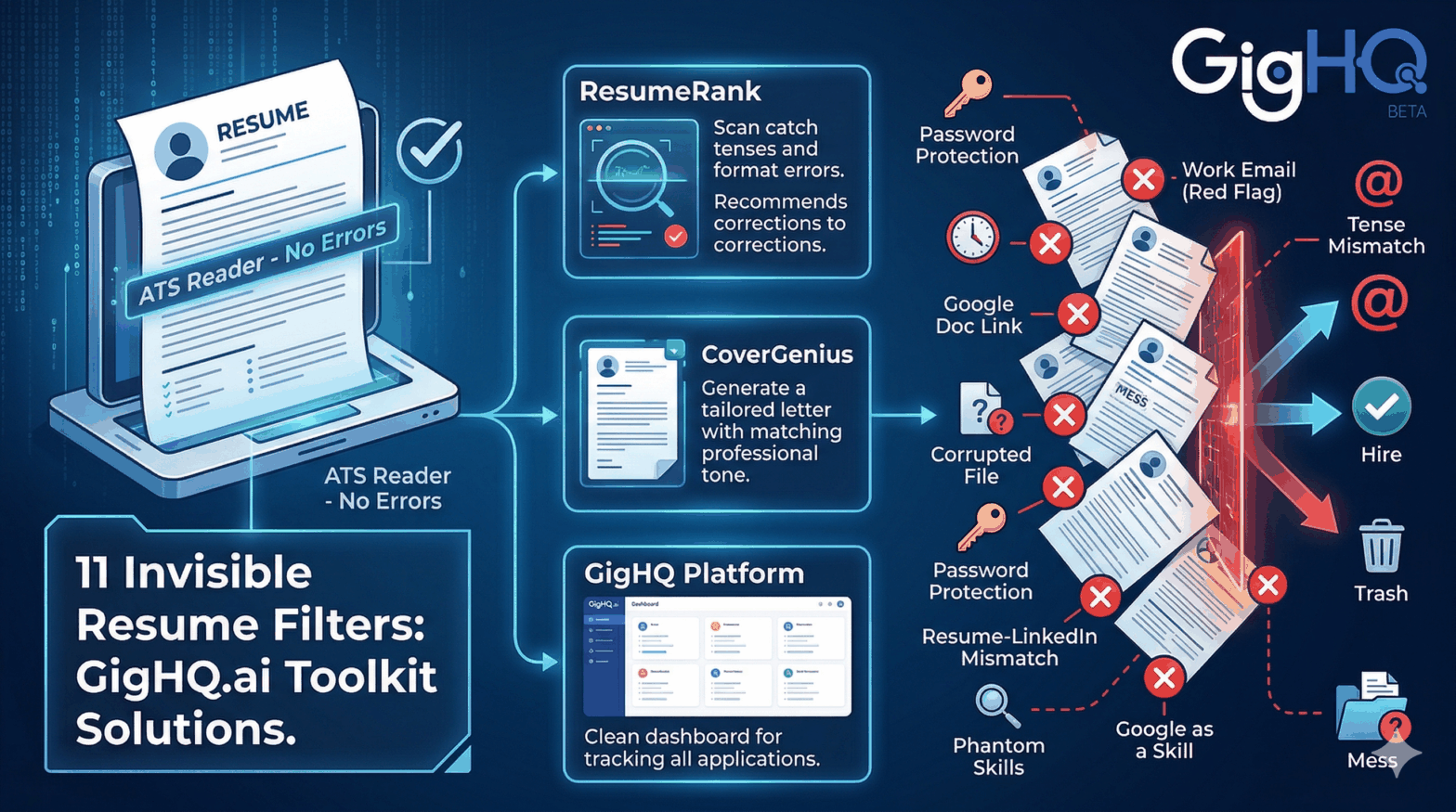
ResumeRank
Scan your resume, get a score, fix what matters.

CoverGenius
Generate personalized, AI-powered cover letters in seconds.

OutreachAgent
Craft perfect networking and AI-powered follow-up emails with ease.

CareerCompass
Instantly generate a personal marketing plan from your resume to define your brand and attract the right opportunities.

Smart Prep
Simulates a real interview based on your resume and the job description, giving you real-time feedback to build your confidence.

Profile Spark
Optimize your LinkedIn profile to attract recruiters and opportunities.