
Over the past decade, postsecondary education has seen an explosion in non-degree credentials. With over 1.1 million distinct credentials in the U.S. market—ranging from weekend bootcamps to industry certifications—institutions have rushed to offer short-term training options.
However, a stark reality has emerged: offering micro-credentials isn’t enough.
Research indicates that while 88% of employers believe industry micro-credentials help candidates stand out, only about 1 in 8 non-degree credentials actually produces a meaningful wage premium or career boost for the earner. When micro-credentials are created in isolation—unaligned with live employer requirements and unarticulated into higher-level degrees—learners risk incurring financial costs and time commitments without gaining long-term economic mobility.
To build credentials that genuinely move the needle, institutions must move from ad-hoc badge creation to employer-validated curriculum co-design.
A landmark report by the Harvard Project on Workforce and Education Design Lab, titled The Agile Community College: Dynamic Labor Market Alignment in an AI-Driven Economy, outlines how forward-thinking institutions are solving this dilemma through agile curriculum design principles.
The Curriculum Design Framework: Stackable, Portable, and Visible
The Harvard report identifies Curriculum Design (“How do we define what students learn?”) as one of four core recurring decisions required for institutional agility. To ensure credentials carry authentic market currency, the report highlights three imperative design principles:
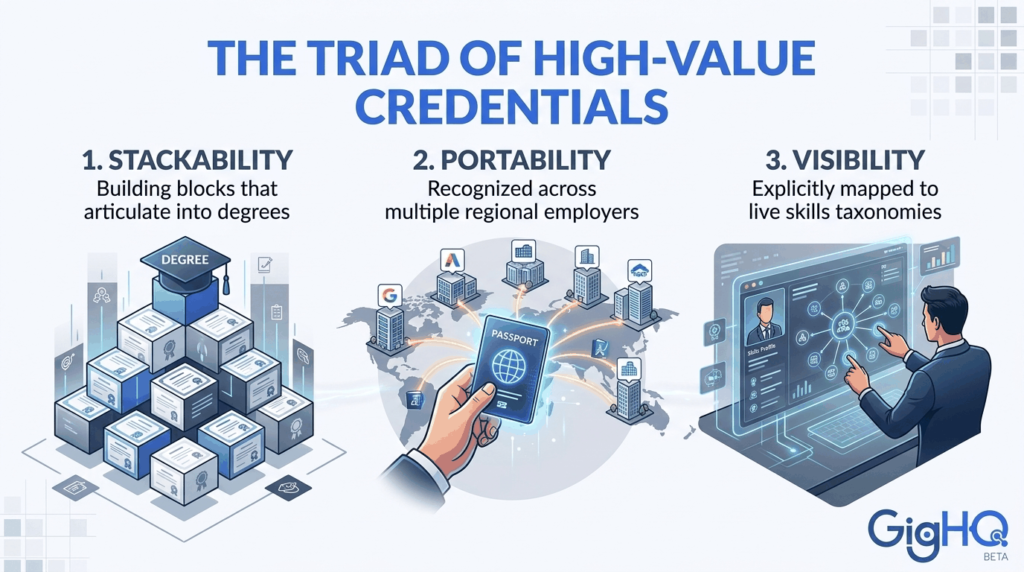
- Stackability: Short-term certificates must serve as modular building blocks toward Associate or Bachelor’s degrees, rather than dead-end terminal points. Stackable pathways allow learners to enter the labor market quickly while preserving clear “on-ramps” for future career advancement.
- Portability: Credentials must hold verified currency across multiple regional employers, rather than over-fitting to the niche preferences of a single firm.
- Visibility: The specific skills, competencies, and durable capabilities (such as critical thinking, communication, and AI literacy) earned within a credential must be easily transparent and verifiable to hiring managers.
Institutional Spotlights: Co-Design in Action
How are leading institutions operationalizing these principles? The Harvard report highlights two powerful institutional models:
1. Riverland Community College: The Stackable EV Technician Certificate
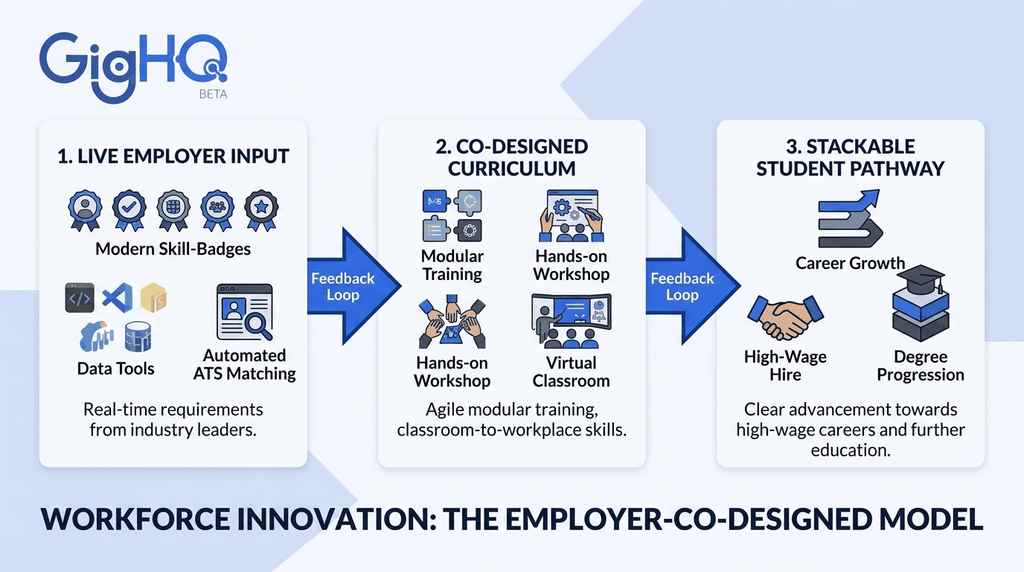
Facing a rapid technological shift in Southern Minnesota’s automotive and manufacturing sectors, Riverland Community College partnered with the Education Design Lab (EDL) to map regional skill clusters. Identifying high local demand for electric vehicle (EV) maintenance and smart grid diagnostic skills, Riverland engaged employers—such as Freeborn Mower Electric Cooperative—to co-design a Stackable EV Technician Certificate.
Backed by an NSF Advanced Technological Education (ATE) grant and a General Motors EmployED grant, Riverland built a modular credential that feeds directly into their traditional Automotive and Manufacturing Associate degree programs. Students earn immediate, high-wage workforce credentials while remaining on track toward a full degree.
2. Community College of Aurora (CCA): Employer-Co-Designed Apprenticeships
To combat acute shortages in heavy equipment technicians, Community College of Aurora collaborated with Wagner Equipment Company (a major Caterpillar dealer) to re-engineer their Diesel Power Mechanics Associate program.
Instead of simulating workplace conditions in a vacuum, CCA condensed the program into an intensive 12-month stackable pathway. Students rotate every two weeks between classroom instruction at CCA and paid, hands-on shop experience at Wagner. Eligible employees complete the program tuition-free, receive a professional tool kit, and enter a clear career trajectory averaging over $67,000 in starting salary.
The Missing Link: Translating Classroom Skills into Hiring Signals
Even when an institution designs a high-quality, stackable micro-credential, a major bottleneck remains: the translation gap.
Graduates often struggle to articulate their newly acquired competencies in the language that hiring systems and Applicant Tracking Systems (ATS) demand. Meanwhile, employers frequently rely on legacy job descriptions that fail to reflect the actual skills earned in modern certificate programs.
Without a real-time feedback loop connecting student resumes to live market demand, even the best credentials remain invisible.
The GigHQ Solution: Bridging the Gap Between Learning and Hiring
GigHQ.ai serves as the connective data layer between stackable classroom credentials and live employer hiring criteria.
Through GigHQ’s AI-powered student copilot and institutional analytics, learners and career teams gain real-time visibility into how their earned competencies convert into actual job offers.
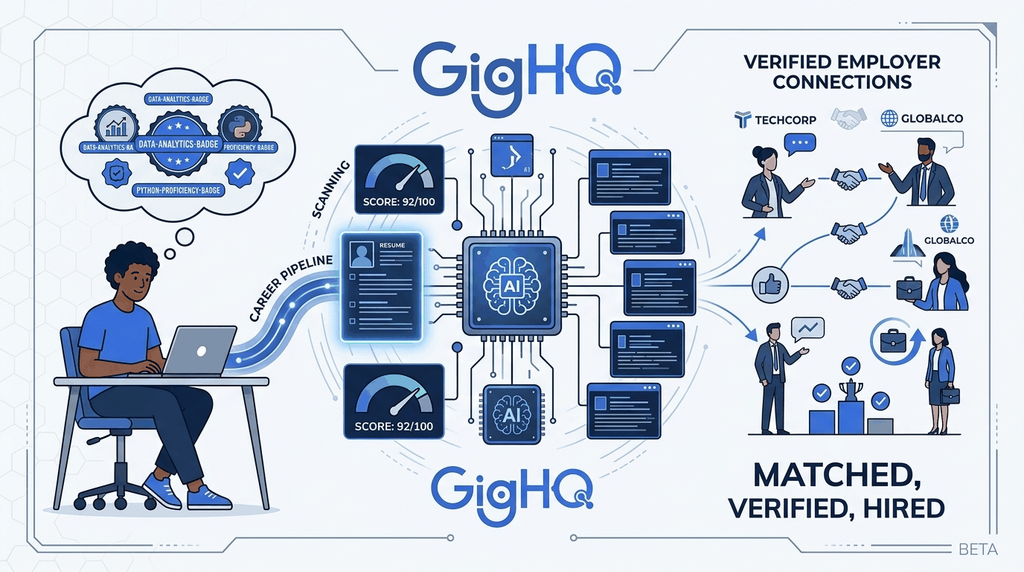
How GigHQ Maximizes the Value of Micro-Credentials:
- Real-Time Skill Match Auditing via ResumeRank: Students paste target job descriptions or use the GigHQ Chrome Extension while browsing live job boards. ResumeRank instantly scores their resume against the employer’s specific requirements, highlighting exactly which micro-credential competencies match the role and which keywords are missing.
- Contextual Brand Positioning via CareerCompass: Helps learners transform discrete certificates into a cohesive narrative, generating positioning statements that showcase the market value of their stackable skills.
- Targeted Interview Preparation via SmartPrep: Runs interactive, role-specific mock interviews that coach students on how to highlight their hands-on work-based learning projects and credential achievements using structured STAR (Situation, Task, Action, Result) responses.
- Continuous Market Feedback for Educators: Through the GigHQ Coach’s Portal, program directors and faculty can see aggregated cohort data. If graduates with a specific micro-credential are experiencing low interview conversion rates at local firms, curriculum teams can instantly identify the ATS keyword or skill mismatch and update course modules accordingly.
Build Credentials That Keep Their Promise
In an AI-driven economy where technical skill requirements evolve every few months, static degrees and isolated badges are no longer sufficient.
To deliver true economic mobility, workforce development organizations and higher education institutions must build stackable, employer-validated micro-pathways—and equip learners with the intelligent tools needed to prove their value in the hiring market.
Watch how GigHQ simplifies job tracking and application optimization in our Student Experience Overview, or explore our guide on How to Track Job Applications Without a Spreadsheet.
👉 Request a Partnership Demo with GigHQ.ai to see how our platform connects your curriculum directly to verified student job placements.
Our Platform Tools:

ResumeRank
Scan your resume, get a score, fix what matters.

CoverGenius
Generate personalized, AI-powered cover letters in seconds.

OutreachAgent
Craft perfect networking and AI-powered follow-up emails with ease.

CareerCompass
Instantly generate a personal marketing plan from your resume to define your brand and attract the right opportunities.

Smart Prep
Simulates a real interview based on your resume and the job description, giving you real-time feedback to build your confidence.

Profile Spark
Optimize your LinkedIn profile to attract recruiters and opportunities.