Prepare Like It Matters: Pitch, CAR Stories, and the 10-Hour Rule
Most candidates believe great conversationalists "wing it." In reality, the candidates who sound the most fluid, spontaneous, and authoritative are the ones who put in rigorous, structured preparation long before the call.


Interviewing is a perishable skill. When you haven’t done it in two, three, or five years, stepping back into the hot seat feels awkward, high-friction, and profoundly uncomfortable.
I recently attended a Deloitte Alumni webinar on modern interviewing led by Mark Zoeller and Tracy Angona—executive transition coaches in Deloitte’s Leadership and Human Potential practice. Their central thesis resonated deeply with everything we see across thousands of hiring cycles at GigHQ.ai: preparation is what lets you sound natural, not scripted.
Most candidates believe great conversationalists “wing it.” In reality, the candidates who sound the most fluid, spontaneous, and authoritative are the ones who put in rigorous, structured preparation long before the call.
In an era where 95% of blind job applications disappear into the void and 73% of online job postings linger as ghost jobs or low-intent requisitions, landing an interview invitation is hard-won real estate. You cannot afford to treat the interview room as a trial run.
Here is how to build an elite interview engine using a proven 60-to-90 second pitch, dynamic CAR storytelling, tactical audience reconnaissance, and the 10-hour rehearsal rule—supercharged with modern AI workflows.
1. Craft Your 60-to-90 Second Pitch: Own the Opening
Almost every interview kicks off with the deceptively simple icebreaker: “Tell me a little about yourself.”
Too many candidates treat this as an invitation to read their resume chronologically from college graduation onward. Within two minutes, the interviewer’s eyes glaze over.
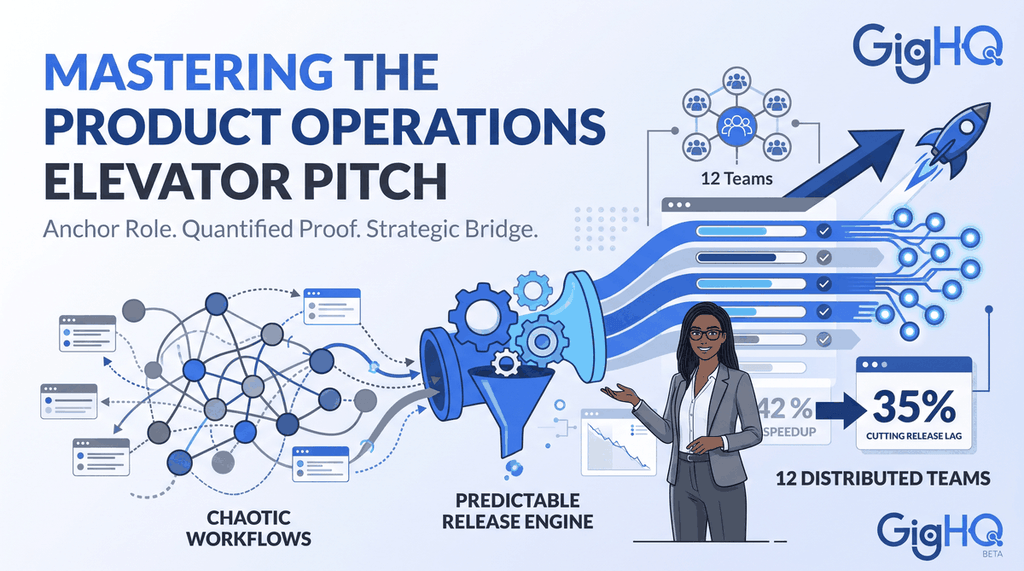
Your opening pitch is not an executive summary of your resume; it is your positioning statement. It must accomplish three things in 60 to 90 seconds:
- Define your core identity: What are you known for, and what is your functional superpower?
- Highlight quantified impact: What is your signature career win?
- Connect the bridge: Why are you sitting in front of this team for this specific challenge today?
Leveraging AI Without Losing Your Voice
AI is incredible at solving the “blank-page syndrome,” but dangerous when used as an auto-pilot.
If you ask a generic chat tool to “write a pitch for a Senior Product Manager,” you will get bland, buzzword-heavy corporate jargon that makes you sound like a brochure.
Instead, feed the model your raw career achievements and the exact target job description. If you use our GigHQ CareerCompass, it extracts your categorized skills and market positioning statement directly from your career milestones. If you work inside conversational AI, you can connect your pipeline directly via our GigHQ MCP Server or use GigHQ in ChatGPT and GigHQ in Claude to pull your real profile data.
The Golden Rule from Deloitte’s Coaches: Treat AI output as a B+ draft. Your job is to rework the cadence, inject your authentic voice, verify that every metric is accurate, and practice it until it sounds effortlessly human.
2. Prepare Stories, Not Answers: The CAR Framework
Behavioral Event Interviewing (BEI) operates on a single premise: past behavior is the best predictor of future performance.
You will inevitably face prompts like:
- “Tell me about a time you had to deliver bad news to a client.”
- “Give me an example of an initiative that failed, and what you did next.”
- “How do you resolve architectural disagreements across engineering pods?”
Trying to memorize canned answers to the “Top 50 Behavioral Questions” found online is an exercise in futility. Tracy Angona shared the story of a coaching client who spent an entire week memorizing answers to 50 generic questions; not a single one was asked.
Instead, refresh yourself on yourself. Build an inventory of 4 to 6 rich, modular stories from your career that demonstrate core competencies:
- Leadership and cross-functional influence
- Adaptability in ambiguity
- Conflict resolution and negotiation
- Execution under technical or time constraints
- Recovery from failure and root-cause learning
The CAR Framework: Context, Action, Result
While many professionals are trained on the STAR framework (Situation, Task, Action, Result), Deloitte’s coaches advocate for the streamlined CAR framework: Challenge, Action, Result.
| Component | Focus | Time Allocation |
|---|---|---|
| Challenge | What was the concrete obstacle, stakes, or problem? | 15–20% |
| Action | What did you personally decide, orchestrate, or execute? | 50–60% |
| Result | What happened, quantified by tangible business metrics? | 20–25% |
A Real-World CAR Breakdown:
- Challenge: A project manager was tasked with consolidating three regional office branches into one headquarters within 90 days across multiple contentious sub-contractors.
- Action: Rather than running weekly status calls, she established an internal target of 80 days, divided the contractors into three autonomous workstreams led by junior leads, and deployed a shared digital tracking workspace with real-time dependency tagging.
- Result: The physical transition completed two weeks ahead of schedule with a 15% budget reduction, and the communication framework was adopted as the company-wide standard operating model.
Notice why this works:
- It runs in under 90 seconds.
- The candidate’s personal contribution is unmistakable (using “I”, not just “the team”).
- It ends with a hard metric and long-term organizational impact.
How GigHQ’s Career Journal Solves Story Memory
Most candidates fail behavioral interviews not because they lack experience, but because they forgot the details of work done two years ago.
In our GigHQ Career Journal, we prompt professionals to log wins while they are actively happening using our Three-Number Quantification Rule:
- Scale of Action: What was the scope? (e.g., 14 engineers, $2.4M pipeline, 80,000 users)
- Direct Result: What was the immediate delta? (e.g., dropped latency by 220ms, cut churn by 4%)
- Organizational Impact: What did it unlock for the business? (e.g., unlocked $1.2M in annual enterprise renewals)
When you document achievements in real-time, preparing for behavioral questions takes minutes instead of days of panic-induced resume analysis.
3. High-Context Reconnaissance: Know Your Audience
Walking into an interview with only a surface-level reading of the “About Us” page is a recipe for rejection. High-performing candidates conduct deep reconnaissance:
The Research Checklist
- Dissect the Job Description: Map every single requirement to a specific bullet in your career history.
- Investigate Your Interviewers: Look up their background on professional networks. Where did they work previously? What technical or operational philosophies do they post about? What common ground do you share?
- Unpack the Business Model: For senior candidates, read recent press releases, quarterly earnings calls, customer case studies, product change logs, and Glassdoor trends.
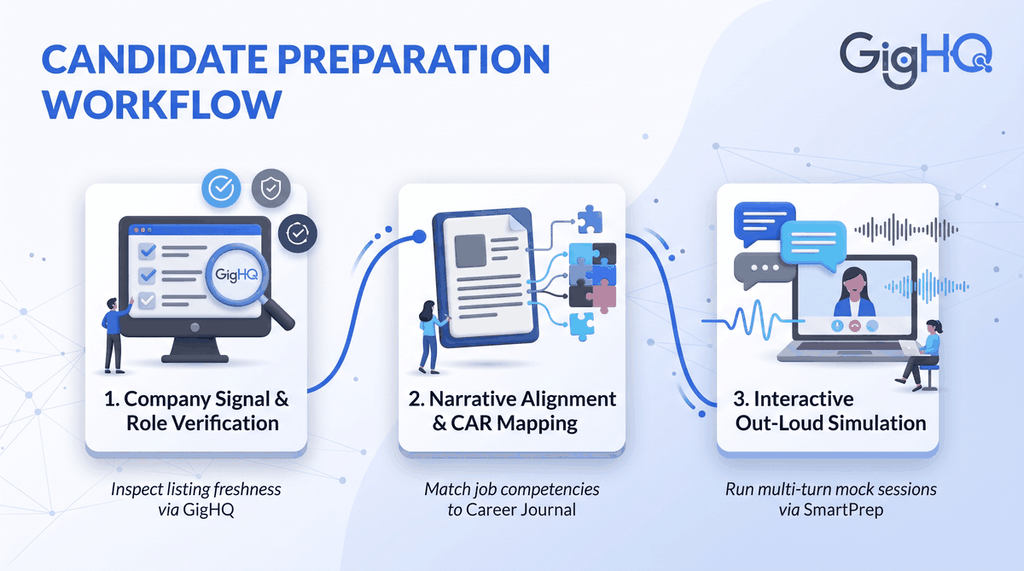
- Assess Market Signal: Before you spend 10 hours preparing, verify the legitimacy of the role. Use tools like the GigHQ Chrome Extension to inspect the posting’s timeline and our proprietary Community Signal to see whether a company is actively moving candidates to interview stages or simply letting postings sit idle.
Strategic Curiosity vs. Used-Car Salesmanship
Demonstrating enthusiasm is critical. Hiring managers want people who are genuinely energized by their mission. A phrase as simple as:
“I was particularly drawn to this role because your team is solving [Problem X], which directly parallels what I tackled at [Company Y]…”
…instantly sets you apart from candidates going through the motions.
However, Mark Zoeller issued a crucial warning: don’t oversell. Don’t pretend you love every single proprietary tool they use, and don’t make promises you cannot deliver on day one. Show competence, grounded self-awareness, and thoughtful curiosity.
4. The 10-Hour Rule and Out-Loud Rehearsal
Mark compared interviewing to a Broadway performance: an actor can know all the lines in their head, but opening night will still be a disaster if they never rehearsed out loud.
Your brain processes silent reading and physical speech through entirely different neural pathways. Speaking your pitch and your CAR stories out loud:
- Exposes awkward sentence structures.
- Eliminates verbal filler words (um, like, basically).
- Locks in muscle memory for concise timing under stress.
How to Budget Your 10 Hours
Citing Sam Owens’ framework in I Hate Interviews, Tracy and Mark highlighted the minimum preparation budget for an interview you care about:
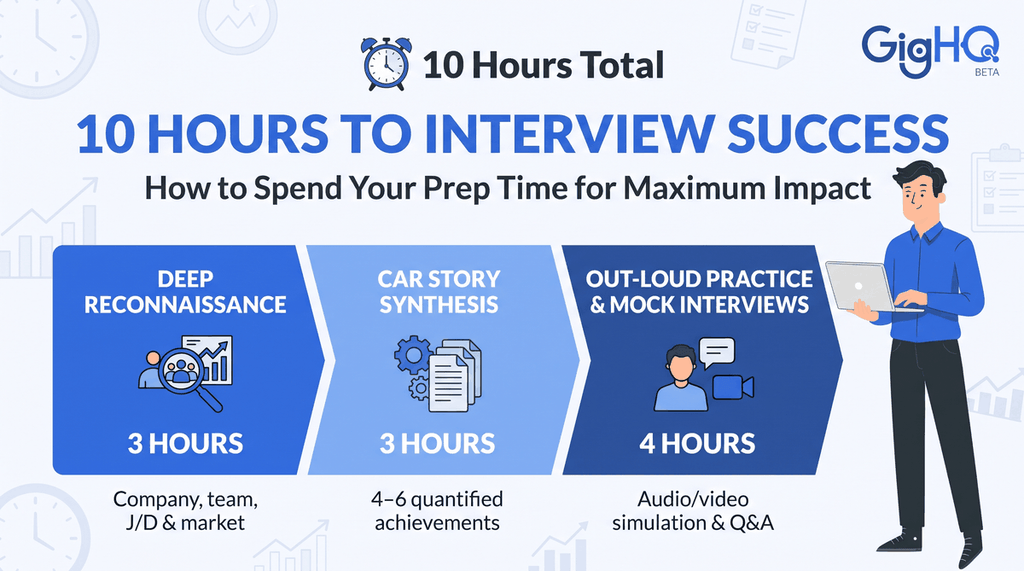
Ten hours sounds demanding—until you remember that this single conversation can determine your compensation, career trajectory, and professional satisfaction for the next three to five years.
Structuring a Killer Mock Interview
- Send the job description to your peer, mentor, or career coach beforehand so they can draft surprise behavioral questions.
- Treat it with strict realism: Have them open cold with “Tell me about yourself” and time your pitch.
- Capture immediate, iterative feedback: Don’t wait until the end of an hour-long chat. Critique your answer right after you deliver it, adjust the structure, and run it again.
If you don’t have a practice partner on demand, this is where specialized technology steps in. Inside GigHQ, our SmartPrep engine simulates dynamic, multi-turn AI interview sessions tailored specifically to the scraped requirements of your target job. It listens, probes deeper based on your answers, and outputs a scored diagnostic showing where your explanations hit the mark and where your metrics fell short.
For a live look at how this fits into your overall workflow, watch our platform walkthroughs:
- Watch: Connecting Your Search Pipeline to AI Workflows
- Watch: Managing Contacts and Strategic Networking
- Watch: Tracking Applications and Outcome Funnels
Your Pre-Interview Action Checklist
Before your next interview, make sure you can check off every box:
- Pitch Locked: Drafted and rehearsed a 60-to-90 second positioning pitch out loud at least 5 times.
- CAR Stories Outlined: Selected 4 to 6 modular stories mapped to core competencies (Challenge, Action, Result) with at least one verifiable metric per story.
- Audience Recon Completed: Researched the interviewers’ professional paths and reviewed company quarterly reports, news, or release logs.
- Gap Framing Ready: Run a candidate gap analysis using ResumeRank or the GigHQ MCP analyze_skills_gap tool to anticipate your experience gaps and frame them proactively.
- Time Budget Honored: Invested meaningful, dedicated hours researching, outlining, and vocalizing your points.
- Questions for Them Prepared: Drafted 3 to 4 strategic business questions that prove you understand their operational bottlenecks.
Turn Chaotic Job Searches into a Strategic Advantage
Interviewing is not a personality contest; it is a demonstration of clarity, preparation, and structured problem-solving. When you enter the room with your CAR stories battle-tested and your research dialed in, you transform an anxiety-inducing interrogation into an executive-level consultation.
Stop treating your job search like an unorganized spreadsheet lottery. Let GigHQ.ai automate your application tracking, monitor company hiring authenticity, and build your living interview playbook.
Create your free GigHQ account today and take command of your career journey.