For decades, higher education governance and workforce planning operated on a predictable, deliberate cadence. Deans, provosts, and workforce directors conducted program reviews every 3 to 5 years, relying on 10-year state labor projections to determine which certificates to launch, expand, or sunset.
In 2026, that multi-year planning cadence has fundamentally broken down.
Driven by the rapid diffusion of generative and agentic AI, global labor markets are evolving faster than traditional curriculum approval cycles. According to the World Economic Forum, employers estimate that nearly 40% of workers’ core skills will be transformed or rendered obsolete within a 5-year window.
In an economy where skill requirements shift every few months, institutions do not need better long-term forecasts—because predicting precise 10-year skill requirements in an AI-driven economy is virtually impossible. Instead, higher education and workforce leaders need Institutional Agility: the capacity to continuously detect, interpret, and adapt to labor market signals in real time.
A landmark August 2026 report by the Harvard Project on Workforce and Education Design Lab, titled The Agile Community College: Dynamic Labor Market Alignment in an AI-Driven Economy, establishes institutional agility as the definitive operational framework for modern postsecondary success.
What Is Institutional Agility?
The Harvard report makes a critical distinction: Institutional agility is not synonymous with sporadic innovation.
Launching a single AI bootcamp, running an isolated pilot project, or purchasing a new software tool does not make an institution agile if the core operating systems remain static. The report defines Institutional Agility as:
The repeatable and systems-level capacity to detect, interpret, and respond quickly to labor market changes, while maintaining the quality and mission of the institution.
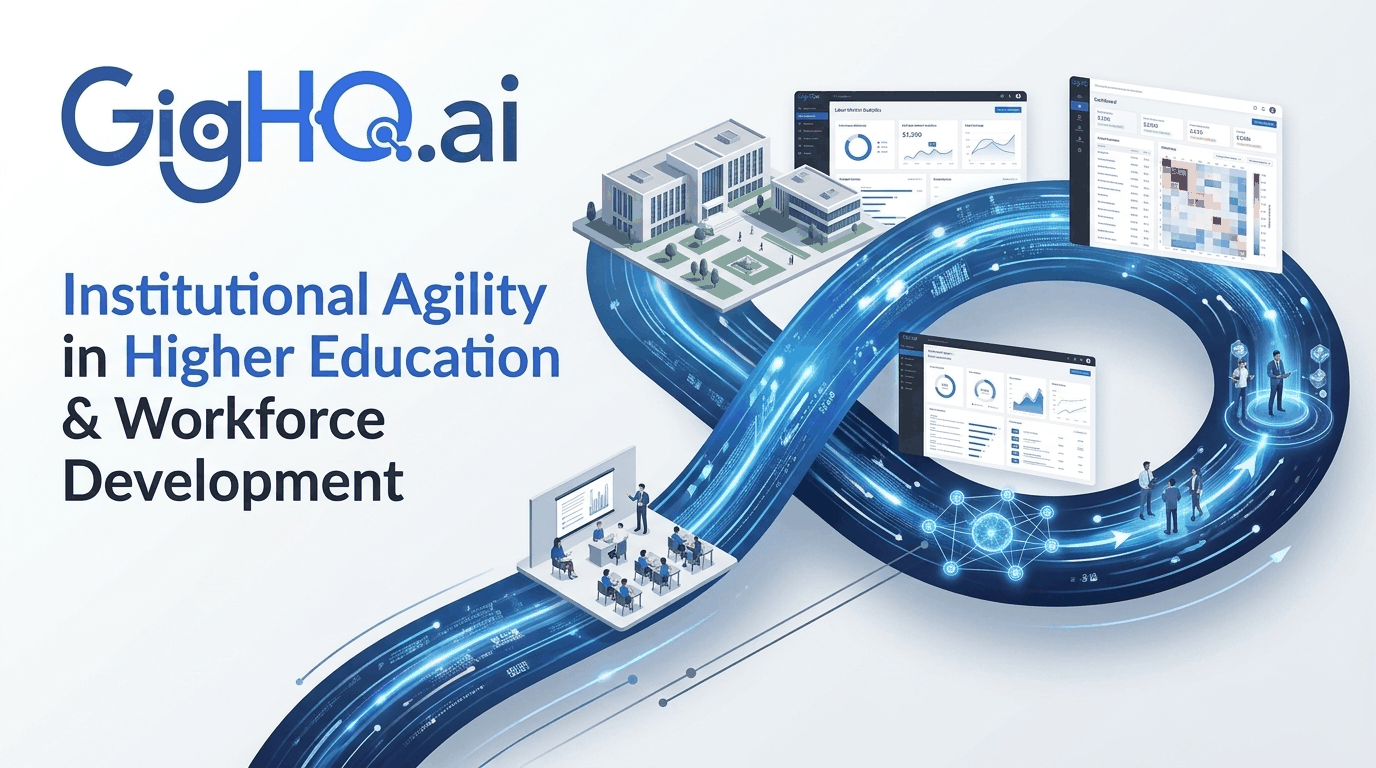
To operationalize agility, an institution must master a continuous three-part capability loop:
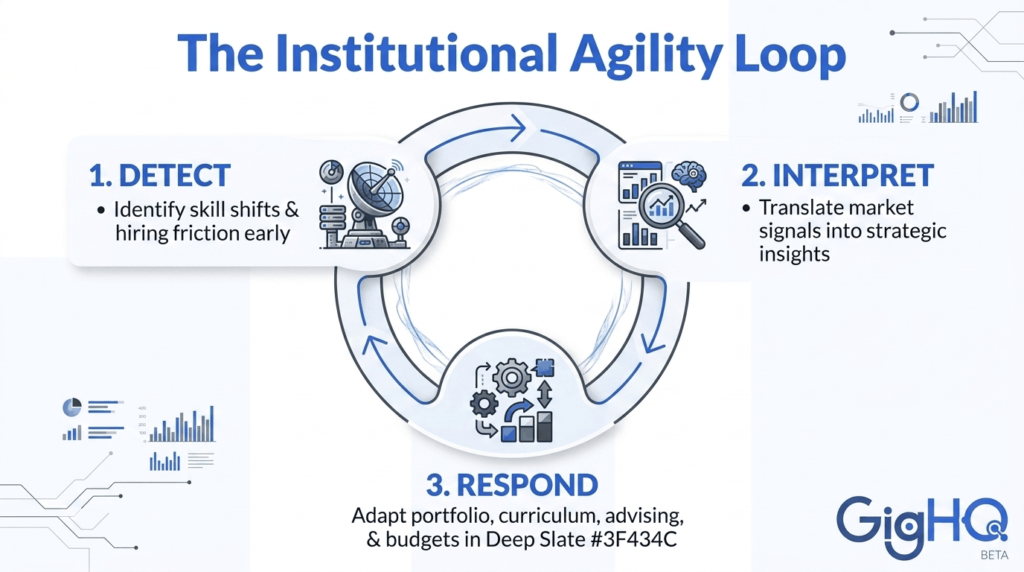
- Detect: Gathering live, high-frequency labor market signals and student application behaviors rather than waiting for lagged 2-to-6-quarter Unemployment Insurance (UI) wage records.
- Interpret: Dissecting why specific student cohorts or credentials are succeeding or struggling in the active hiring funnel.
- Respond: Making timely, evidence-based adjustments to institutional operations before students disengage or drop out.
Executing Agility Across the 4 Recurring Decisions
The Harvard report emphasizes that institutional agility is not a periodic strategic planning exercise that happens once every half-decade. It is an ongoing discipline that informs four recurring decisions faced by postsecondary leaders:
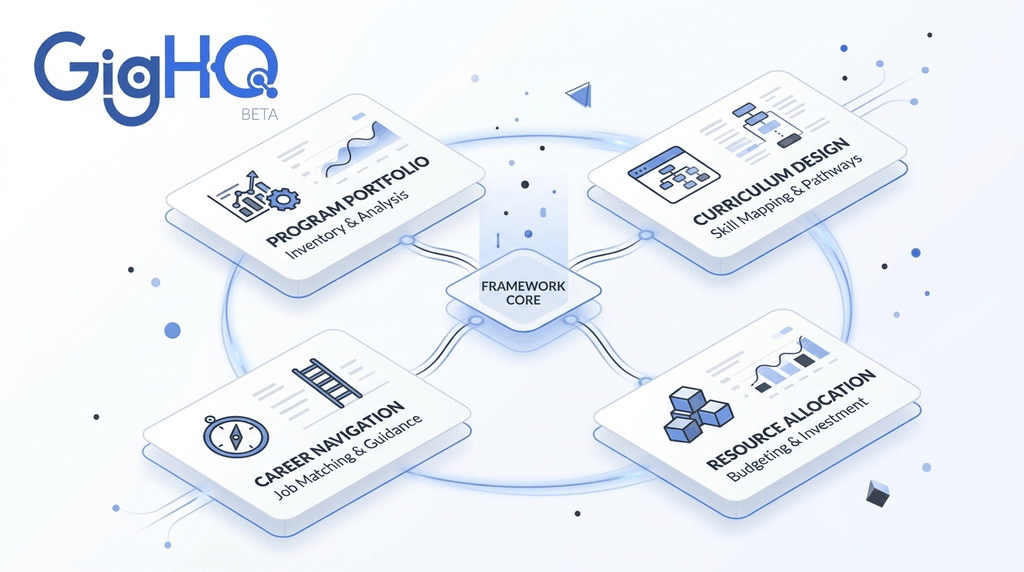
1. Program Portfolio (“How do we shape a program portfolio?”)
Agile leaders systematically evaluate whether existing credit and noncredit offerings match regional absorption capacity. Rather than maintaining low-value legacy programs, institutions establish continuous review cycles to expand high-demand pathways and sunset underperforming credentials without displacing faculty.
2. Curriculum Design (“How do we define what students learn?”)
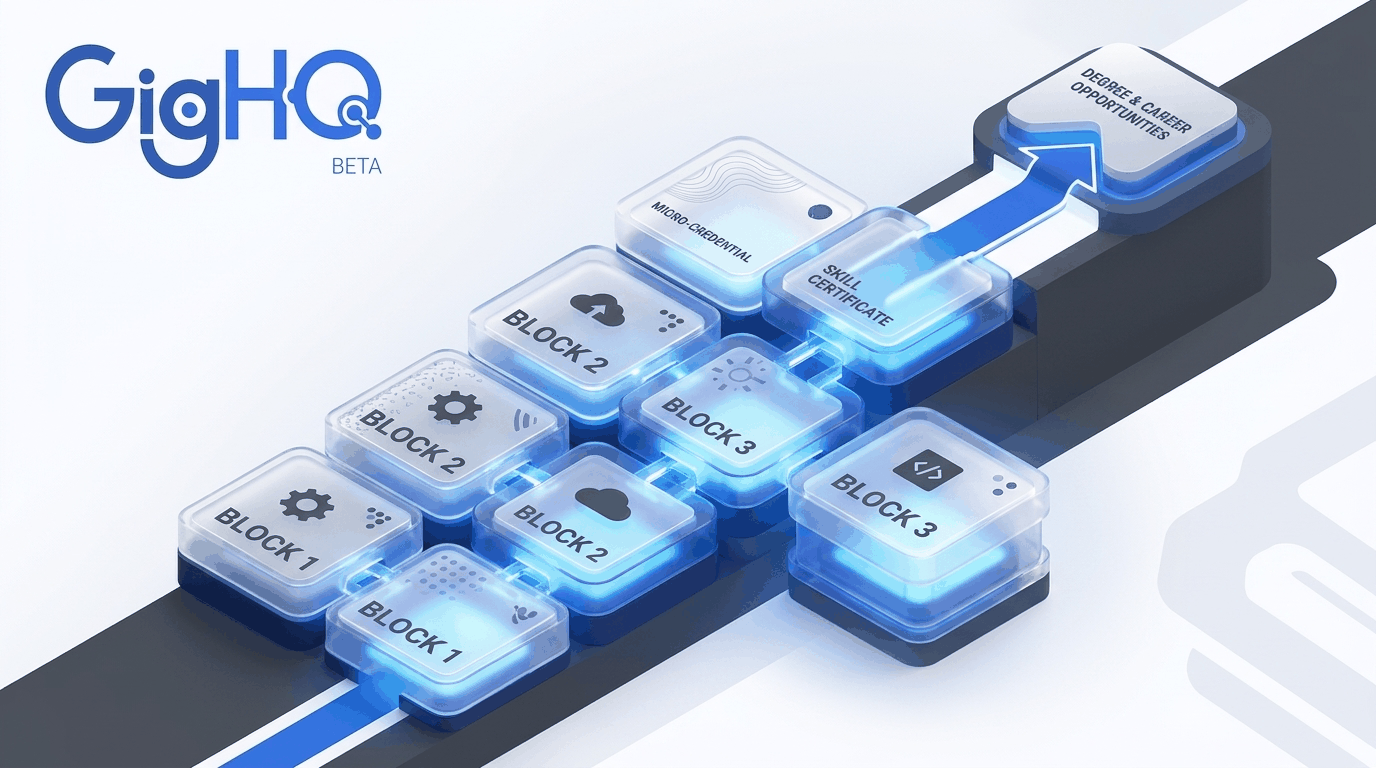
Programs must prepare students for long-term career resilience, not just their initial job placement. Agile institutions leverage real-time market data to integrate durable capabilities (such as critical thinking, communication, and AI literacy) into modular, stackable micro-credentials that articulate into higher degrees.
3. Career Navigation (“How do we help students make informed career decisions?”)
Instead of relying on understaffed career centers where advising ratios often reach 1,200:1, agile institutions equip counselors with real-time early warning data. Technology is used to augment human advisors—a “human-in-the-loop” model—allowing staff to intervene at the exact moment a student experiences application friction.
4. Resource Allocation (“How do we allocate resources?”)
Agile institutions break away from rigid, incremental budgeting (simply adjusting last year’s line items by 2%). Instead, they link budget decisions directly to outcome intelligence, full-cost accounting, and verified Return on Investment (ROI) metrics.
The Bottleneck: Why Most Institutions Remain Trapped in Reactive Modes
If institutional agility is the goal, why do so many higher education institutions and Workforce Development Organizations (WDOs) struggle to achieve it?
The primary barrier is the Data Deficit. Most executive teams operate in an administrative “black box”:
- Lagging Endpoints: Leaders track enrollment at entry and post-graduate employment 6 to 12 months post-exit via low-response alumni surveys (15–20% response rates).
- Missing Process Intelligence: Institutions cannot see what happens between graduation and hire. They do not know how many applications graduates are submitting, which ATS systems are filtering out their resumes, or which specific skills are failing to convert into interview invitations.
Without real-time process data, institutional decision-making remains slow, speculative, and reactive.
The GigHQ Solution: The Operating System for Institutional Agility
GigHQ.ai provides the connective software layer that equips workforce leaders with the systems-level capacity required for dynamic labor market alignment.
By converting the daily student job search into an automated stream of verified outcome data, GigHQ transforms chaotic application activity into actionable institutional intelligence.
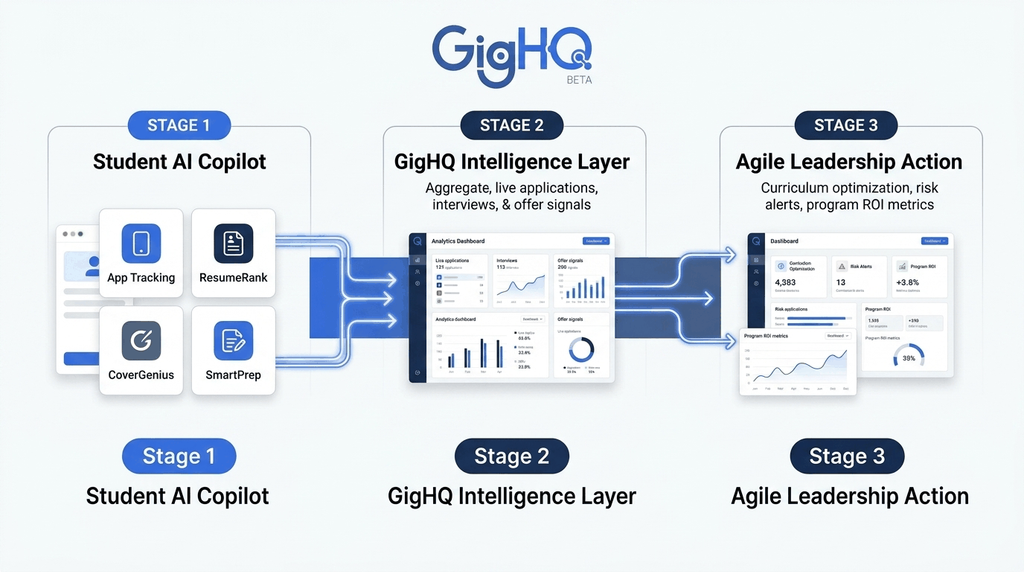
How GigHQ Powers the Agility Loop for Leadership:
- Continuous Signal Detection via the Coach’s Portal: Case managers and program directors access real-time cohort analytics. If graduates from a newly launched micro-credential submit 50+ applications but yield a 0% interview callback rate, GigHQ flags the bottleneck immediately—allowing faculty to update course modules during week three of a term rather than waiting for an annual review.
- Empowering Students with AI Self-Service Tools: To remove application friction and build career readiness, learners receive an AI copilot equipped with ResumeRank for ATS keyword auditing, CoverGenius for tailored outreach, CareerCompass for brand positioning, and SmartPrep for STAR-based interview coaching.
- Passive, Audit-Ready Outcome Verification: When a student receives an official job offer through their dedicated
@gighq.aijob-search workflow, the system automatically captures time-stamped, third-party verifiable records (employer, title, salary, start date). This equips institutions with an “audit shield” for Workforce Pell Grant compliance, Texas HB8 funding, WIOA PIRL reporting, and NACE First Destination Surveys without chasing graduates with phone calls. - Seamless Ecosystem Integration: Through the GigHQ MCP Integration and custom AI workflows, institutions can connect live career journal data and outcome analytics directly into Claude, ChatGPT, or existing Student Information Systems (SIS).
Shift Your Institution from Reactive Planning to Dynamic Leadership
In 2026, institutional agility is no longer an optional management philosophy—it is a core condition for survival, accreditation, and sustainable funding.
Institutions that rely on static 5-year plans and lagging alumni surveys will continue to fall behind the pace of labor market disruption. Leaders who deploy continuous outcome intelligence will protect their grant funding, scale advisor impact, and deliver on the promise of economic mobility for every learner.
Watch how GigHQ simplifies student tracking in our Student Experience Overview, or explore how advanced AI integration works in our GigHQ MCP Integration Walkthrough.
👉 Request an Institutional Agility Demo with GigHQ.ai to see how our platform turns chaotic job searches into a continuous, audit-ready intelligence layer for your institution.
Our Platform Tools:

ResumeRank
Scan your resume, get a score, fix what matters.

CoverGenius
Generate personalized, AI-powered cover letters in seconds.

OutreachAgent
Craft perfect networking and AI-powered follow-up emails with ease.

CareerCompass
Instantly generate a personal marketing plan from your resume to define your brand and attract the right opportunities.

Smart Prep
Simulates a real interview based on your resume and the job description, giving you real-time feedback to build your confidence.

Profile Spark
Optimize your LinkedIn profile to attract recruiters and opportunities.