For years, if you asked a job seeker why they were rejected from a role they were perfectly qualified for, the honest answer was: nobody knows.
Not the candidate. Not always even the hiring manager.
The algorithm said no, the applicant portal sent an automated “noreply” email, and that was the end of it. No explanation. No recourse. No visibility into what, exactly, the system decided was wrong with your professional background.
This is what people in HR technology circles call the black box problem. And for most of the history of modern Applicant Tracking Systems (ATS), it has been treated as an unfortunate but acceptable feature of how hiring works at scale. Companies receive thousands of applications. Humans can’t read all of them. Algorithms triage. Some candidates get through. Most don’t. The reasons why stay inside the machine.
That may be about to change.
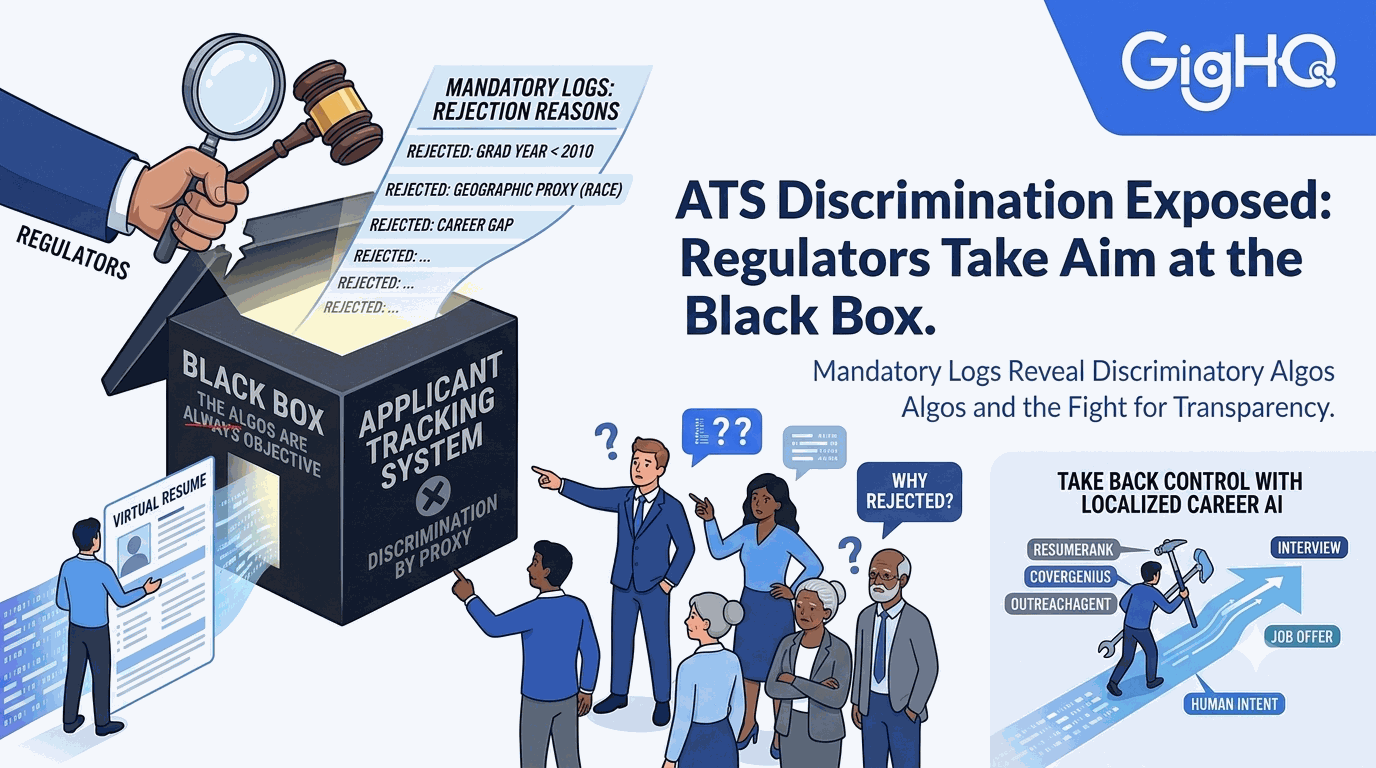
Regulatory pressure is building around the major ATS vendors—Greenhouse, Lever, Ashby, Workday, and others—that would require them to do something they have never been required to do before: explicitly log and disclose the precise reason a candidate was rejected.
Not a generic “we’ve decided to move forward with other candidates.” The actual algorithmic reasoning. The specific criteria that caused the system to filter this person out.
It sounds like a technical compliance requirement. It is actually a seismic shift. Because the moment you require these systems to explain their decisions, you require them to confront something that the black box has been quietly obscuring for a long time: the filters aren’t neutral, the algorithms aren’t objective, and the discrimination that job seekers have experienced is real, documented, and increasingly difficult to defend.
What ATS Systems Actually Do (Behind the Scenes)
To understand why this regulatory push matters, you need to understand what these systems are actually doing when they process your application—which is considerably more than most candidates realize.
The surface-level understanding of an ATS is keyword matching. You upload a resume, the system scans it for terms that appear in the job description, and candidates with more keyword overlap get higher scores. That’s true as far as it goes, but it’s a significant oversimplification of modern ATS data-gathering.
1. Cross-Company Profile Building
These platforms are building comprehensive data records. Every application you submit through a major ATS vendor contributes to a persistent data profile associated with your email address, your name, and your professional history. When Greenhouse or Workday is the ATS at Company A, Company B, and Company C, your activity across all three is visible to the platform.
2. The Shared Algorithm Problem
The dominant ATS systems have developed shared algorithmic infrastructures. According to emerging research, these platforms may share candidate signals in ways that create a de facto profile of candidates across the broader ecosystem. If you apply broadly without a coherent, tailored strategy and accumulate instant rejections, the system can begin to form a view of you as a low-match candidate. This shadow profile follows you from application to application without your knowledge or consent.
3. The Configuration Layer (Proxy Discrimination)
ATS systems are highly configurable tools that companies tune to their own specifications. Recruiters set thresholds, filters, and rules that determine which candidates are surfaced and which are buried. Some of those configurations act as direct demographic proxies:
- Graduation Year Filters: Function as a proxy for age.
- Geographic Restrictions: Correlate with race, socioeconomic background, and national origin.
- Employment Gap Thresholds: Disproportionately penalize women, caregivers, and people who experienced layoffs during economic downturns.
None of these configurations require a company to explicitly state that they want to discriminate. They just set a parameter. The discriminatory outcome is built into the design without ever being named.
The Research That Changed the Conversation
For a long time, the evidence for ATS discrimination was largely anecdotal. Job seekers experienced it, and diversity advocates argued it was happening, but the opaque nature of these systems made it incredibly difficult to prove systematically.
That changed as academic and economic researchers began building an empirical case.
A landmark Stanford study examined how ATS systems process candidates at scale. The researchers found evidence consistent with what job seekers had been reporting for years: the algorithms were correlating rejection patterns with demographic signals in ways that couldn’t be explained by qualifications alone.
Older job seekers were systematically filtered out at rates that suggested age-based discrimination was deeply embedded in the algorithmic logic. Candidates from specific geographic zip codes faced unexplained disadvantages. People with non-linear career paths—gaps, transitions, unconventional progressions—were penalized in ways that bore no relationship to their actual capabilities.
The research wasn’t saying that every ATS system is intentionally biased. It was saying something far more unsettling: these systems produce discriminatory outcomes without anyone at any point making an explicit, conscious discriminatory decision.
Bias gets built in through historical training data, configurations, and proxy variables that seem neutral until you look at who they are actually filtering out. And because the reasoning is never disclosed, neither the candidate nor the employer ever has to confront what the machine is doing.
What the Proposed Rule Would Require
The regulatory movement taking shape would impose a straightforward but radical requirement on ATS vendors: when a candidate is rejected by an algorithmic system, the specific reason for that rejection must be logged.
Not a generic category, but the actual criteria. For example:
- Rejected: Resume did not contain “Kubernetes” or “Go” keyword requirements.
- Rejected: Configured filter excluded candidate due to employment gap exceeding 12 months.
- Rejected: Graduation year prior to 2010 flagged as outside target experience range.
This requirement would fundamentally change the accountability structure around these systems for several reasons:
Transparency Exposes Patterns
Right now, individual candidates receive form rejections. Employers see aggregate metrics but limited step-by-step reasoning. Regulators have no access to the logic at all. Mandatory logging makes discriminatory patterns visible. If a system is systematically rejecting candidates over 50 years old at rates inconsistent with their qualifications, it will show up in the logs.
Upstream Design Pressure
When vendors know that their rejection criteria will be logged and potentially audited by civil rights regulators or plaintiffs’ attorneys, they face a massive incentive to examine those criteria before deploying them. They are forced to ask whether a given filter produces discriminatory outcomes before it processes millions of applications, rather than after.
Why the Tech Industry Is Scrambling
The major ATS vendors are not greeting this regulatory development with enthusiasm.
Part of the challenge is technical. These legacy systems were not built with explainability as a design requirement. The algorithmic logic driving filtering decisions is often complex, layered, and in some cases, not fully transparent even to the engineers who built it. Building the logging infrastructure to explain every single automated decision at scale is a monumental undertaking.
But the deeper challenge is legal and reputational. The moment you require explicit logging of rejection reasoning, you create a discoverable record of algorithmic decision-making. For any vendor whose system has been producing discriminatory outcomes—intentionally or not—that record represents an enormous liability.
How to Navigate the “Black Box” Right Now
While the regulatory wheels turn, the ATS systems processing your application today are operating under the same opaque conditions they were a year ago. The discrimination is still happening, and the black box is still closed.
To win in this environment, you have to play the game strategically while taking back control of your data. Here is how you can bypass, optimize, and beat the system right now:
1. Optimize for the Current Machine with ResumeRank
Don’t guess what the algorithms want. Use ResumeRank to score your resume against any job description before you apply. It analyzes your semantic fit, highlights missing keywords, and gives you the exact feedback an ATS would use to filter you out—allowing you to optimize your resume before hitting submit.
2. Stand Out with Human Intent (No Auto-Apply Spam)
With the rise of “Easy Apply” bots, recruiter inboxes are drowning in generic, AI-generated spam. Recruiters are tightening their filters to compensate. When you apply with a @gighq.ai email address, it signals to employers that you are a high-intent, prepared candidate.
Use CoverGenius to craft highly tailored, job-specific cover letters that demonstrate real research, showing hiring managers that you actually want to be there.
3. Bypass the ATS entirely via OutreachAgent
The absolute best way to beat a biased algorithm is to bypass it entirely. Use OutreachAgent to identify key internal contacts at your target companies and automatically craft hyper-personalized networking emails. Referral candidates bypass automated resume screens, placing you directly in front of human decision-makers.
4. Track Your Journey Automatically (No More Spreadsheets!)
Stop copying and pasting your job search data into messy spreadsheets. Learn how to track job applications without a spreadsheet using the GigHQ Chrome Extension.
By installing the Chrome Extension, you get instant company insights, real-time application trends, and “Ghost Job” warnings directly on LinkedIn, Indeed, and Handshake.
5. Supercharge Your AI Workflows with Claude and ChatGPT
For advanced job seekers, you can stop manual data entry entirely. By setting up the GigHQ MCP Server, you can connect your AI assistant directly to your GigHQ account.
Use Claude or ChatGPT to analyze your skills gaps, update application statuses, and manage your pipeline using simple, conversational voice or text.
The Bigger Picture: From “Searching” to “Matching”
The regulatory push around ATS transparency is part of a broader, systemic reckoning with algorithmic decision-making.
Hiring is a high-stakes domain. A biased filter doesn’t just affect a simple transaction; it shapes whether someone can pay their mortgage, support their family, and access meaningful work. At scale, these opaque gatekeepers reproduce and entrench historical inequalities.
The “black box” has protected these outcomes from scrutiny for too long. For job seekers who have spent years applying into what felt like a void, change is coming. The void has been documented, the regulators are paying attention, and the systems that created the void are finally being asked to explain themselves.
Until those regulations are fully realized, your best defense is an active, intelligent offense. Stop applying blind. Optimize your resume, automate your tracking, utilize the power of localized career AI, and never let an unexplainable algorithm have the final word on what you are capable of.
Ready to take back control of your job search? Sign up for GigHQ.ai for free today and get your own AI-powered job search copilot.
Our Platform Tools:

ResumeRank
Scan your resume, get a score, fix what matters.

CoverGenius
Generate personalized, AI-powered cover letters in seconds.

OutreachAgent
Craft perfect networking and AI-powered follow-up emails with ease.

CareerCompass
Instantly generate a personal marketing plan from your resume to define your brand and attract the right opportunities.

Smart Prep
Simulates a real interview based on your resume and the job description, giving you real-time feedback to build your confidence.

Profile Spark
Optimize your LinkedIn profile to attract recruiters and opportunities.