Let’s be completely honest: the modern job market is brutal.
You can follow all the old textbook rules, spend eight hours a day editing documents, send out hundreds of applications, and still find yourself searching for months—or even years.
There is no magical playbook for getting hired in an era where data shows 73% of online listings are “ghost jobs” and over 95% of blind applications drop into an absolute black box.
Recently, an ex-recruiter who transitioned into professional resume writing dropped some truth bombs about the exact job search myths giving candidates a massive headache. They shared real, raw perspectives from working behind the scenes.
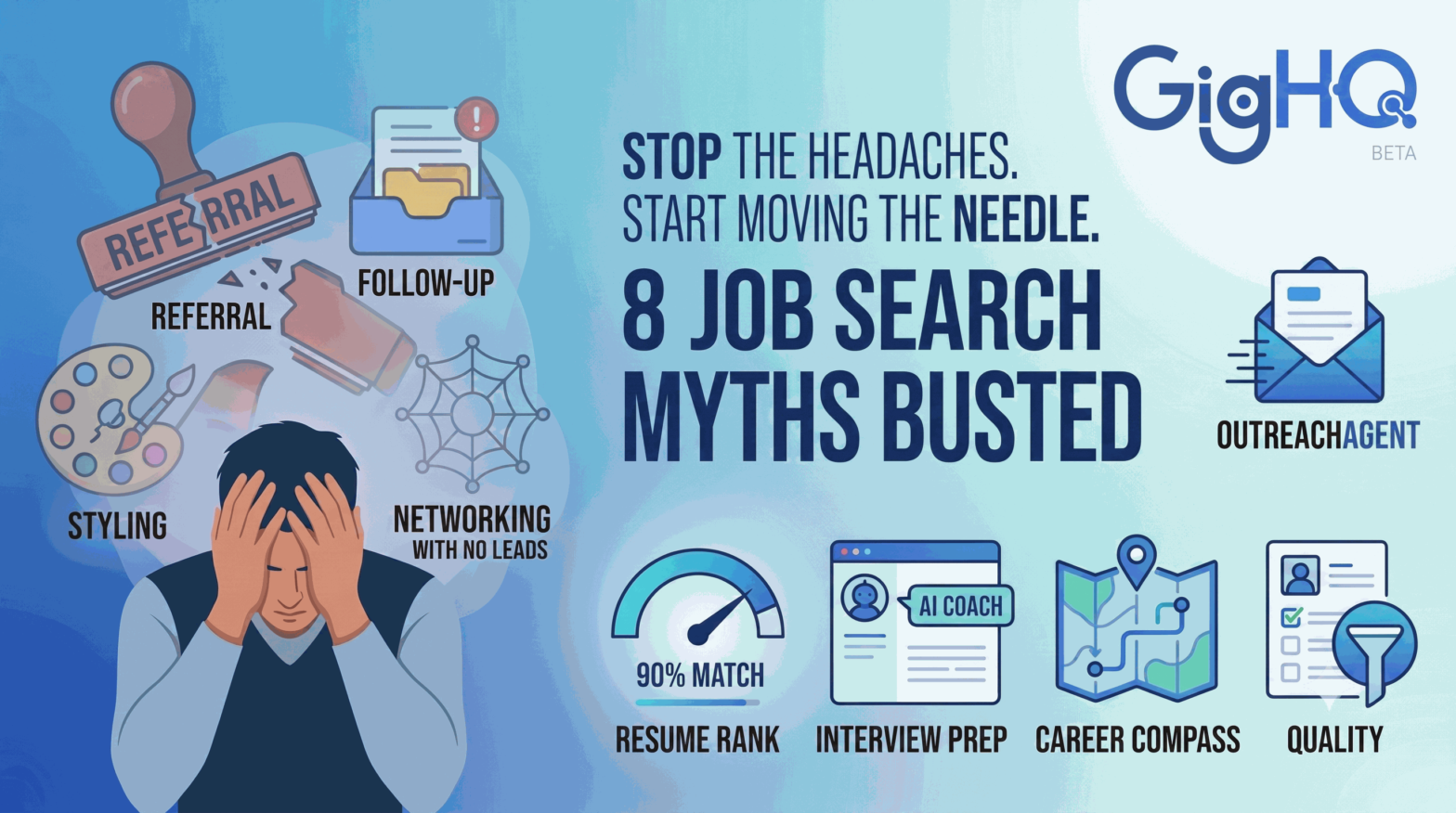
If you feel like your job search has turned into a second full-time job that yields zero results, it’s time to stop the empty busywork. Let’s break down these 8 major myths, separate feeling productive from being productive, and look at how data-driven tools can help you reclaim your time and energy.
Myth 1: Getting a referral guarantees you the job.
The Reality: A referral does exactly one thing: it gets your resume in front of human eyes. But if your resume fails to explicitly prove you can do the job, the referral dies right then and there. Landing a internal champion is only step one; your data must back it up.
How to move the needle: Before you pass your resume to an internal contact, scan it against the exact target job description. Tools like ResumeRank instantly score your resume against explicit job requirements and highlight semantic skills gaps. Ensure your resume hits a 90%+ match score before wasting a valuable internal referral.
Myth 2: Following up after an application changes a “No” into a “Yes.”
The Reality: If a recruiter wants to move you forward, they will do it without a nudge. In a hyper-automated market, an unprompted follow-up email rarely alters a hiring decision; it simply reminds them you applied.
How to move the needle: Stop spending hours manually drafting emotional follow-up emails into the dark. Instead, track company response behaviors using the free GigHQ Chrome Extension to see real-time community hiring data. When a strategic follow-up is actually logical, let OutreachAgent instantly handle the outreach framework so you don’t waste mental energy.
Myth 3: A pretty, highly styled resume beats a plain one.
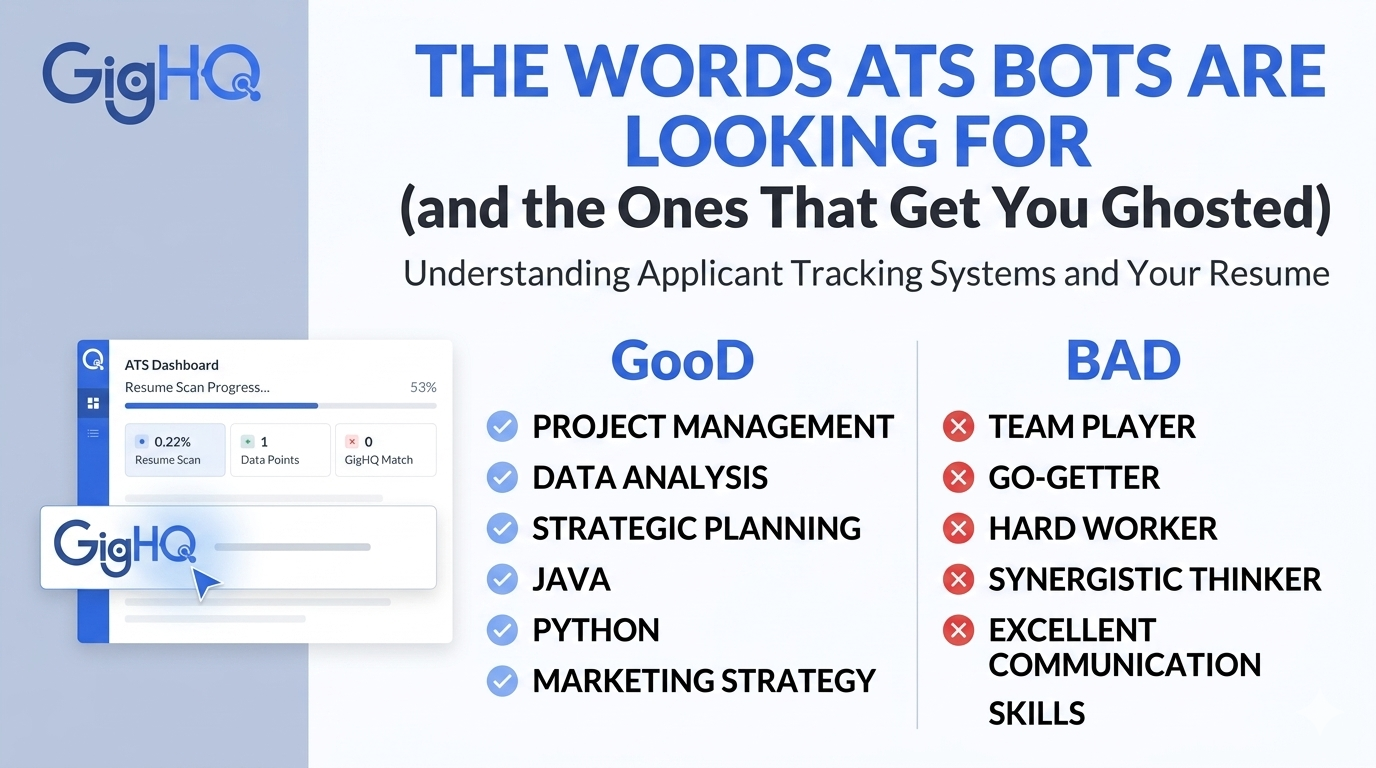
The Reality: Too many job seekers spend hours tweaking aesthetics, dual-column layouts, and graphics on Canva. A pretty resume does not mean a good resume. Formatting simply check-marks basic professionalism (and often breaks automated applicant tracking systems). Content and clear impact metrics are what actually convert to interviews.
How to move the needle: Strip out complex formatting that screens you out. Focus entirely on keywords, hard skills, and outcomes. Let ResumeRank inspect the literal text substance of your file to ensure automated parsers and hiring managers read your actual value, not your design choices.
Myth 4: The best interview strategy is to “Just be yourself.”
The Reality: This is arguably the least useful advice ever spoken. Interviewing isn’t a casual conversation—it is a structured professional performance. The candidates who get cross-department offers are prepared, strategically positioned, and thoroughly practiced. That isn’t being “fake”; it’s being smart.
How to move the needle: Treat the interview room like a stage. Use an AI simulator like SmartPrep to run mock interviews customized to your specific target job description. Practice articulating your technical wins aloud and get instant objective feedback on where your answers miss the mark.
Myth 5: The more senior you are, the easier it is to write your resume.
The Reality: The opposite is true. The most experienced professionals struggle the most with their resumes. Why? Because you have too much to say and you are far too close to your own narrative. Distilling 15+ years of complex leadership into two concise pages feels nearly impossible on your own.
How to move the needle: Step away from the blank document. Use CareerCompass to instantly generate a personal search strategy and clear market brand directly from your raw career milestones. Let AI handle the heavy lifting of synthesizing decades of experience into clear positioning data.
Myth 6: Networking is the definitive solution to everything.
The Reality: Traditional networking advice says to talk to everyone. But the reality is that roughly 70% of an average person’s organic network is filled with peers in the exact same boat—navigating layoffs or actively looking for work. A job seeker cannot refer another job seeker into an invisible role.
How to move the needle: Transition from accidental networking to highly intentional targeting. Stop trying to keep track of networking links on messy spreadsheets. View our guide on How to Track Job Applications (Without a Spreadsheet!) and leverage OutreachAgent to pinpoint and contact active, verified hiring decision-makers rather than blasting generic messages.
Myth 7: You should apply if you only meet 60% of the job requirements.
The Reality: This piece of advice worked wonderfully a few years ago when talent markets were highly liquid. In today’s hyper-competitive ecosystem, employers are flooded with applicants and demand “day-one impact.” The individuals actually clearing the automated filters and getting called back typically match 90% or more of the explicit requirements.
How to move the needle: Quality over quantity. Stop playing a blind numbers game that results in rejection fatigue. Focus your time exclusively on roles where you hold a powerful competitive advantage. Use the GigHQ MCP Integration to quickly analyze deep semantic gaps right inside your favorite LLM chat context before hitting submit.
Myth 8: A brilliant cover letter will save a weak resume.
The Reality: No one reads a cover letter if the resume doesn’t clear the initial technical evaluation. A cover letter is a secondary supporting document—it cannot resurrect an application that failed the core skills match.
How to move the needle: Never spend hours hand-writing individual cover letters from scratch. Let CoverGenius generate context-aware, hyper-personalized cover letters tailored to your resume in a single click. Keep your primary focus on tightening your core resume matching metrics.
Stop the Productive Procrastination
None of this reality check is meant to discourage you. It is meant to protect you. It is designed to save you from spending critical energy in the wrong places.
There is a profound difference between doing tasks that make you feel busy (like rewording a cover letter for the 40th time) and taking actions that actually move the needle. The job search landscape has changed completely, and traditional advice simply hasn’t kept up with automated corporate reality.
Be incredibly honest with yourself about what is actually working in your daily pipeline. Take control of your data, automate the tedious administrative tracking grind, and match your skills to real opportunities with precision.
Ready to transform your job hunt from a numbers lottery into a structured strategy?
- For Job Seekers: Get access to the complete, free platform at GigHQ.ai.
- For Career Coaches & Advisors: Discover how to track member analytics with our Coach’s Portal Demo on YouTube.
- For Advanced Users: Learn how to plug your job data directly into your workflows with our Claude & ChatGPT MCP Setup Guide.
Our Platform Tools:

ResumeRank
Scan your resume, get a score, fix what matters.

CoverGenius
Generate personalized, AI-powered cover letters in seconds.

OutreachAgent
Craft perfect networking and AI-powered follow-up emails with ease.

CareerCompass
Instantly generate a personal marketing plan from your resume to define your brand and attract the right opportunities.

Smart Prep
Simulates a real interview based on your resume and the job description, giving you real-time feedback to build your confidence.

Profile Spark
Optimize your LinkedIn profile to attract recruiters and opportunities.