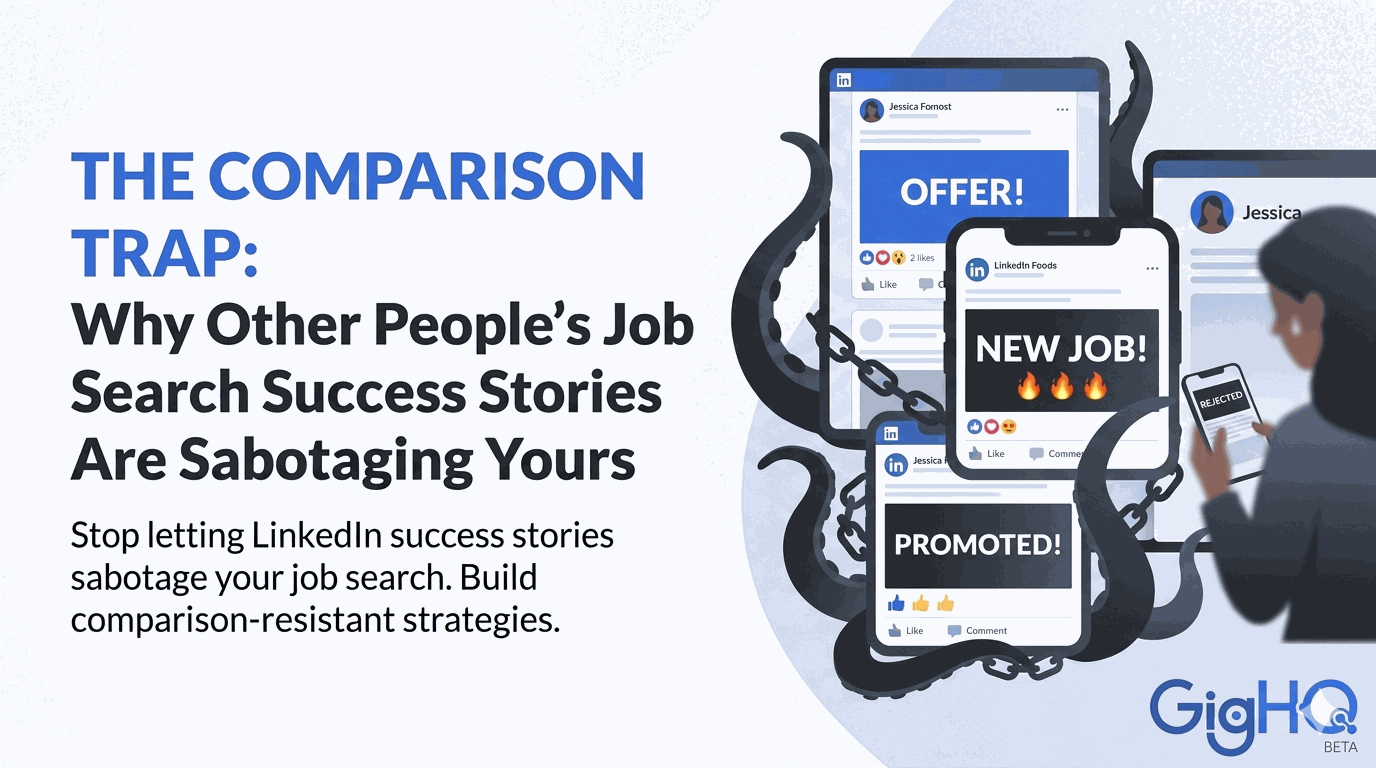
Jessica refreshed LinkedIn and immediately regretted it. Three success stories in a row:
- “Two weeks from application to offer!”
- “Coffee meeting turned into dream job!”
- “So grateful for this smooth process!”
Meanwhile, Jessica was four months into her marketing job search with nothing but form rejections to show for it.
Sound familiar? You’re caught in the comparison trap—and it’s sabotaging your search in ways you probably don’t realize.
The 5 LinkedIn Lies That Are Ruining Your Job Search
Myth #1: “Everyone else finds jobs quickly”
The reality: The average job search takes 3-6 months, with some extending much longer. Those “quick” success stories represent the exceptions, not the rule.
Why it’s posted: Success stories with dramatic timelines get more engagement. “Found a job after 6 months of consistent effort” doesn’t generate likes.
The damage to your search: You panic after 2 months and start making desperate decisions instead of staying strategic.
Myth #2: “Networking always leads to instant opportunities”
The reality: Most networking success stories omit years of relationship-building that preceded the “casual coffee” that led to a job offer.
Why it’s posted: People want to emphasize the power of networking without acknowledging the years of groundwork.
The damage: You abandon systematic applications to chase networking events, expecting immediate results that rarely materialize.
Myth #3: “The job market is red-hot for everyone”
The reality: Job availability varies dramatically by industry, role level, location, and economic timing. Government roles take an average of 53.8 days to hire, while restaurant positions average 10.2 days.
Why it’s posted: People in high-demand fields or roles naturally share their positive experiences more than those struggling.
The damage: You question your skills and approach when the real issue might be market conditions in your specific niche.
Myth #4: “Great candidates always have multiple offers”
The reality: Even excellent candidates often receive just one offer after months of searching, and many successful professionals have stories of extended job searches that they don’t share publicly.
Why it’s posted: Multiple offers make for exciting success stories and demonstrate market value.
The damage: You turn down reasonable offers hoping for better options that might not come.
Myth #5: “Job searching should feel effortless when you’re qualified”
The reality: Job searching is inherently challenging, requiring sales skills, emotional resilience, and strategic thinking that are separate from professional competence.
Why it’s posted: No one wants to admit they struggled with something that “should” be straightforward.
The damage: You interpret normal job search challenges as evidence of personal inadequacy.
The Algorithm Problem
LinkedIn’s algorithm amplifies success stories because they generate engagement. Meanwhile, struggle stories get suppressed because they don’t drive clicks. This creates a systematically biased view of job search reality.
What you see: Endless stream of celebrations and “grateful to announce” posts.
What you don’t see: The months of applications, multiple rejections, interview anxiety, and self-doubt that preceded every success story.
The result? You’re comparing your behind-the-scenes reality to everyone else’s highlight reel, creating psychological pressure that sabotages strategic thinking.
The Comparison Antidote: Focus on Your Own Metrics
Instead of measuring yourself against curated social media stories, track metrics that actually matter for your search:
Week-by-Week Progress Tracking
- Applications submitted: Aim for 5-10 per week for strategic quality
- Response rate: Track improvements over time rather than absolute numbers
- Interview skills: Notice better preparation, reduced anxiety, or improved responses
- Network expansion: Count meaningful professional conversations, not LinkedIn connections
Market Intelligence Gathering
- Industry patterns: What hiring trends are you noticing across multiple companies?
- Skill gaps: What capabilities keep appearing in job postings or interview feedback?
- Timing insights: Are certain companies or industries moving faster than others?
Use GigHQ’s market intelligence tools to understand actual hiring patterns rather than relying on social media anecdotes for market information.
Strategic Social Media Usage
Instead of avoiding LinkedIn entirely, use it strategically:
Follow industry leaders and companies rather than just peers. This provides market insights without comparison triggers.
Engage thoughtfully with content that helps you build visibility and relationships, rather than passively consuming success stories.
Share your own professional insights about industry trends, skills, or challenges. This positions you as an expert rather than a job seeker.
Congratulate others strategically. Thoughtful congratulations can begin professional relationships, but don’t let others’ success derail your focus.
The Strategic Response to Success Stories
When you do see success stories, extract strategic intelligence instead of making emotional comparisons:
Company intelligence: Which organizations are actively hiring in your field?
Timing patterns: Do success stories cluster around certain times of year?
Skill trends: What capabilities are successful candidates highlighting?
Process insights: What can you learn about effective search strategies?
Transform comparison triggers into market research opportunities that improve your own outcomes.
Quick Recovery from Comparison Spirals
When you catch yourself in a comparison spiral:
Close social media immediately. Take a 24-48 hour break to reset your perspective.
Review your own progress. Look at your application tracking, interview improvements, or network expansion over the past month.
Connect with your support system. Talk to mentors, career coaches, or trusted friends who can provide realistic perspective.
Take one strategic action. Apply to a role, reach out to a contact, or work on skill development. Progress beats comparison every time.
Building Comparison Immunity
The most successful job seekers develop psychological immunity to comparison by:
Focusing on process over outcomes. You control application quality, interview preparation, and networking consistency. You don’t control hiring timelines, company priorities, or market conditions.
Celebrating small wins. Good interviews, positive feedback, or expanded network connections are progress markers independent of final outcomes.
Maintaining realistic timelines. When you expect job searches to take 3-6 months, month two doesn’t feel like failure.
Building strategic support systems. Join communities like GigHQ’s Discord where people share realistic experiences rather than just celebration announcements. Groups like Never Search Alone and Linkedin’s AHF are also really good options.
Your Anti-Comparison Action Plan
This week: Track your own metrics instead of consuming social media success stories.
This month: Build your job search marketing plan based on your market feedback rather than others’ experiences.
This quarter: Focus on sustainable progress toward your career goals rather than timeline comparisons with people in different situations.
Remember: Everyone’s career path is different, market timing affects outcomes independent of merit, and the only comparison that matters is between where you are now and where you want to be.
The most successful professionals don’t find jobs faster than market conditions allow—they maintain strategic focus regardless of external noise and build careers that compound over decades, not just individual job search sprints.
Your success story will be uniquely yours, based on your specific circumstances and strategic choices. Focus on writing it rather than reading everyone else’s.
Our Platform Tools:

ResumeRank
Scan your resume, get a score, fix what matters.

CoverGenius
Generate personalized, AI-powered cover letters in seconds.

OutreachAgent
Craft perfect networking and AI-powered follow-up emails with ease.

CareerCompass
Instantly generate a personal marketing plan from your resume to define your brand and attract the right opportunities.

Smart Prep
Simulates a real interview based on your resume and the job description, giving you real-time feedback to build your confidence.

Profile Spark
Optimize your LinkedIn profile to attract recruiters and opportunities.