The landscape of youth workforce development is undergoing a seismic shift. With the passage of the “A Stronger Workforce for America Act” (H.R. 6655), the federal government has officially rebranded “Out-of-School Youth” (OSY) as “Opportunity Youth.” This isn’t just a semantic update. It represents a fundamental change in how we view, support, and—most importantly—report on the success of young people in our workforce systems. For Local Workforce Development Boards (LWDBs), the rebrand comes with a mandate for greater flexibility, but it also highlights a persistent, painful reality: tracking youth outcomes across diverse pathways is a reporting nightmare.
At GigHQ.ai, we are helping local boards move beyond “manual chasing” to a system of automated, auditable outcomes that ensure every successful youth pathway is counted.
The Opportunity Youth Mandate: What’s New in H.R. 6655?
H.R. 6655 makes critical improvements to the Workforce Innovation and Opportunity Act (WIOA), specifically targeting the barriers faced by “Opportunity Youth”—individuals aged 16–24 who are disconnected from both school and work.
Key changes include:
- Renaming & Redefining: The shift to “Opportunity Youth” includes specific inclusions for homeless youth, justice-involved youth, and those in the foster care system, regardless of their school status.
- Spending Flexibility: The bill reduces the required percentage of youth funds spent on out-of-school youth from 75% to 65%, giving local boards more room to intervene earlier.
- Emphasis on Work-Based Learning: There is a heightened focus on paid and unpaid work experiences, pre-apprenticeships, and internships.
While these changes are designed to “strengthen pathways to economic opportunity,” they complicate the already difficult task of performance reporting.
The 2nd and 4th Quarter Challenge
Unlike WIOA Title I Adult and Dislocated Worker programs—where a “win” is almost strictly defined as unsubsidized employment—the Youth program (Title I Youth) has a unique dual-track success metric.
According to DOL TEGL 10-16, Change 1, the primary indicators of performance for youth include:
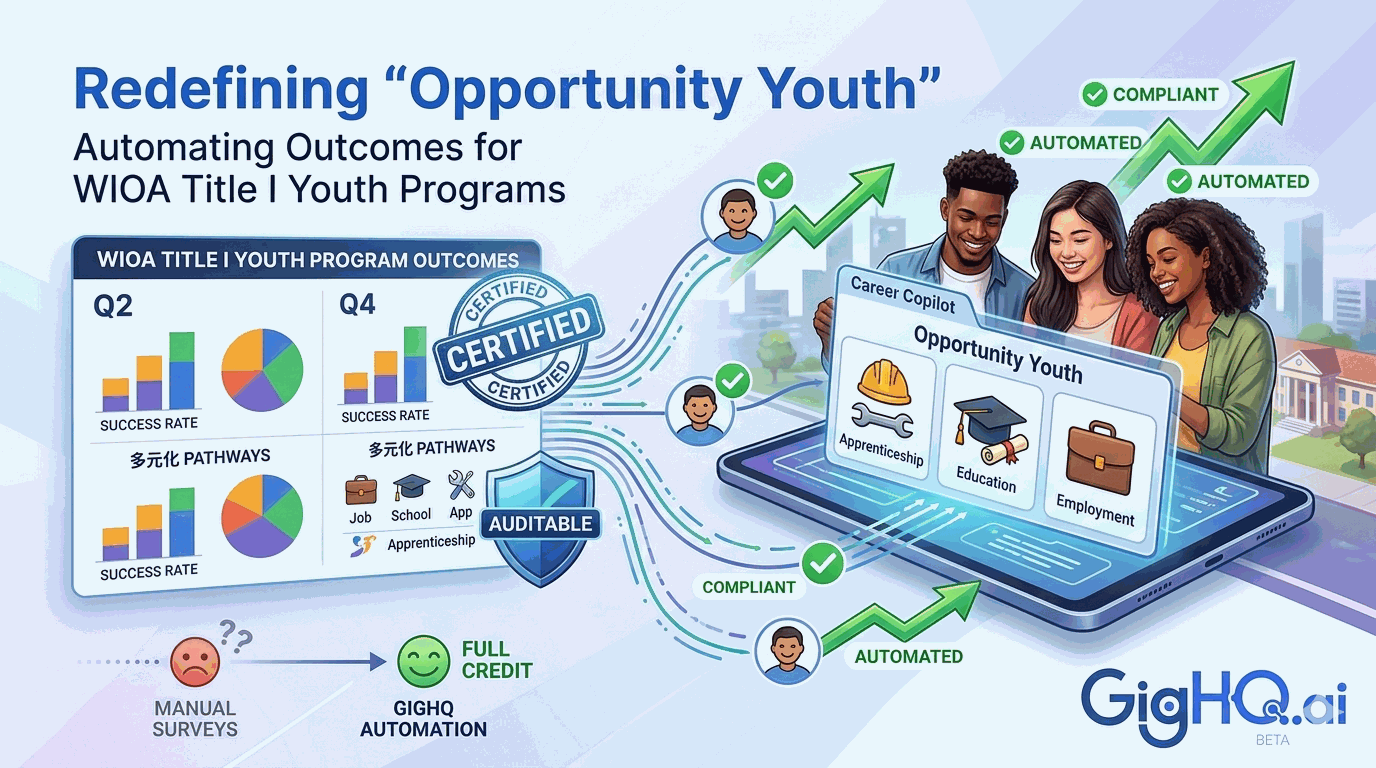
- Employment or Education Rate (2nd Quarter after Exit): The percentage of participants in education, training activities, or unsubsidized employment.
- Employment or Education Rate (4th Quarter after Exit): The same metric measured a full year after the participant leaves the program.
For youth, a “successful outcome” is highly diverse. It could be a pre-apprenticeship in the trades, enrollment in a community college, or a full-time job.
The problem? Traditional reporting relies on self-reported surveys. Youth are notoriously difficult to reach six or twelve months after program exit. When a graduate doesn’t answer the phone, the local board gets a “zero” for that outcome—even if that young person is currently thriving in a degree program or a high-paying job.
Automating the Youth Pathway with GigHQ.ai
GigHQ.ai was built to solve the “Knowledge Rate” problem. Our platform converts the chaotic job and education search into a structured, auditable data stream.
1. Tracking Diverse Outcomes
GigHQ doesn’t just track job applications; it tracks the intent and verification of the entire career journey. Whether a participant is applying for a Registered Apprenticeship, a postsecondary program, or a corporate role, our WIOA Compliance Engine captures the activity in real-time.
2. Eliminating Survey Fatigue
Local board staff shouldn’t have to act like a call center. By providing youth with a “Career Copilot”—including tools like ResumeRank and CoverGenius—GigHQ creates a value loop where the participant uses the tool to succeed, and the tool captures the outcome evidence passively.
3. Auditable Employment & Education Evidence
When it comes time for an audit, “I think they went back to school” isn’t enough. GigHQ provides verified signals—interview invites, enrollment confirmations, and offer letters—that serve as objective evidence for Q2 and Q4 reporting.
Getting Full Credit for Non-Traditional Success
In the current system, many LWDBs are effectively “penalized” for the success of their participants because they lack the tools to prove it. If a youth participant enters a non-traditional but successful pathway—like a specialized certification program or a “gig” that leads to long-term stability—it often goes unrecorded.
GigHQ tracks the “Community Signal.” By aggregating anonymized data from across our ecosystem, we can identify when and where youth are being hired or enrolled, ensuring local boards get 100% credit for the impact they are making.
Conclusion: A System Built for the Future
The rebrand to “Opportunity Youth” is a call to action to treat young people as the assets they are. But to support them effectively, we need data that moves at the speed of their lives.
Local Workforce Development Boards that embrace automated outcome tracking aren’t just “acing the audit”—they are reclaiming hundreds of staff hours to focus on what actually matters: coaching, mentorship, and connection.
Stop chasing data. Start proving your impact.
Our Platform Tools:

ResumeRank
Scan your resume, get a score, fix what matters.

CoverGenius
Generate personalized, AI-powered cover letters in seconds.

OutreachAgent
Craft perfect networking and AI-powered follow-up emails with ease.

CareerCompass
Instantly generate a personal marketing plan from your resume to define your brand and attract the right opportunities.

Smart Prep
Simulates a real interview based on your resume and the job description, giving you real-time feedback to build your confidence.

Profile Spark
Optimize your LinkedIn profile to attract recruiters and opportunities.