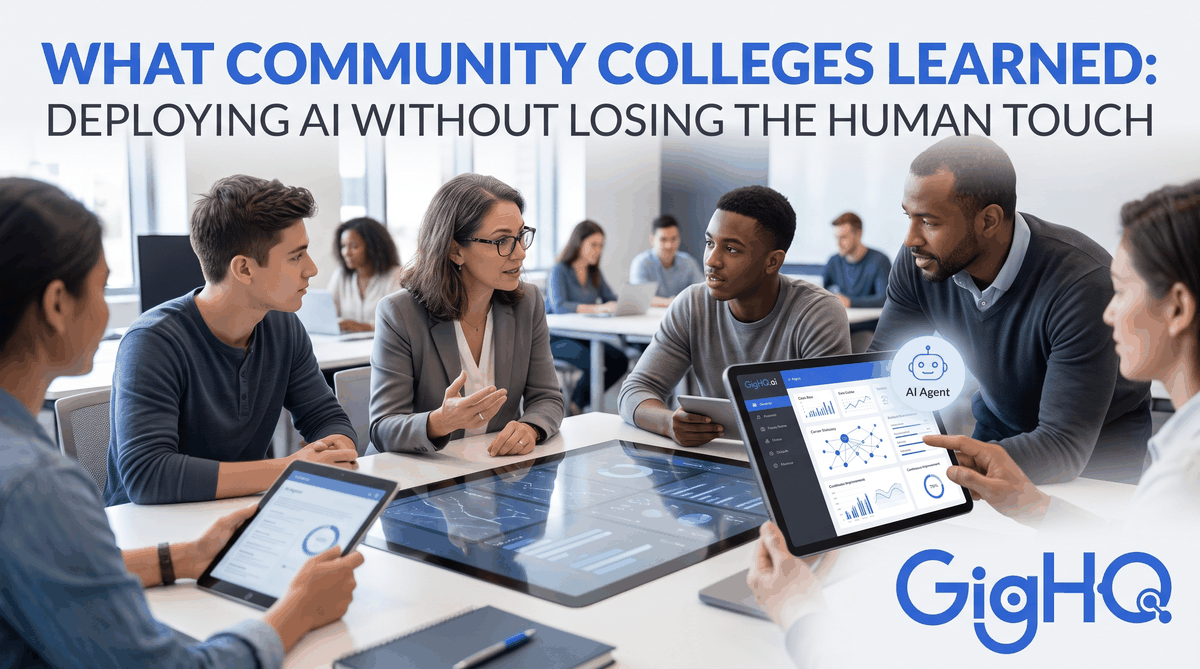
Most organizations adopting AI right now are optimizing for the wrong finish line. The question they’re answering is “how do we get this deployed?” when the question that actually matters is “does this make us better at the thing we’re here to do?”
Community colleges—not usually where you’d look for cutting-edge AI strategy—have quietly been forced to answer that second question for real. They’re serving students who need jobs now, working with employers who expect AI fluency yesterday, and doing it all with a fraction of the budget a four-year university or a tech company would have.
That constraint turns out to be useful. It strips the vanity out of “AI adoption” and leaves you with the actual test: did this make the institution more responsive, or did it just make it look busy?
A recent playbook by the Harvard Project on Workforce, titled verbatim as “The Agile Community College- Dynamic Labor Market Alignment in an AI-Driven Economy”, puts that test into words directly: “the end goal is not technology adoption itself, but the creation of a more responsive institution.”
That single line is a better AI strategy than most companies have written down—and it holds up just as well for an individual deciding how to use AI in their own career as it does for a college deciding how to use it across an entire campus.
The $5 Million Initiative That Started With People, Not Software
Sinclair College’s approach is the clearest example of what it looks like to take that principle seriously. In the summer of 2025, Sinclair launched the AI Excellence Institute—a three-year, $5 million initiative to integrate AI across teaching, learning, and workforce preparation. On paper, that’s the kind of number that usually buys a platform rollout and a training deck. That’s not what Sinclair built.
Christina Amato, Sinclair’s Vice Provost for Academic and Workforce Innovation, described the structure on a recent webinar: instead of routing AI strategy through a standing committee and pushing decisions down to faculty, they built a new structure entirely—a base of fellows, not administrators. Four faculty fellows, fully reassigned out of the classroom, one from each academic division. Two student fellows representing the student body. Four staff fellows spanning instructional design, research, and AI architecture.
“We knew at the beginning we could not just put this in committee or create new programs and resources, and push them down and out,” Amato said. The fellows weren’t handed a finished policy—they were handed three focus areas (curriculum integration, campus-wide AI fluency, and community partnerships) and asked to figure out what that should actually look like at Sinclair.
The results in year one:
- A comprehensive review of more than 325 academic programs to find where AI integration made sense.
- New general-education outcomes around AI fluency.
- AI competency assessment built into 60% of classrooms campus-wide.
- A set of AI-related continuous improvement goals that every faculty and staff member on campus adopted, by choice, in their own performance reviews.
None of that required inventing new software. It required deciding, deliberately, who got to shape how the technology was used before anyone was asked to use it.
The Pattern That Shows Up in Every Single Capacity
Sinclair’s story isn’t a one-off. The Agile Community College playbook breaks institutional AI adoption into five areas—teaching and learning, student support, career navigation, work-based learning, and employer partnerships—and lays each one out with a strategic opportunity and an “implementation tension.” Read across all five, and the tension is the same sentence, reworded five times:
- Teaching and learning: Colleges “must ensure that such systems enhance rather than diminish student autonomy, critical thinking, problem-solving, and meaningful human interaction.”
- Student support: Automation should free advisors for higher-value work, but “should ensure this automation does not come at the expense of human interaction associated with student persistence, belonging and success.”
- Career navigation: AI tools should “inform rather than prescribe student choice,” expanding awareness while “preserving exploration, agency, and alignment with individual interest and goals.” (Looking for tools that inform rather than prescribe? Explore the GigHQ Job Market Radar).
- Work-based learning: Technology should help students discover and progress through opportunities, not just list them.
- Employer partnerships: Technology should coordinate relationships “while preserving the trust and responsiveness that makes those partnerships valuable”—not replace relationship-building with transactional data collection.
Five different functions, one identical warning: automation is only a win if it protects—or expands—the human relationship underneath it, not if it routes around it. That’s not a soft, feel-good caveat bolted onto a technology strategy. It’s the actual design constraint.
A tool that hits every efficiency metric while eroding trust, agency, or belonging has failed the framework’s own test, even if the adoption numbers look great.
Building Instead of Buying: Riverland’s Learning Lab Analysis
The instinct in most AI conversations is to shop first—evaluate the vendor landscape, pick a platform, roll it out. Riverland Community College took a different route. Their Institutional Research Team built an in-house predictive analytics initiative—the Learning Lab Analysis—designed specifically to connect student outcomes to the interventions that actually move them.
The reason that matters isn’t “build over buy” as a general principle. It’s that Riverland’s team could design the model around the exact questions their institution needed answered, instead of adapting their institution to fit whatever a vendor’s platform happened to track. A purchased tool optimizes for what’s generalizable across every customer. A tool built in-house can optimize for what’s true and specific to your students, your programs, your outcomes.
That’s a useful gut-check for any organization—or any person—evaluating an AI tool: Is it shaping itself around your actual goal, or are you quietly reshaping your goal to fit what the tool happens to measure?
The Strongest Argument for “Agent-Native” Design
Strip the higher-ed context away, and what’s left is a fully-formed argument for a specific kind of AI product design: AI that works alongside a person’s judgment, rather than AI that stands in for it.
That’s not a marketing angle GigHQ.ai invented—it’s the same conclusion these institutions arrived at independently, under real constraints, evaluated against real outcomes (completion, job placement, trust, retention), not vendor claims. Automation should extend human capacity—advisors, coaches, mentors, employers—not substitute for it. Hudson County’s own advising model was described explicitly as “human-in-the-loop.” The technology surfaces information and flags what needs attention; a person still does the interpreting, the deciding, the relationship-building.
That is the exact model GigHQ is built on for individual career management. GigHQ is an agent that handles the tracking, surfacing, and pattern-matching a person doesn’t have time to do manually, while leaving the actual judgment—which opportunity to pursue, which relationship to invest in, which move fits a person’s own goals—where it belongs.
To see this agent-native philosophy in action, check out how we integrate our tools directly into the platforms you already use:
- Browse & Capture: Our Chrome Extension acts as your eyes on the ground, instantly surfacing insights without taking over the driver’s seat.
- Seamless Chat Integration: Connect your job search data directly to your favorite LLM with GigHQ in ChatGPT and GigHQ in Claude.
- Developer Control: If you want total command over your job search data, explore our MCP Server to let your AI talk directly to your GigHQ account.
Watch the GigHQ approach in action:
- 🎥 Supercharging Your Job Search with AI
- 🎥 Automating the Tracking Grind
- 🎥 Making Data-Driven Career Decisions
- 🎥 The Human-in-the-Loop Workflow
- 🎥 Uncovering the Hidden Job Market
The evidence for this design choice doesn’t have to come from a product roadmap. It’s already sitting in how the institutions that are actually accountable for outcomes have chosen to deploy the exact same technology.
The Real Lesson Isn’t About AI At All
Sinclair didn’t succeed because they spent $5 million. Riverland didn’t succeed because they built custom software. The common thread across every example here is that the institutions asked what they were actually trying to protect—student agency, advisor relationships, employer trust—before they asked what the technology could do, and then built or bought accordingly.
That ordering is the whole lesson, and it applies just as well outside a campus: adoption was never the goal. Being more responsive—to a student, a client, a market, or your own career—was.
The technology only earns its place if it gets you there without costing you the human part that made you responsive in the first place.
Ready to experience an AI career copilot that empowers your judgment instead of replacing it? Start reclaiming your time and energy at GigHQ.ai.
Our Platform Tools:

ResumeRank
Scan your resume, get a score, fix what matters.

CoverGenius
Generate personalized, AI-powered cover letters in seconds.

OutreachAgent
Craft perfect networking and AI-powered follow-up emails with ease.

CareerCompass
Instantly generate a personal marketing plan from your resume to define your brand and attract the right opportunities.

Smart Prep
Simulates a real interview based on your resume and the job description, giving you real-time feedback to build your confidence.

Profile Spark
Optimize your LinkedIn profile to attract recruiters and opportunities.