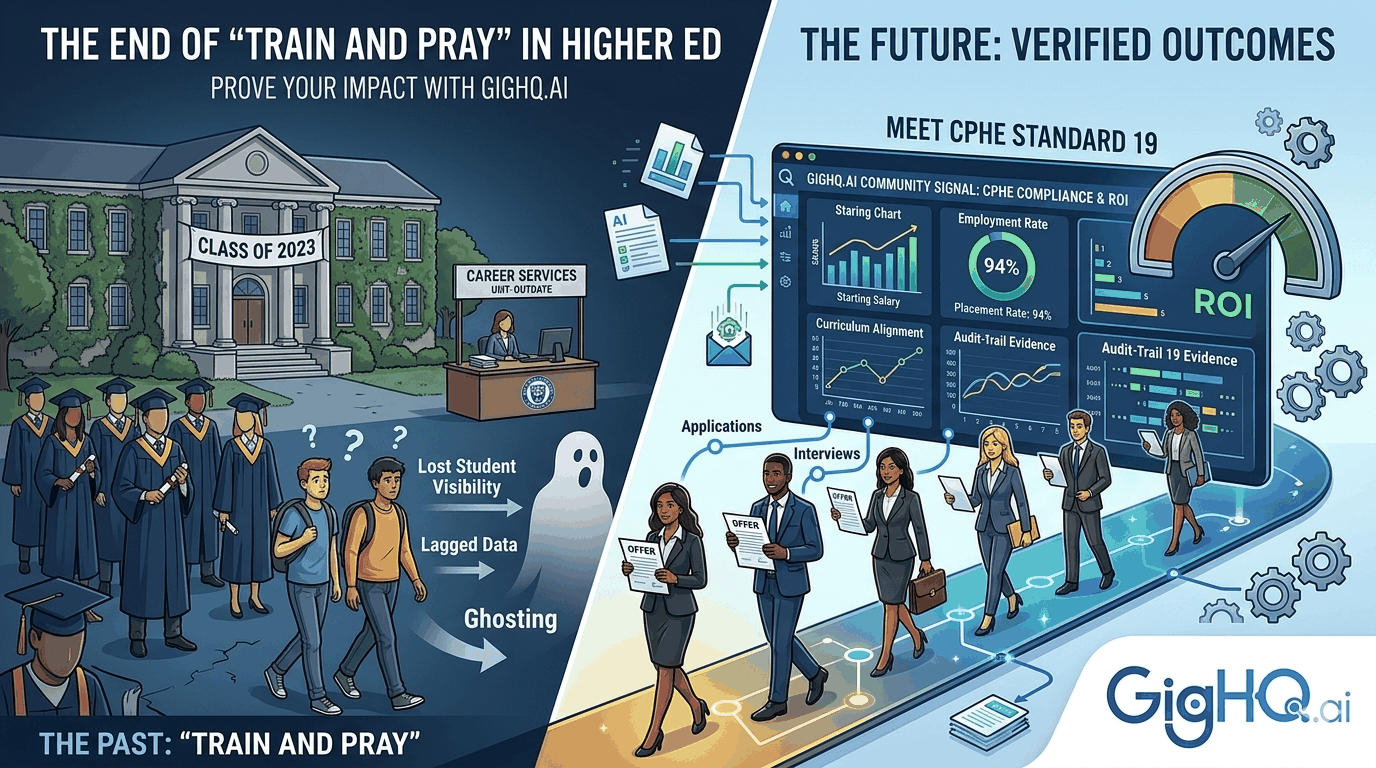
For decades, the standard operating procedure for many higher education institutions was a model we call “Train and Pray.” Universities would admit students, provide them with a curriculum, and then simply “pray” that the job market would absorb them upon graduation. Success was measured by inputs—enrollment numbers and faculty pedigrees—rather than the actual economic mobility of the graduates.
That era is officially over.
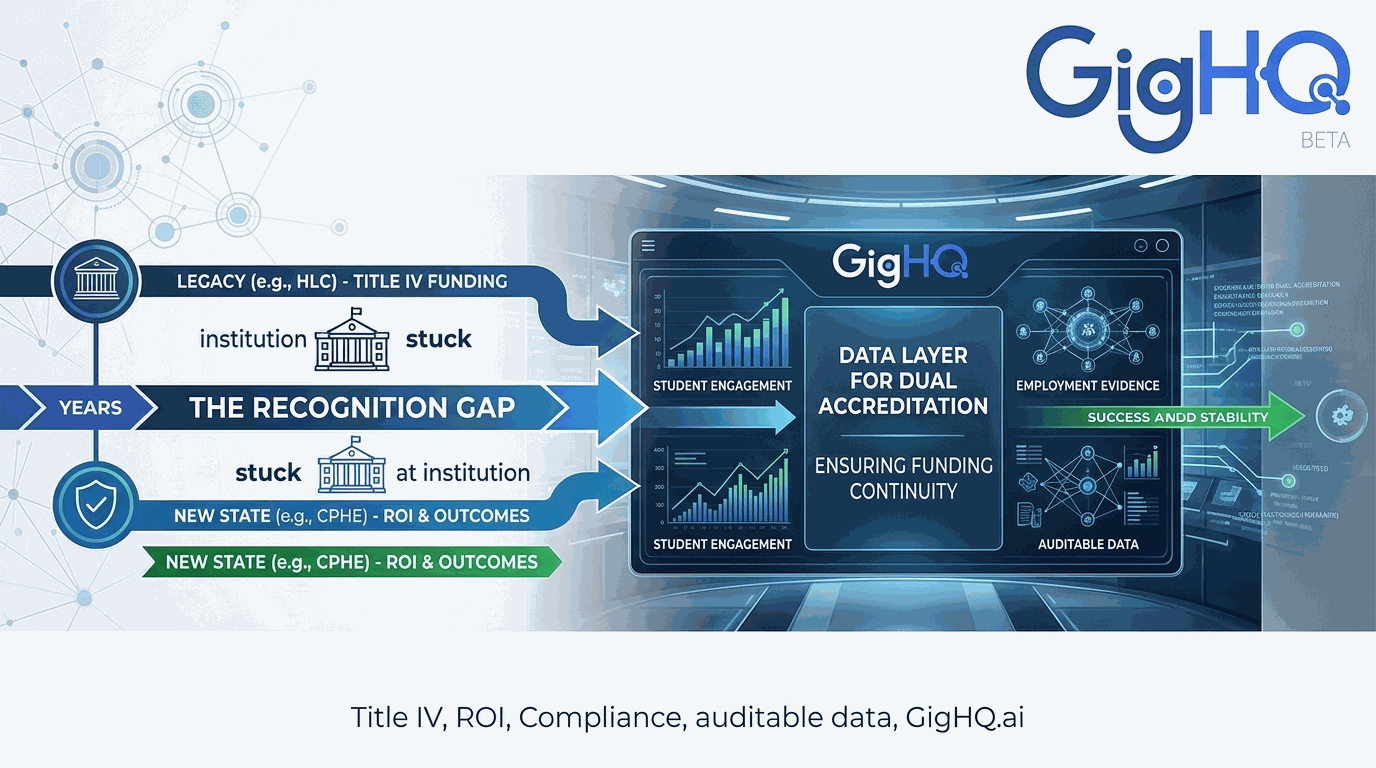
The rise of the Commission for Public Higher Education (CPHE)—a disruptive new accreditor backed by states like Florida and Texas—has signaled a permanent shift in how institutional quality is verified. With the release of the Draft Evidentiary Guidance in February 2026, the mandate is clear: “Return on Investment” (ROI) and “Workforce Alignment” are no longer optional goals—they are conditions of accreditation.
The New Hard-Data Reality: Standards 16 & 17
While traditional accreditors focused on qualitative assessments of “learning environments,” the CPHE’s new evidentiary guidance for Standards 16 (Student Success) and 17 (Student Support Services) demands empirical, auditable proof of impact.
The commission now specifically looks for evidence of:
- Direct Economic Return: Verifiable data showing that graduates are achieving a “wage premium” that justifies the cost of their degree.
- Workforce Integration: Proof that support services aren’t just “available,” but are actively placing students into high-demand, high-wage roles.
- Longitudinal Stability: Moving beyond the “first job” to show sustained employment outcomes and career progression.
Under this new guidance, institutions can no longer hide behind low-response-rate alumni surveys. They must prove, in real-time, that their programs are functioning as engines of economic opportunity.
The Death of the “Train and Pray” Model
The federal government and state legislatures are no longer satisfied with the “black box” of career services. New mandates like Financial Value Transparency (FVT) and the proposed Workforce Pell are converging with CPHE standards to create a “triple threat” to institutions that lack outcome visibility.
If an institution cannot prove its graduates are finding jobs, it risks more than just a bad reputation—it risks losing its eligibility for federal financial aid. The “Train and Pray” model is not just ineffective; it is now a massive liability.
The Problem: You Can’t Manage What You Can’t Measure
The challenge for most universities isn’t a lack of desire to help students; it’s a lack of infrastructure. Currently, Career Services departments often lose visibility the second a student leaves the classroom. They rely on “ghosting” data—students who stop responding to emails—to guess at placement rates. This results in “lagged data” that arrives months too late to satisfy a CPHE auditor’s request for evidence.
To meet these stringent new expectations, universities need a dashboard that doesn’t just report history, but manages outcomes in real-time.
Enter “Community Signal”: The GigHQ Advantage
At GigHQ, we’ve built the “Intelligence Engine” that higher education has been missing. Our Community Signal technology provides institutions with a live data layer that replaces the uncertainty of the job hunt with auditable proof.
By acting as the AI-powered Job Search Copilot for the student, we capture every application, interview, and offer letter. This isn’t self-reported survey data; it is passive, objective, and time-stamped evidence that aligns directly with the CPHE’s February 2026 Evidentiary Guidance.
For a university navigating this new era, GigHQ offers:
- Verified Placement Data: Automatically identify and categorize offer letters, providing the “Verified Human” guarantee auditors require.
- Real-Time ROI Dashboards: Instantly see the starting salaries and roles of your current graduating cohort—no surveys required.
- Workforce Alignment Insights: Identify exactly which skills are currently converting into interviews at top companies, allowing for rapid curriculum optimization.
Moving from Compliance to Competitive Advantage
The shift toward outcome-based accreditation is inevitable. Institutions that resist will find themselves buried under compliance audits and dwindling enrollment.
Institutions that embrace this shift—using tools like GigHQ to turn the chaotic job search into a structured, auditable data stream—won’t just survive the new CPHE standards. They will use that data to prove their ROI to a skeptical public, attracting more students and securing more funding than ever before.
The “Train and Pray” model is dead. Long live the era of verified outcomes.
Want to see how GigHQ.ai can help your institution prove its impact and ace the next accreditation cycle? Request a Partnership Demo today.
Our Platform Tools:

ResumeRank
Scan your resume, get a score, fix what matters.

CoverGenius
Generate personalized, AI-powered cover letters in seconds.

OutreachAgent
Craft perfect networking and AI-powered follow-up emails with ease.

CareerCompass
Instantly generate a personal marketing plan from your resume to define your brand and attract the right opportunities.

Smart Prep
Simulates a real interview based on your resume and the job description, giving you real-time feedback to build your confidence.

Profile Spark
Optimize your LinkedIn profile to attract recruiters and opportunities.