
The modern job search is defined by a central, pervasive paradox: a dynamic, rapidly evolving labor market remains tethered to an administrative technology—the resume—that was fundamentally designed for the 15th-century economy. As the primary gatekeeper to professional opportunity, the resume has transitioned from a tactical letter of introduction into a standardized, algorithmic data point. Yet, as we approach the third decade of the 21st century, this document is undergoing a crisis of utility. The rise of artificial intelligence, the shift toward skills-based hiring, and the increasing reliance on verifiable data are rendering the traditional self-reported narrative obsolete. To understand the future of employment, one must first deconstruct the resume’s long-standing reign, the technological pressures that standardized its form, and the emerging systems that promise to replace it.
The Genesis of Professional Self-Presentation: The Renaissance Pivot
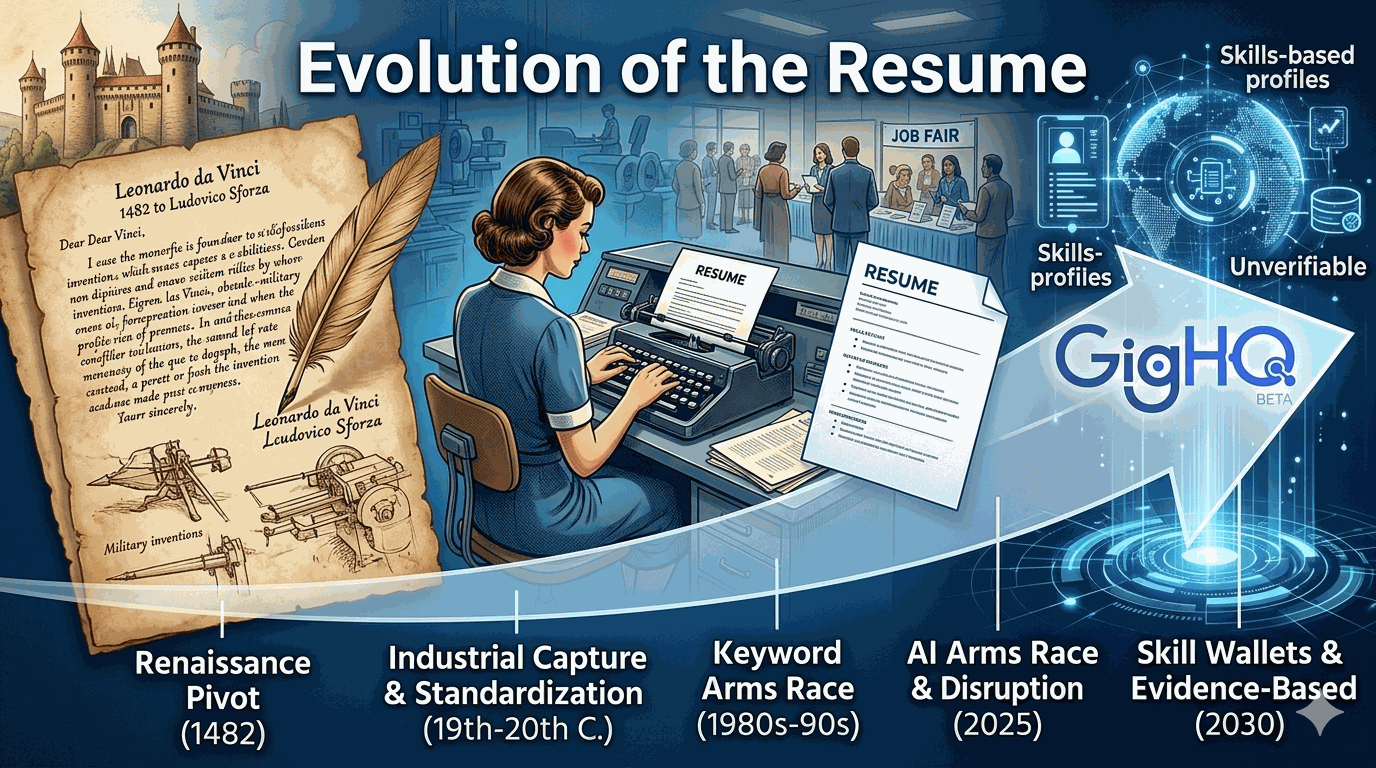
The origin of the resume is frequently traced to Leonardo da Vinci in 1482, but the significance of his contribution lies not just in the document’s existence, but in its strategic departure from the conventions of his time. In the late Middle Ages, professionals and craftsmen were largely evaluated through social reputation and letters of recommendation from masters or guild leaders. These documents served as portable references of character rather than technical catalogs. When da Vinci sought the patronage of Ludovico Sforza, the Duke of Milan, he realized that a mere inventory of his artistic achievements—his painting and sculpture—would not satisfy the Duke’s immediate, existential concerns regarding military defense and regional warfare.
Da Vinci’s 11-point letter represents the first documented instance of a “tailored” application. He systematically addressed the Duke’s needs as a military engineer, architect, and inventor, promising to construct “very light and strong” bridges, “cannon, mortars, and light ordnance,” and “unattackable armored cars”. His artistic genius was relegated to a concluding sentence, framing it as a peacetime capability rather than a core offering. This established a fundamental principle of recruitment that persists today: the most effective applications are those that position the candidate as a specific solution to an employer’s problem.
| Era of Genesis | Primary Document Form | Core Function | Evaluation Metric |
| Middle Ages | Recommendation Letters | Proof of character and guild membership | Social status and master’s reputation |
| Renaissance (1482) | Tactical Patronage Letter | Problem-solving proposal for a specific patron | Utility, engineering, and innovation |
| 16th-17th Century | Advertisements / Profile Summaries | Early mass-marketing of specialized skills | Demonstrated experience (e.g., Ralph Agas) |
In the late 1500s, this concept began to move beyond the elite circles of royal patronage. Ralph Agas, an English land surveyor, utilized advertisements to publicize his 40 years of field experience, marking the transition from private letters to public-facing professional marketing. This era demonstrated that as the complexity of the workforce increased, the need for a portable summary of qualifications grew alongside it. However, until the Industrial Revolution, the resume remained a rarity, as birthright and social stratification largely dictated professional outcomes.
Industrialization and the Administrative Capture of Talent
The transition from an agrarian and craft-based economy to a corporate-industrial model in the 19th century necessitated a new form of talent management. The opening of massive factories and the emergence of transcontinental railways created a workforce that was no longer localized or known to employers personally. During the 1800s, the “letter of recommendation” became the primary gatekeeper for office-based roles. These were handwritten testimonials from previous employers or respected community leaders. For the worker, talent was effectively hidden behind social capital; without a personal connection to a person of status, securing a professional role was nearly impossible.
By the early 20th century, the scale of global business necessitated the standardization of the resume. Managers who needed to hire hundreds of people simultaneously could no longer afford the time to read long, rambling, handwritten letters of introduction. By the 1930s, resumes became a standard requirement for formal job openings, serving as a quick sorting mechanism. These early standardized documents were remarkably different from modern versions, focusing on “human statistics” rather than achievements. Employers of this era demanded a candidate’s exact height, weight, religion, marital status, and a photograph—details that were used to make rapid, albeit subjective and often discriminatory, decisions.
Following World War II, the resume underwent what historians call a “significant democratization”. The post-war economic boom increased job mobility, and the GI Bill allowed more workers to gain formal credentials that needed documenting. It was during the 1950s that the resume became truly mandatory for professional employment. The focus shifted from a character sketch to a “strict professional profile” that included formal schooling, job titles, and personal hobbies like gardening or golf, which were intended to define the applicant’s entire identity on a single sheet of paper.
The Convergence of Job Fairs and the One-Page Standard
The shift toward the “one-page” resume with “bulleted achievements” is not an arbitrary aesthetic choice but a direct result of physical and cognitive constraints that emerged in the mid-to-late 20th century. While the one-page limit was touted as a rule for decades, its roots are firmly planted in the logistical realities of the job fair and the emergence of human resources as a specialized corporate function.
In the 1970s and 1980s, the field of “personnel administration” evolved into “Human Resources Management” (HRM), reflecting a new corporate view of people as resources to be managed and optimized. Simultaneously, the proliferation of job fairs created a high-volume screening environment. In these settings, recruiters might encounter 300 to 800 candidates in a single event. The physical constraint of carrying hundreds of paper resumes and the time constraint of meeting a candidate for under 60 seconds necessitated a document that was concise, scannable, and durable.
The “one-page” standard became a “nice guideline” for early-career professionals and a “brassbound rule” for recruiters who had limited attention spans. A single page ensured that the most critical information—summary, key skills, and recent employment—was visible at a glance, preventing the “cognitive load” that multi-page documents introduced. It also forced job seekers to synthesize their life stories into high-impact achievements rather than lengthy descriptions of day-to-day tasks.
| Key Driver of One-Page Standard | Impact on Format | Resulting Convention |
| Physical Job Fairs | Need to carry and store paper resumes in bulk | Single-sheet requirement |
| Recruiter Attention Span | 6–7.4 second initial scan | Front-loaded top third of page |
| Administrative Efficiency | High volume of applicants per role | Standardization of sections (Experience, Education) |
| Technology Limitations | Photocopying and manual filing costs | Clear white space and legible fonts |
The Technological Evolution: From Typewriters to Word Processors
The physical appearance of the resume has been dictated by the tools used to create it. In the 1950s and 1960s, typewritten resumes were common, but they were difficult to modify, often resulting in “scraps of paper” being used during meetings. The 1970s saw advancements in digital typesetting and word processing, which made resumes look more professional and consistent. By the 1980s and 1990s, the advent of personal computers and software like Microsoft Word revolutionized the process, making professional-looking templates available to the masses.
This technological shift democratized design but also contributed to the “keyword arms race.” As companies began storing resumes in digital databases, the importance of keyword optimization emerged. The resume was no longer just a narrative; it was a searchable record. The fax machine (1987) and later email (1990s) accelerated the speed of distribution, allowing candidates to apply for more roles than ever before, which in turn forced employers to turn to automated parsing technology—the precursor to modern Applicant Tracking Systems (ATS).
The Emergence of the Bullet Point
The “bullet point” convention followed a similar technological trajectory. While typographers had used symbols like the “midpoint” for centuries, the term and widespread usage of the “bullet point list” in professional documents emerged alongside presentation software like Harvard Graphics and PowerPoint in the late 1980s. On a resume, the bullet point solved the problem of the “wall of text”. It allowed recruiters to utilize an “F-shaped” scanning pattern, where they would read the first few words of each line to determine relevance. This shift from paragraphs to bullets turned the resume into a “marketing tool” focused on discrete, quantifiable ideas rather than a flowing narrative of one’s career journey.
The Modern Dilemma: Shortlisting for Red Flags vs. Interviewing for Potential
In today’s job market, the resume serves a purpose that is often at odds with the interview process. Organizations use resumes as a “first filter” designed primarily for elimination rather than selection. During the initial scan, which eye-tracking studies indicate lasts between 6 and 7.4 seconds, recruiters are not looking for potential; they are looking for “red flags” or a lack of baseline requirements.
This creates a significant dilemma: the resume emphasizes “proxies” for talent—such as degree pedigree, former company names, and unbroken work history—while the interview is intended to explore the candidate’s actual career journey, problem-solving skills, and cultural fit. Research indicates that traditional resume screening is deeply flawed, as credentials and work history do not always equate to actual capability.
The Predictive Gap in Recruitment
| Screening Method | Predictive Validity of Job Performance | Common Bias Introduced |
| Resume Screening | Low (Narrative/Self-reported) | Pedigree Bias, Keyword Stuffing |
| Traditional Interview | Moderate (Subjective/Performative) | Confidence over Competence |
| Psychometric Assessment | High (Objective/Data-driven) | Minimal (when properly validated) |
| Work Samples | Very High (Evidence-based) | None (focuses on output) |
The cost of this “gut feel” hiring is substantial. Statistics show that when hiring is based on instinct and resume proxies, only 26% of employees turn out to be true high performers. The resume, as a personal marketing document, highlights achievements without context and fails to demonstrate how a person processes complex information or responds to feedback. Consequently, forward-thinking organizations are beginning to reframe the resume as “secondary information,” placing more emphasis on practical evaluations such as assessments, portfolios, and structured interviews.
The Proactive Shift: From Resume Reconstruction to Career Journaling
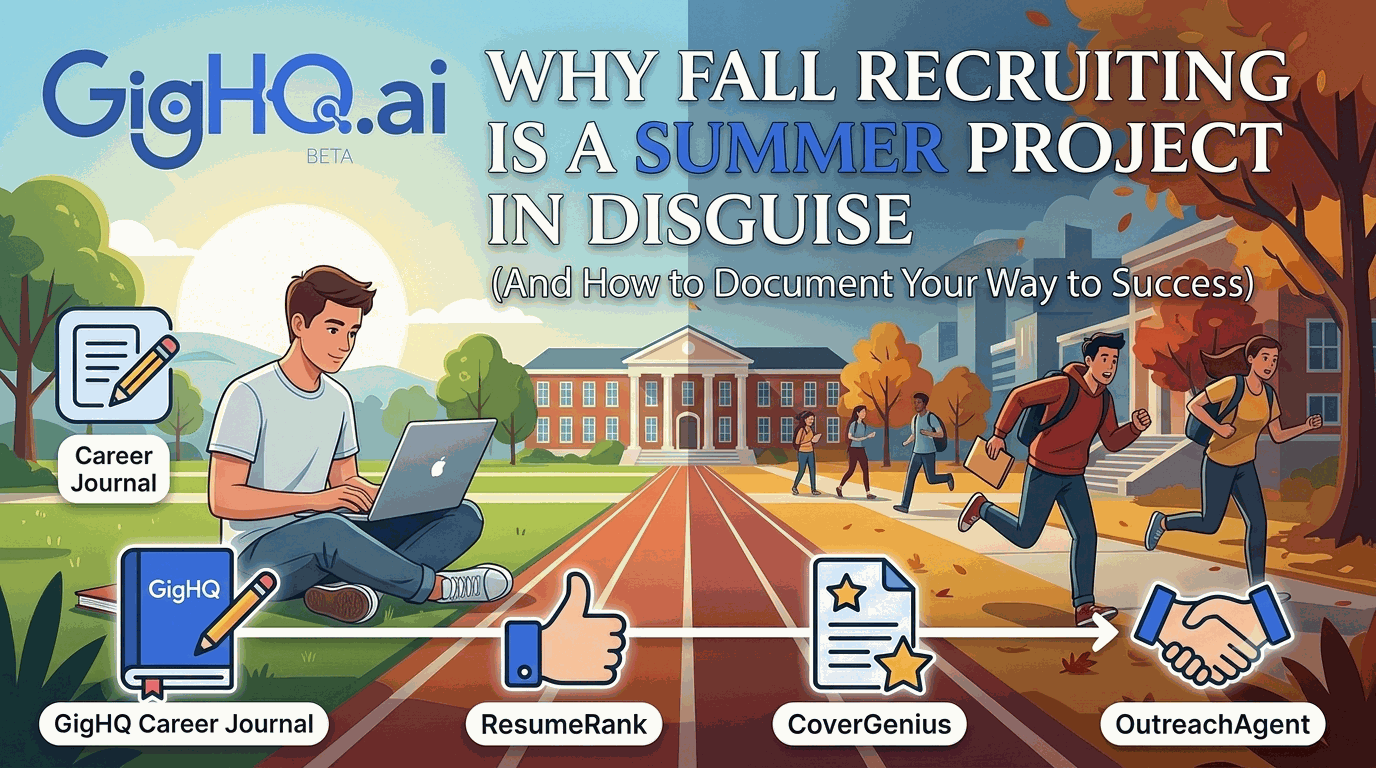
At GigHQ.ai, we identify the root of this recruitment dysfunction in the way candidates prepare for the market. Most job seekers treat the resume as a reactive document—a frantic attempt to reconstruct a career history only when a job is lost or an opportunity arises. This “blank page” pressure often leads to generic, low-signal summaries that fail the 7.4-second scan.
The GigHQ.ai perspective encourages a transition from the static resume to a dynamic “Career Journal”. A career journal is a structured, private record where professionals capture milestones, technical wins, and reflections at regular intervals—much like a bi-annual review—rather than once every few years. This habit solves the primary hiring dilemma by separating the “ad” from the “story”:
- The Resume as the Ad: Using the raw data from the journal, you craft the resume to be a high-impact, tailored advertisement designed to pass the shortlisting filter.
- The Journal as the Story: The journal stores the deep context—the challenges, failures, and “how-to” insights—that form the narrative foundation of a successful interview journey.
Research indicates that this reflective practice not only makes interview preparation more manageable but also enhances critical thinking and helps professionals identify their own patterns of success. By maintaining a “living map” of their accomplishments, job seekers can pivot from a position of desperation to a position of strength, ensuring their resume isn’t just a list of dates, but a strategic asset backed by a wealth of evidence.
The AI Arms Race: Candidate Optimization vs. Algorithmic Rejection
The labor market of 2025 and 2026 is characterized by an “AI standoff”. On one side, candidates are leveraging generative AI to create “perfectly tailored” resumes and cover letters that mirror job descriptions with high precision. On the other side, 91% of employers are deploying AI to score, rank, and reject candidates at scale. This “race to the bottom” has made every application lower-signal than ever before; while it is easier than ever to apply, it has never been harder for a human recruiter to find the right candidate amidst the noise.
This standoff creates a cycle of distrust. Hiring managers have caught 65% of candidates using AI deceptively—such as using deepfakes, AI-generated scripts for video interviews, or “hidden prompt” injections in resumes to manipulate ATS scoring. Meanwhile, only 8% of job seekers believe the AI-driven process is fair. This distrust leads to an environment where talent is buried, and organizations shift their resources toward “fraud detection” rather than “talent identification”.
The GigHQ.ai Intervention: Signal Recovery
GigHQ.ai addresses this crisis by providing tools that help job seekers navigate this standoff with strategic clarity rather than mere volume. Tools like ResumeRank and CoverGenius allow candidates to bridge the “Requirements vs. Responsibilities” gap. Many candidates fail because they match keywords for job requirements but do not demonstrate they can perform the actual responsibilities listed. GigHQ’s ecosystem focuses on “applying to people” and using outcome data to identify roles that actually convert to offers, rather than just firing applications into the “digital void”.
- ResumeRank: Scores resumes against job descriptions to identify missing “signal”.
- CoverGenius: Generates personalized AI cover letters that emphasize “day-one impact”.
- SmartPrep: Uses AI for interview practice, ensuring candidates can translate their resume bullets into “full journey” narratives that survive human scrutiny.
- CareerCompass: Leverages a “living map of the job market” to identify hiring trends and ghosting patterns.
The Future of the Resume: From Narrative to Evidence
Looking toward 2030, the traditional resume is likely to become obsolete in many sectors, replaced by dynamic, verifiable, and data-driven representations of capability. The resume, as a “story,” is being supplanted by the “Skill Passport” or “Digital Skill Wallet,” which functions as “evidence”.
The Components of the 2030 Professional Identity
The future hiring process is predicted to center on three core components that replace the static PDF:
- Skill Graphs: Structured, continuously updated representations of an individual’s capabilities mapped across domains.
- Evidence-Based Portfolios: “Proof of skill” through code repositories, completed projects, peer endorsements, and real-world performance data.
- AI-Assisted Matching: Multidimensional matching based on skills, behavior, and learning potential rather than historical job titles.
The World Economic Forum reports that 39% of key job market skills will change by 2030, making “learning history and progression” more valuable than “historical summaries”. In this landscape, degrees function less as gatekeepers, as digital learning platforms and open-source contributions allow for the measurement of demonstrated ability.
| Feature | Traditional Resume (Present) | Verifiable Digital Identity (2030) |
| Trust Model | Self-reported (Storytelling) | Third-party verified (Evidence) |
| Update Frequency | Static/Periodic | Real-time/Continuous |
| Data Structure | Free-text (PDF) | Machine-readable (JSON/Wallets) |
| Primary Signal | Job Titles & Pedigree | Demonstrable Competencies |
| AI Role | Filtering and Keyword Matching | Predictive Fit and Potential Mapping |
The “Proof of Work” Paradigm
Platforms like Fueler and GigHQ.ai are already moving in this direction by advocating for “proof of work” over historical document formats. As remote hiring becomes the default, the gap between “documents” and “real identity” becomes a high-risk area for fraud. Consequently, digital identity providers are being integrated into the hiring lifecycle to ensure that the person who interviews—and whose skills are being measured—is the same person who signs the offer.
Strategic Implications for the Professional Workforce
The evolution of the resume from a tactical proposal in 1482 to a cryptographic skill wallet in 2030 reflects a broader shift in the nature of work itself. We have moved from an era of “stable roles” to one of “continuous skill acquisition”.
For the modern job seeker, the strategy must be twofold:
- Immediate Optimization: In the current “AI standoff,” utilizing tools like ResumeRank is essential to ensure that your resume survives the 7.4-second algorithmic and human scan. This requires focusing on quantifiable achievements, using symbols like percentages and dollar signs to catch the human eye, and tailoring for the specific responsibilities of the role.
- Long-Term Positioning: Professionals must move beyond the resume as their only career asset. Building a “Career Journal” and an eventual “Skill Passport”—a portfolio of verified work, peer testimonials, and micro-credentials—is the only way to remain competitive as the document-based hiring system collapses.
For the employer, the transition toward skills-based hiring offers a 6.1x global expansion of talent pools. By moving away from “pedigree” filters and toward “capability” assessments, organizations can reduce turnover and improve productivity by as much as 70-80%.
The resume is a terminal technology. It was born from the need to summarize a life in a world of slow information and high friction. In a world of real-time data and AI-driven matching, the summary is no longer enough. The future belongs to those who can prove what they can do, rather than just narrating what they have done. GigHQ.ai is building the infrastructure for this transition, turning the “chaos” of the job search into a science of career growth. The resume may have defined the last 500 years of work, but the next decade will be defined by the verifiable capability of the individual.
Our Platform Tools:

ResumeRank
Scan your resume, get a score, fix what matters.

CoverGenius
Generate personalized, AI-powered cover letters in seconds.

OutreachAgent
Craft perfect networking and AI-powered follow-up emails with ease.

CareerCompass
Instantly generate a personal marketing plan from your resume to define your brand and attract the right opportunities.

Smart Prep
Simulates a real interview based on your resume and the job description, giving you real-time feedback to build your confidence.

Profile Spark
Optimize your LinkedIn profile to attract recruiters and opportunities.